
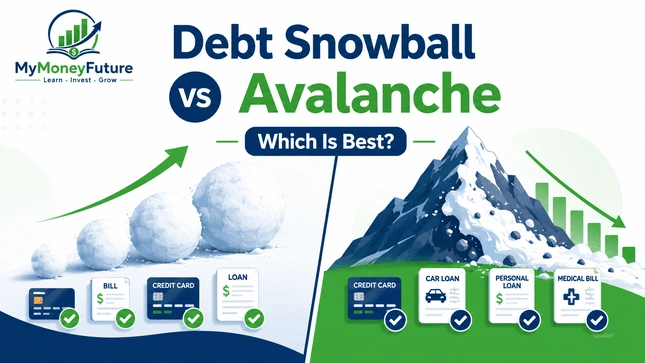
The debt snowball vs debt avalanche choice is a simple question: Do you desire faster emotional wins, or do you want to reduce interest costs?
The two techniques have a common base. You pay the minimum payment on all your debts, decide on one balance to be your objective, and put all of your spare money on that balance. When that debt is paid off, its monthly payment goes to the next goal.
The difference is the order of things.
With the debt snowball strategy you pay off the lowest balance first. The avalanche approach of debt reduction targets your debt at the highest interest rate first.
The avalanche method is usually cheaper on paper. In real life, the ideal debt payback approach is the one you can stick to whether your motivation wanes, a surprise bill comes in, or your progress appears to be slower than you thought.
Best Moments
- The snowball method pays off debts from smallest balance to greatest.
- The avalanche method is about paying off debts starting with the highest interest rate.
- Debt avalanche generally provides more interest savings.
- The debt snowball can provide quicker wins and help you feel progress faster.
- Both methods have minimum payments for every account.
- A small emergency fund can assist you avoid taking on additional debt as you pay off your existing debt.
- If none of the methods suits you perfectly then you can utilize a hybrid approach.
- It’s better to be consistent with a system which is not perfectly mathematical and stick with it than to choose a system that’s mathematically perfect and then ditch it later.
Debt Snowball vs Debt Avalanche: A Quick Comparison
| Feature | Debt avalanche | Debt snowball |
|---|---|---|
| Smallest balance paid off | First loan paid off | Highest interest rate |
| Primary Benefit | Quicker Psychological Wins | Less Total Interest Cost |
| Best for | People who need encouragement | People who are efficiency-minded |
| Information required | Current balances | Balances and interest rates |
| Early victories | More obvious | Slower |
| Mathematical advantage | Generally lower | Generally higher |
| Risk | Paying more interest | Losing motivation |
| Complexity | Very simple | A little more detailed |
Neither approach will make debt disappear on its own. The speed at which the plan works depends on the amount of your monthly payment, interest rates, income, spending habits and your ability to prevent new borrowing.
Snowball Method
The snowball method involves arranging your debts from the smallest current balance to the largest balance.
The sequence is not dictated by interest rates.
Make minimum payments on all accounts and put any additional money toward the smallest obligation. When you pay that account off, you add its former payment to the next smallest balance.
Going down the list your payment gets bigger. Like a snowball rolling downhill.
Debt Snowball Illustration
Say your debts look like this:
| Debt | Balance | Interest Rate | Minimum Payment |
|---|---|---|---|
| Store card | $500 | 18% | $30 |
| Credit Card | $2,500 | 25% | $80 |
| Personal Loan | $6,000 | 11% | $150 |
| Auto loan | $10,000 | 6% | $220 |
The snowball approach would rank the payout as:
- Store card $500.
- Credit Card : $2500
- Personal loan 6000 dollars
- Car loan: $10,000
The $2,500 credit card has a significantly higher interest rate but you would pay the $500 shop card first.
This is not the mathematically cheapest ordering. On the plus side, a $500 amount can go away fast, leaving you with a goal achieved and one less bill to keep track of.
Why Snowballing Might Work
Paying off debt is not just numbers. It’s also a behavioral problem.
People realize they should pay down expensive debt but it is hard to stay focused for months, even years. A zero balance can create a sense of progress that a huge balance that is progressively falling may lack.
The snowball approach is especially helpful when:
- You have a few little debts to pay.
- You have too many accounts.
- You’ve begun debt plans before but quit.
- You like easy rules.
- Make quick progress, stay disciplined.
- Your rates of interest are very similar.
The Consumer Financial Protection Bureau’s guidance on reducing debt outlines the balancing and interest rate approaches and explains that while the snowball method may help you get to see progress sooner, it may end up costing you more in the long run.
What Is the Debt Avalanche Method?
The avalanche method is a way to pay off debts by paying off the debts with the highest annual percentage rate (APR) first.
The APR is the cost of borrowing expressed yearly. It may also contain specific fees and interest on some products.
Pay the minimum on each debt and put all additional money toward the account with the highest rate. Once you have done that, you go onto the next highest rate account.
Example of the Debt Avalanche
Same debts:
| Debt | Amount | Interest rate | Minimum payment |
|---|---|---|---|
| Store card | $500 | 18% | $30 |
| Credit Card | $2,500 | 25% | $80 |
| Personal Loan | $6,000 | 11% | $150 |
| Car loan | $10,000 | 6% | $220 |
Avalanche payment order would be:
- Credit card: 25%
- 18% Store Card
- Personal Loan @11%
- Car loan: 6%
The $ 2,500 credit card would be addressed first because it is the most expensive debt, while the store card has a lesser balance.
Why the Avalanche Method Saves You Money
Interest is the cost of borrowing money.
If you don’t pay off a high-rate amount, a larger share of your future payments could be used to interest rather than the principle.
Principal is the amount you still owe, before accruing interest in the future.
The avalanche method eliminates the highest rate debt first and so eliminates the most expensive balance as soon as possible. If you pay the same amount each month under either plan, this will usually end up with less overall interest.
The avalanche method may be superior if:
- Your interest rates are very different.
- You have a credit card debt with a high interest rate.
- Saving money is a better motivation than closing accounts.
- You’re fine with tracking APRs.
- You have a stable income and can follow a long-term plan.
- Your highest-rate debt isn’t so big that improvement seems out of reach.
Which direction is cheaper?
When most normal payback conditions are considered, the debt avalanche strategy saves more money.
Suppose two people have the same debt and pay the same total amount each month. One is for the lowest balance, the other is for the highest APR.
With avalanche, the person using it usually pays less interest because it pays down the most expensive balance first.
The extent of the discrepancy, however, varies according to:
- The difference in interest rates
- Each size balance
- The monthly amount available
- Debt payoff velocity
- Whether the interest rate is fixed or variable
- Whether or not there is a prepayment penalty on each loan
- New purchases added during payback
If all your debts have a similar interest rate, the difference may be pretty minimal. If one card charges 29% and another loan charges 6%, the savings from avalanche can be more considerable.
Worked Debt Payoff Comparison
Here is a simplified example:
| Debt | Balance | APR | Min Payment |
|---|---|---|---|
| Credit Card A | $1,000 | 18% | $50 |
| Credit Card B | $3,000 | 24% | $90 |
| Personal Loan | $7,000 | 10% | $150 |
| Auto loan | $10,000 | 6% | $200 |
Total debt is $21,000. Includes minimal payments. The borrower can make $800 payments every month.
Simple repayment calculation
| Result | Snowball | Avalanch |
|---|---|---|
| Approximate payoff time | 30 months | 30 months |
| Approximate interest paid | $2,309 | $2,271 |
| Approximate avalanche saving | — | $38 |
Here, the time to pay off for both techniques is pretty similar, as the monthly payment is fairly large and the smaller obligations are paid off relatively quickly.
The difference could be much greater if you have a larger balance, lower monthly payments, or a larger differential between interest rates.
This is why you should conduct your own math and not assume avalanche will always save thousands of dollars. Sometimes the emotional benefit of snow balling may be worth a small increase in interest cost. Sometimes the savings from the avalanche are too good to resist.
Which Method Is Easier to Follow?
The initial result comes sooner, which makes snowball seem easier to many newcomers.
Let’s say your smallest loan is $300, but your highest-interest debt is a $9,000 credit card. It’s real progress when you clear $300 of debt in the first month. The avalanche method can save you more money in interest, but it can seem slower if you spend many months working on that $9,000 amount.
However, not everyone is driven to close out accounts.
Some folks get a lot of satisfaction out of knowing that every payment is knocking down the most expensive debt.
It might be just as motivating to watch the predicted interest savings grow as it is to watch someone else pay off a tiny debt.
Which of these statements feels more like you:
- “If I don’t see the accounts go away I will lose interest.”
- “I will be motivated if I know I am on the cheapest plan”
What a spreadsheet tells you should want is less important than your real answer
Debt Snowball vs. Debt Avalanche – Which One Is Best For You?
Choose Debt Snowball If:
- You want fast wins.
- You are bombarded with lots of balances.
- Your debts have similar interest rates.
- You’ve been trying to keep it together.
- You want the easiest debt strategy for beginners.
- Closing accounts provides you a real sense of satisfaction.
Use Debt Avalanche When:
- You want to make the most interest.
- You have one or more debts with very high APRs.
- You can stay focused without fast account closings.
- You’re fine with comparing rates.
- Your income and budget are steady.
- You’re probably not going to quit if you don’t see results.
When to Consider a Hybrid Approach:
- You can pay off your smallest loan very quickly.
- One debt has an abnormally high rate.
- You want a quick win and long-term interest savings.
- You have a debt that is a particular source of worry.
- First, you need to cut back on the quantity of bills you pay each month.
One hybrid technique would be to pay off one relatively modest balance, then switch to avalanche for the rest of the bills.
Or you may target a high interest account first, then snowball once you contain the biggest interest risk.
Mathematically, a hybrid technique is not necessarily flawless. But if it keeps you interested, it can still be a smart approach.
Step by Step Debt Payoff Plan
Step 1. List All Your Debts
Create a table with:
- Name of creditor
- Balance now
- Rate of interest
- Minimum payment
- Deadline
- If the rate is fixed or variable
- All prepayment penalties
- Whether the debt is secured by assets
This includes credit cards, personal loans, medical bills, store financing, vehicle loans, payday loans and any other sums you intend to pay off through the plan.
Step 2: Get Accounts Current
Just be sure you’re also making minimum payments on your other debts before you start sending substantial extra payments to one account.
Late fees, additional interest, collection activity, loss of promotional rates and damage to your credit history may result from missed payments.
Step 3: Create a Small Emergency Fund
It might seem efficient to throw every dollar you can at paying off debt, but it can leave you exposed.
Without cash savings, a car repair, medical bill or urgent house need may go straight back onto a credit card.
The appropriate emergency fund will depend on your scenario. A tiny starting cushion can allow a rookie planner to avoid small surprises that break the cycle of repayment.
Step 4. Select Your Ordering Rule
For snowball, sort debts by smallest balance to largest.
Rank them from highest interest rate to lowest interest rate for the avalanche.
Don’t move the order around every week unless your financial condition really changes.
Step 5: Choose a Fixed Monthly Number
Figure out how much you can afford to pay consistently after the fundamental costs of life.
It’s better to realistically say $600 a month than to promise $900 a month and fall short over and over again.
Step 6: Create Automatic Minimum Payments
Automatic payments may help lessen the likelihood of missed due dates. However, you should keep an eye on your statements as payment amounts, interest rates and account details can vary.
Step 7: Wire Extra Money to One Target
Instead of dispersing small little sums over all the debts, focus your extra payment.
Targeted payments boost the performance of the chosen strategy.
Step 8: Roll Forward Payments
When the target debt is satisfied, add the whole old payment to the following debt.
If you’ve freed up some money, then don’t spend it on the ordinary expenses unless you really need to.
Step 9: Monthly Check-In
Track:
- Total debt outstanding
- Number of accounts closed
- interest charged
- Foregone interest
- Expected date to be debt free
- Any new debt incurred
A monthly review is generally sufficient.
It can be frustratingly slow to see normal development when you’re checking every day.
First Save or Pay Off Debt?
Sometimes you can have your cake and eat it too.
Possible even starting order:
- Pay for basic living expenses.
- Make all minimum debt payments required.
- Build an emergency reserve to start out.
- If offered, be sure to take advantage of an employer retirement match.
- Pay off high interest debt aggressively.
- If you can handle expensive debt, increase long-term savings.
The order relies on employment security, savings, interest rates, family responsibilities and access to cheap financing.
A low-rate loan is not typically as pressing as a credit card that charges 28%. But at the same time, if you put every dollar toward debt reduction and have no emergency savings, you could end up borrowing more.
Which debts should be included?
Best for Debts with clear balances, required payments, and interest rates Snowball and avalanche are best for
These can include:
- Credit card debts
- Consumer loans
- Credit cards (store cards)
- Medical installment plans
- Car loans
- Private student loans
- Balances on buy now, pay later
- Expensive short-term credit or payday
But there are some tasks that deserve special consideration.
Mortgage debt is generally addressed individually because it tends to be large, has a lower rate, is treated specially for tax purposes in some countries and house stability is often a concern.
Federal student loans may have income-based repayment, forbearance, deferment or other safeguards that could be lost by refinancing or aggressive repayment.
If you’ve fallen behind on debts secured by your car or home, those can also deserve precedence, to avoid repossession or foreclosure.
Don’t Make These Mistakes When Paying Off Debt
Paying extra on every debt
You may feel like you’re doing something by spreading an extra $100 among five accounts, but it dilutes the focus of both techniques.
Pay the minimums on all of them and then go after one.
Still Adding More Charges
A repayment plan won’t work when fresh purchases continually coming in to replace the balance you just paid off.
Remove saved cards from shopping applications, cancel subscriptions you don’t need and consider locking cards that trigger you to spend too much.
Without regard to changes in interest rates
Credit card APRs are variable. The balance that was third on your avalanche list can prove to be your most expensive debt down the road.
Periodically review rates.
Spending Retirement Funds Without Knowing the Price
Early withdrawals from retirement accounts mean taxes, penalties, lost investment growth and less security in the future.
Don’t use your retirement funds as a quick way to solve your debt problems without considering the long term.
Pay Off Each Credit Card And Immediately Close It Out
Closing an account can effect the amount of credit you have available, the age of the account and the amount of accessible credit you are using
Sometimes it’s a good idea to keep a no-fee account open, but only if you can resist racking up the balance again. That could be different with a card with a hefty annual fee or significant spending temptations.
Debt relief promises fall for
Beware of companies who say they can wipe off your debt, guarantee a settlement, or cease all collection efforts.
The Federal Trade Commission has guidance on getting out of debt with valid solutions and warning signals to watch for. Watch out especially for companies that require you to pay up ahead, or promise results before they’ve ever seen your finances.
Advantages and Disadvantages of the Debt Snowball Method
Advantages
- Quicker early wins
- simple to grasp
- Decreases the amount of open balances
- May boost motivation
- Good for those who feel overwhelmed
- No need for extensive interest calculations
Against
- Often leads to more curiosity than avalanche.
- May pay down pricey credit card debt more slowly
- Ignores the cost of each loan.
- May be less efficient if rates vary dramatically
Benefits and Drawbacks of the Debt Avalanche Approach
Benefits
- Usually reduces interest costs
- Targets the highest-interest debt first
- Is mathematically sound
- Lowers the financial risk of high-rate balances
- Can shorten the repayment time period if large interest savings are realized
Drawbacks:
- Initial payoff might take longer
- Progression may seem less obvious
- Requires precise interest-rate data
- Might be harder to stay motivated using this method if you are motivated by quick wins
- Changing rates may change the order
Strategies to Accelerate Debt Repayment
Increase Payments With Each Pay Raise
Apply some or all of salary increases to paying off debt before increasing your spending.
Take Advantage of Windfalls
Bonuses, gifts, tax refunds, or freelance income can be useful when applied to the target amount.
Don’t lock away money you may need for taxes or other critical needs in the road.
Contact Your Creditors Before You Miss Payments
A creditor may provide a hardship plan, which is a temporarily reduced rate or modified payment schedule.
You often have fewer options once you’ve missed multiple payments.
Reconsider the Balance Transfer
A promotional balance-transfer offer might cut interest, but take a close look:
- Transfer charges
- Validity period
- Rate with the promotion
- Eligibility criteria
- If the same rate will be extended to new buyers
- Whether you’re able to pay off the debt before the deal ends
Moving debt is not the same as paying down debt.
Don’t Experience Lifestyle Whiplash
A budget to pay that back that denies every little pleasure may be hard to stick with for years.
Keep some aside for flexible spending, but yet go forward in a meaningful way.
Follow the Outcome That Moves You
Snowball users can keep track of accounts removed.
Avalanche users can track avoided interest.
Some people are motivated by the fact that they see their overall net worth increase, even if they haven’t paid off specific obligations to zero yet.
FAQ’s
1. Debt avalanche vs debt snowball: which is best?
The debt avalanche often does a better job of minimizing interest. Debt snowball may be preferable for someone that needs faster wins to keep motivated. The greatest way is the way you can keep on going without incurring more debt.
2. Does the Snowball Debt Payoff Method Work?
Yes. It works well when swift account closures help you stay consistent. You might pay more interest than on avalanche but better to successfully pay back than drop a cheaper plan.
3. How does the debt avalanche save money?
It pays the highest interest balance first. That decreases the amount of pricey debt that is continuously accruing interest.
4. How to pay down debt faster?
Avalanche is faster when interest savings are large and monthly payments are equal. In certain circumstances both approaches end at quite similar times. Sometimes it’s not how you ordered a payment, it’s how big.
5. What is the greatest way to pay off credit card debt?
Credit cards can have hefty APRs therefore Avalanche is usually good for credit card debt. Snowball can still be useful if you have to clear one minor card to get some momentum going.
6. Can I mix debt snowball and debt avalanche?
Yeah. Or you might pay off one minor balance first and then work on the loan with the highest interest rate. Alternatively you might target a very expensive payday loan first then use snowball for the rest of the accounts.
7. What if two debts have the same interest rate?
You can hit the smaller balance first under avalanche and obtain a quicker win. Or you can select the account with the greater minimum payment to free up more cash flow each month.
8. What if the two debts have the same balance?
With snowball, attack your highest interest rate debt first. It keeps the quick-win framework, but it decreases the interest.
9. Should I put my mortgage on the snowball or avalanche?
Many keep a mortgage separate since it is big, backed by a house, and may have a cheaper rate. Prioritize paying off high-interest, unsecured debt first unless you’re behind on your mortgage or have other extenuating circumstances.
10. Should I pay off my credit card or student loan debt first?
Credit cards tend to have higher rates and are therefore avalanche priority. But before modifying your student loan plan, check out loan safeguards, tax treatment, employment advantages and forgiveness eligibility.
11. Emergency Fund or Pay Off Debt?
It’s a good thing to have a small emergency fund because it reduces the likelihood of an unexpected expense leading to more debt. Once you have high interest balances under control, you can grow a larger reserve.
12. Does paying off debt increase your credit score?
Paying down revolving credit card debt will help lessen your credit usage. Making payments on time adds to a good payment history.
The specific effect will rely on your entire credit profile and scoring methodology.
13. Should I cancel my credit card when I pay it off?
Not always. Cutting a card can cut your available credit and impact your utilization rate. Consider the annual fee, how old the account is, the temptation to spend, and whether you can keep the account in good standing.
14. Can I use the snowball method if my income is irregular?
Yes, but use cautious incomes for minimum payments. Make extra goal payments in months when you have more income but be sure to have enough cash on hand to cover taxes, basic needs and months of reduced income.
15. What if I can’t pay my minimum payments in full?
Contact your creditors right away and ask them about hardship options. You may also want to speak with a reputable nonprofit credit counselor about your budget and repayment plan. Don’t ignore bills or pledge to pay money you can’t afford.
16. Snowball or Avalanche, Which is the Best Debt Consolidation?
Debt consolidation is a product, snowball and avalanche are repayment strategies. Consolidation can be a good thing if it lowers your rate and fees but it can be a bad thing if you extend the repayment period or start using your old cards again.
17. Are these strategies applicable to medical debt?
Yes, but read over the bill first for errors, insurance modifications, financial aid and no-interest payment plans. It may not be the cheapest sequence to pay for a no-interest medical plan before a high-interest card.
18. How much more do I need to add to my target debt?
Pay an amount you can afford to pay every month without having to skip essentials or adding new balances. Even another $25 or $50 helps but a bigger payment will cut the payoff term substantially.
19. How often should I review my debt payback plan?
Review it monthly and any time an interest rate, revenue stream, minimum payment or big expense changes.
20. How can I determine which strategy suits my personality?
Look at what you’ve done before. If finishing tiny goals keeps you engaged, pick snowball. If knowing that you’re minimizing interest will be enough to keep you consistent, pick avalanche.
Conclusion
In the end, the debt snowball vs debt avalanche debate is about choosing between momentum and math.
The avalanche strategy tends to save you more money because it prioritizes high-interest debt. The snowball method might be simpler to stick to because it eliminates tiny balances faster and makes progress more obvious.
There is not one-size-fits-all method that is automatically right for all.
Pick a clear order. Protect your minimum payments. Maintain a small emergency cushion.
Don’t accrue more debt. Agree on a monthly amount you can actually afford.
One big payment generally does not lead to becoming debt free. It comes from making the same good decision month after month until the balances are finally gone.
Educational Purpose
This post is for educational and informational purposes only and is not financial, credit, legal or tax advice.
How to pay down debt is a decision based on your balance, interest rate, length of the loan, stability of income, necessary spending and personal situation. Review your agreements and consider talking to a knowledgeable financial professional or respected credit counselor before making major adjustments.
