
Introduction
What is personal finance? Personal finance is how you manage your money every day and over the long term. It includes earning, spending, saving, borrowing, investing, and protecting yourself from financial risk.
For most people, personal finance isn’t about complicated charts or being naturally “good with money.” It’s about building a money system that fits your life and helps you make better decisions.
A strong personal finance plan starts with knowing where your money goes. From there, you can build savings, reduce debt, protect your income, and invest for future goals.
Beginners often feel overwhelmed because money affects almost everything: rent, food, transportation, health care, debt, family plans, and retirement. But the basics are easier than they look.
Spend less than you earn. Avoid expensive debt. Save for emergencies. Protect yourself from major losses. Invest once your foundation is stable.
That’s the heart of personal finance.
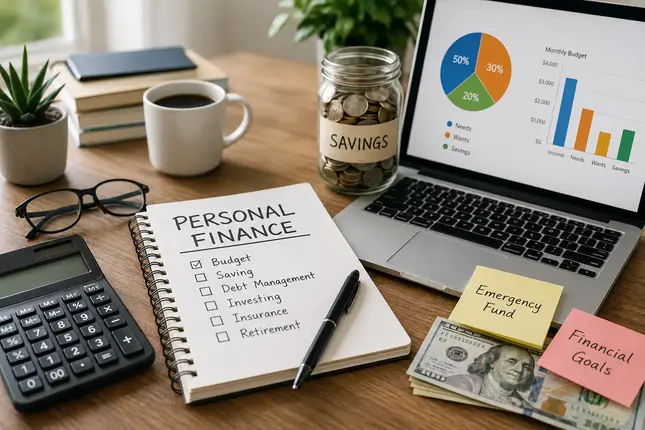
What Is Personal Finance?
Personal finance is the way you manage your money through budgeting, saving, debt repayment, insurance, and investing. It helps you cover daily expenses, prepare for emergencies, reduce financial stress, and work toward long-term goals such as buying a home, retiring, or building wealth.
Key Takeaways
Personal finance is the system you use to manage money day to day and over time.
The main areas of personal finance are budgeting, saving, debt management, insurance, and investing.
A good financial plan starts with understanding your income, expenses, assets, and debts.
Emergency savings usually come before aggressive investing for beginners.
Good money habits matter more than perfect spreadsheets.
Personal Finance Explained
Personal finance is the set of habits, choices, and tools you use to manage your money. It covers how you earn income, plan spending, save for the future, handle debt, buy insurance, and invest.
Think of it as your personal money operating system.
When the system is weak, even a good income can disappear quickly. Bills pile up. Credit cards fill the gap. Savings stay low. Long-term goals keep getting delayed.
When the system is strong, your money has a job. You know what must be paid, what can be saved, and what needs to change.
Personal finance matters because money decisions compound. A small habit repeated for years can either help you build stability or keep you stuck.
For example, saving $50 a month may not feel powerful at first. But it creates the habit of paying yourself first. Later, that same habit can support emergency savings, retirement contributions, or a down payment.
Personal finance is not about perfection. It’s about direction.
The Main Areas of Personal Finance
1. Budgeting
Budgeting is the foundation of personal finance. It shows you where your money goes before it disappears.
A budget helps you separate fixed costs, flexible costs, and optional spending. Fixed costs may include rent, loan payments, insurance, or subscriptions. Flexible costs include groceries, fuel, utilities, and personal care. Optional spending includes dining out, entertainment, shopping, and travel.
For readers who want a practical budgeting worksheet, the Consumer Financial Protection Bureau offers free money-management tools and worksheets.
A beginner-friendly method is the 50/30/20 budget:
| Category | Suggested Share | Examples |
|---|---|---|
| Needs | 50% | Rent, groceries, utilities, transport, insurance |
| Wants | 30% | Dining out, streaming, shopping, and entertainment |
| Savings and debt repayment | 20% | Emergency fund, extra debt payments, investing |
This rule is not perfect for every household. Someone living in a high-cost city may spend more than 50% on needs. Someone with debt may need to put more than 20% toward repayment.
Use it as a starting point, not a rule you must follow forever.
Beginner advice: Start by tracking your spending for 30 days. Don’t judge the numbers. Just write them down. Clarity comes before improvement.
Common mistake: Many beginners build a budget based on what they wish they spent. A useful budget starts with what’s actually happening.
2. Saving
Saving gives you breathing room. It protects you from small emergencies and gives you more choices when life changes.
A savings habit can help you handle car repairs, medical bills, job loss, family needs, or a sudden move without relying on a credit card.
Most beginners should start with an emergency fund. A full emergency fund often covers several months of essential expenses, but you don’t need to reach that number immediately.
Start small if needed.
Your first goal might be $500 or $1,000. That may not cover every emergency, but it can stop a minor problem from becoming expensive debt.
After that, work toward one month of expenses. Then three months. Then more if your income is irregular or your household depends on one earner.
Pro tip: Keep emergency savings in a separate account from your daily spending account. If the money is too easy to access, it often gets used for non-emergencies.
Best for: Anyone who wants less stress, fewer credit card surprises, and more control over short-term problems.
3. Debt Management
Debt is not always bad. A mortgage, student loan, or business loan may help someone build assets or increase future income.
But high-interest consumer debt can make personal finance much harder.
Credit card debt is especially risky because interest can grow quickly. If you only make minimum payments, the balance may take years to clear.
Good debt management starts with a clear list of what you owe.
Write down:
| Debt Type | Balance | Interest Rate | Minimum Payment | Priority |
| Credit card | $2,400 | High | $75 | High |
| Car loan | $9,500 | Medium | $310 | Medium |
| Student loan | $18,000 | Lower | $180 | Lower |
Once you know the numbers, choose a payoff method.
The debt avalanche method focuses on the highest interest rate first. This usually saves the most money.
The debt snowball method focuses on the smallest balance first. This can build motivation because you see faster wins.
Neither method works unless you stop adding new debt while paying off old balances.
Expert tip: If your debt payments are eating most of your income, focus on cash flow first. A perfect payoff plan won’t work if you can’t cover groceries, rent, and utilities.
4. Investing
Investing is how many people build wealth over time. Savings protect you in the short term. Investing helps your money grow for long-term goals.
Common investing goals include retirement, education, home buying, or long-term wealth building.
For beginners, the key idea is time. The earlier you start, the longer your money has to grow through compounding.
Compounding means your returns can start earning returns of their own. Over many years, that can become powerful.
You don’t need to invest a large amount right away. Many people start with small, regular contributions.
The bigger issue is consistency.
Investing before you have basic savings can backfire. If an emergency happens, you may be forced to sell investments at the wrong time or use credit cards.
Beginner advice: Build a starter emergency fund first. Then begin investing with an amount you can keep contributing even during normal busy months.
Best for: Long-term goals, especially goals that are five or more years away.
5. Insurance and Protection
Insurance is part of personal finance because it protects your plan from major losses.
Without insurance, one accident, illness, lawsuit, disability, or death in the family can undo years of progress.
Common types of protection include:
| Type of Insurance | What It Helps Protect |
| Health insurance | Medical costs |
| Auto insurance | Vehicle accidents and liability |
| Renters insurance | Personal belongings and liability |
| Homeowners insurance | Home structure, belongings, and liability |
| Disability insurance | Income if you cannot work |
| Life insurance | Family income needs after death |
Not everyone needs every type of insurance. Your needs depend on your age, family, job, assets, debts, and risk level.
For example, a single renter with no dependents may not need life insurance. A parent with young children and a mortgage may need it badly.
Common mistake: People skip insurance because it feels boring. But protection is what keeps one bad event from wrecking the rest of your financial plan.
How to Build a Beginner Money System
Step 1: Know Your Numbers
Start with four numbers:
- Monthly take-home income
- Monthly expenses
- Total savings
- Total debt
These numbers give you your baseline.
You don’t need fancy software. A notebook, spreadsheet, or budgeting app can all work.
The goal is simple: know what comes in, what goes out, what you own, and what you owe.
Practical example: If you earn $3,500 a month and spend $3,450, your problem is not just budgeting. Your margin is too thin. You either need to cut costs, increase income, or both.
Step 2: Set One Clear Goal
Beginners often try to fix everything at once. That usually leads to frustration.
Pick one goal for the next 30 to 90 days.
Good starter goals include:
- Save your first $500
- Pay off one credit card
- Cancel unused subscriptions
- Build one month of rent in savings
- Track spending for 30 days
- Set up automatic savings
One clear goal gives your money a direction.
Pro tip: Make the goal specific. “Save more money” is too vague. “Save $500 by September 30” is easier to act on.
Step 3: Make a Simple Budget
A beginner budget should be simple enough to use every week.
Start with essentials:
- Housing
- Food
- Utilities
- Transportation
- Insurance
- Minimum debt payments
Then add savings.
Then add wants.
That order matters. If you budget wants first, savings usually gets whatever is left. In many months, that means nothing.
If your income changes from month to month, build your budget around your lowest predictable income. Treat extra income as a bonus for savings, debt payoff, or planned expenses.
Common mistake: Forgetting irregular costs. Car repairs, annual subscriptions, school fees, gifts, and holidays can break a budget if you don’t plan for them.
Step 4: Build an Emergency Fund
An emergency fund is cash set aside for real surprises.
It is not for vacations, shopping, or upgrades. It is for things like urgent repairs, medical costs, temporary income loss, or family emergencies.
A starter emergency fund gives you a cushion. A full emergency fund gives you resilience.
Try this simple path:
| Emergency Fund Stage | Target |
| Starter fund | $500–$1,000 |
| Basic cushion | 1 month of essential expenses |
| Strong cushion | 3–6 months of essential expenses |
| Extra cushion | 6+ months for unstable income or single-income households |
The right amount depends on your situation. A freelancer may need more cash than someone with a stable salary and strong benefits.
Expert tip: Don’t wait for the perfect month to start. Save a small amount automatically each payday.
Step 5: Attack Expensive Debt
Once you have a small emergency fund, focus on expensive debt.
High-interest debt drains money that could be used for savings, investing, or better quality of life.
Start by paying minimums on all debts. Then send extra money to the debt you choose as your top priority.
Use the avalanche method if you want to save the most interest.
Use the snowball method if you need motivation from quick wins.
Both can work. The best method is the one you’ll actually follow.
Practical example: If one card charges 24% interest and another charges 17%, the avalanche method attacks the 24% card first. That reduces the most expensive balance faster.
Step 6: Start Investing Slowly
After your budget is stable, your starter emergency fund is in place, and high-interest debt is under control, you can begin investing.
Start with long-term accounts if available, such as a retirement account through work or an individual retirement account.
Keep the amount realistic. A $50 monthly contribution you can maintain is better than a $500 contribution you stop after one month.
Investing is not a race. It is a habit.
Beginner advice: Avoid investing money you may need soon. Short-term money belongs in safer, more accessible places.
A Simple 2026 Starter Plan
A beginner personal finance plan should focus on control first and growth second.
That order matters.
If you start investing before you can handle a basic emergency, one surprise bill can push you back into debt.
Here’s a simple staged plan for 2026:
| Stage | Goal | What to Do First | Why It Matters |
| Stage 1 | Stabilize cash flow | Track income and expenses | You need a clear picture before making changes |
| Stage 2 | Build safety | Save a starter emergency fund | Prevents small shocks from becoming debt |
| Stage 3 | Reduce pressure | Pay down high-interest debt | Frees up future income |
| Stage 4 | Grow wealth | Begin regular investing | Helps money compound over time |
| Stage 5 | Protect progress | Review insurance and goals | Keeps one event from undoing your plan |
This staged approach works because it matches real life.
Most beginners cannot save, invest, repay debt, upgrade insurance, and plan retirement all at once. Trying to do everything often leads to doing nothing well.
Start with the step that gives you the most stability.
Example: A New Earner
Suppose you bring home $3,500 a month.
Using a rough 50/30/20 structure, your money might look like this:
| Category | Amount | Examples |
| Needs | $1,750 | Rent, groceries, utilities, transportation |
| Wants | $1,050 | Dining out, hobbies, shopping, entertainment |
| Savings and debt repayment | $700 | Emergency fund, debt payoff, investing |
This is only a starting point.
If rent takes up more of your income, you may need to lower wants. If you have credit card debt, you may send more toward debt repayment for a while.
If you have no emergency fund, some or all of the savings category should go into cash first instead of investing right away.
That may not feel exciting. But financial stability is built before financial growth.
A strong base gives you more freedom later.
Common Mistakes
1. Not Tracking Spending
Many people think they know where their money goes. Then they check the numbers and get surprised.
Small purchases can add up fast.
Coffee, delivery fees, subscriptions, rideshares, and impulse buys may not seem serious alone. Together, they can block your goals.
Fix: Track spending for one month before making major changes.
2. Saving Only What Is Left
If you wait until the end of the month to save, there may be nothing left.
This is one of the most common beginner mistakes.
Fix: Treat savings like a bill. Move money into savings right after you get paid.
3. Using Credit Cards for Routine Shortfalls
Credit cards can be useful tools when paid in full. They become dangerous when used to cover regular income gaps.
If groceries, rent, or utilities are going on a card because cash is short, the budget needs attention.
Fix: Reduce spending, increase income, or adjust fixed costs before debt becomes normal.
4. Investing Before Building a Safety Cushion
Investing is important, but it should not replace emergency savings.
If you invest all extra cash and then need money suddenly, you may have to sell investments or borrow.
Fix: Build at least a starter emergency fund before investing aggressively.
5. Ignoring Insurance
Insurance is easy to ignore because you may not use it often.
But when you need it, it can protect your savings, income, and family.
Fix: Review your basic coverage once a year or after major life changes.
6. Setting Too Many Goals at Once
Trying to save for a house, pay off debt, invest, travel, upgrade your car, and build an emergency fund at the same time can split your focus.
Fix: Choose one main priority for the next 90 days.
Pros and Cons of Self-Managing Money
Many people can manage the basics of personal finance on their own. Others may benefit from professional guidance, especially when taxes, retirement, business income, or estate planning become more complex.
Managing Your Own Personal Finance Plan
| Pros | Cons |
| You stay in control of your money | It takes time and discipline |
| You can start without paying advisor fees | Mistakes can be costly |
| Small improvements can create big long-term results | Too many choices can feel confusing |
| You can adjust quickly when life changes | Emotional decisions can hurt progress |
Self-managing works best when your situation is simple and you’re willing to learn.
Professional help may be useful if you have complex investments, high income, major tax questions, business ownership, inheritance issues, or retirement decisions.
Expert Tips
Automate Savings
Automation removes the need to make the same decision every payday.
Set up an automatic transfer to savings after income arrives. Even a small amount builds the habit.
Review Your Budget Monthly
A budget is not something you create once and forget.
Review it monthly. Look for bills that changed, subscriptions you no longer use, and spending categories that keep going over budget.
Separate Bills, Spending, and Savings
Many beginners struggle because all money sits in one account.
Using separate accounts can make your system easier:
| Account | Purpose |
| Bills account | Rent, utilities, loan payments, insurance |
| Spending account | Groceries, fuel, personal spending |
| Savings account | Emergency fund and short-term goals |
This gives each dollar a clearer job.
Match the Tool to the Stage
Debt payoff and investing are both useful, but not always at the same time.
If high-interest debt is hurting your cash flow, debt payoff may give you a stronger return than investing small amounts.
If your debt is manageable and your emergency fund is stable, investing becomes more important.
Focus on Repeatable Habits
A good personal finance system is not flashy.
It is simple, predictable, and hard to break.
The best plan is one you can follow when work gets busy, life gets stressful, and motivation drops.
FAQ Section
Q: What is personal finance in simple words?
A: Personal finance is how you manage your money. It includes budgeting, saving, borrowing, investing, and protecting yourself from financial risks.
Q: Why is personal finance important?
A: Personal finance helps you make better money decisions. It can reduce stress, prepare you for emergencies, help you avoid expensive debt, and support goals such as buying a home, paying for education, or retiring.
Q: What are the basics of personal finance?
A: The basics of personal finance are budgeting, saving, debt management, insurance, and investing. These five areas help you control daily money, prepare for surprises, and build long-term stability.
Q: How do I start personal finance as a beginner?
A: Start by tracking your income and expenses. Then create a simple budget, build a starter emergency fund, and pay attention to high-interest debt. Once your foundation is stable, you can begin investing for long-term goals.
Q: Should I save or invest first?
A: Most beginners should save a starter emergency fund first. After that, they can begin investing while continuing to build savings and manage debt. Investing too early can be risky if you have no cash for emergencies.
Q: How much should I save each month?
A: There is no perfect number for everyone. A common starting point is to save a fixed percentage of income, even if it is small. If money is tight, start with an amount you can repeat every payday.
Q: Is debt always bad in personal finance?
A: No. Some debt can help you buy a home, get education, or build a business. But high-interest consumer debt, especially credit card debt, can be damaging and should usually be paid down quickly.
Q: What budget method is easiest for beginners?
A: The 50/30/20 budget is one of the easiest methods for beginners. It divides income into needs, wants, and savings or debt repayment. You can adjust the percentages based on your income, location, and goals.
Q: Do I need a financial advisor to manage personal finance?
A: Not always. Many people can manage basic budgeting, saving, debt payoff, and beginner investing on their own. A financial advisor may help if your situation involves complex taxes, retirement planning, business income, inheritance, or large investments.
Q: What is the biggest mistake beginners make?
A: One of the biggest mistakes is skipping emergency savings. Without a cash cushion, one unexpected bill can lead to credit card debt or missed payments.
Disclaimer
This article is for general educational purposes only. It is not financial, tax, legal, or investment advice. Personal finance decisions depend on your income, expenses, debts, goals, location, and risk tolerance. Consider speaking with a qualified financial professional before making major financial decisions.
