
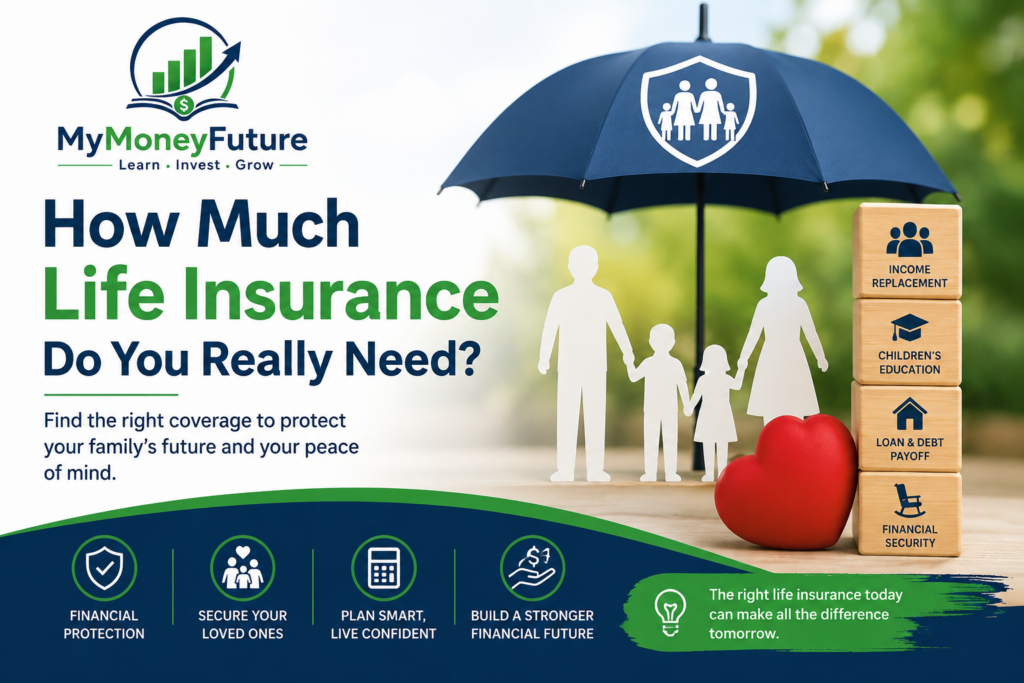
Life insurance is meant to protect those that depend on you for their livelihood.
If you lost your income, unpaid care or financial support, a life insurance payment can help your family continue to pay the mortgage or rent, cover the cost of day-to-day living, raise children, pay off debts and prepare for future needs.
The hard thing is figuring out how much coverage you really need.
Buy too little and you could still see your family suffer financially when you get the payout. If you get more than you need, you could be paying higher rates for years for coverage that doesn’t match what you actually need.
How much life insurance you need relies on factors including your income, bills, savings, family makeup, future aspirations and the number of years your loved ones might need support.
This guide helps you find your own life insurance needs with easy calculations, real-world examples, and practical planning tools.
Short answer
Calculating the amount of life insurance you need can be as simple as adding up your bills, mortgage, income replacement needs, future family expenses, education costs, and funeral expenses. Then deduct any cash, investments and existing life insurance that your family may realistically tap into.
A good starting point for many people is 10 times their annual salary. However, a specific needs calculation is often more accurate because it includes your family size, debt, savings, housing prices and long-term ambitions.
The aim here is not to buy the largest policy possible. It’s about finding enough money to safeguard your dependents without making the premiums prohibitive.
Key Highlights
| Key Point | Summary |
|---|---|
| Life insurance protects dependents | Your coverage should safeguard those who depend on your income or unpaid care. |
| Your coverage need is personal. | The right amount depends on your family, income, debt, savings, and goals. |
| Ten times income is just a shortcut | It gives a starting point, but it could be too high or too low. |
| Term life is typically suitable for transitory purposes. | It can help protect your family while raising children or paying off a mortgage. |
| Stay-at-home parents may need coverage | Replacing childcare and household responsibilities can be costly. |
| Your employer might not cover you | Your employment may determine your coverage. |
| Review periodically | Your needs can alter due to marriage, children, property purchases, debt, and income. |
What Is Covered by Life Insurance?
Life insurance is not just for the funeral.
For many families, the greatest financial danger is the loss of years of income or unpaid family assistance.
If a parent or spouse dies, the surviving family may still have to cover:
- Rent or mortgage
- Food
- Utilities –
- Transportation
- Child care
- School costs
- Health care
- Insurance *
- Debt repayment
- Repairing your house
- The Education of the Future
- The pension fund
A life insurance payout might offer surviving family members time to adjust without selling a property, borrowing money or making huge financial decisions when they are going through a tough time.
Universal Life Insurance Needs
| Coverage Need | Examples |
|---|---|
| Income replacement | Money your family needs if your pay check disappears |
| Housing expenses | Mortgage, rent, property taxes and basic home costs |
| Debts | Credit cards, personal loans, auto loans and medical debt |
| Childcare | Daycare, babysitting, after-school care and summer programs |
| Education | School fees, college costs, training, tutoring |
| Final Expenses | Funeral, burial, medical bills and estate expenditures |
| Family assistance | Financial support to spouse, children, parents or relatives |
| Household services | Cooking, cleaning, transportation and home management |
| Business needs | Business financing, buy-sell agreement, key-person needs |
It is not to make the beneficiaries wealthy. The aim is to have financial security, flexibility and time.
Who Needs Life Insurance
You probably need life insurance if you died and somebody would have financial trouble.
This individual could be:
- A partner
- A young one
- An elderly parent.
- A handicapped relative
- A business associate
- A co-lender
- Anyone you help financially on a regular basis
Life insurance becomes especially crucial in the following conditions.
| Situation | Why Coverage May Be Required |
|---|---|
| You have children | Helps with the expense of living, daycare and schooling |
| Spouse dependent on your salary | Replaces lost income and maintains home stability |
| You have a house loan | Helps the family stay in the home or lower the loan amount |
| You have a lot of debt | Provides funds to pay off debts and safeguard shared assets |
| You’re a stay-at-home parent | Helps cover child care and home services |
| You are trained to help parents or relatives | Safeguards of those who depend on your help |
| You own a business | Helps with business debt, ownership changes or key-person risk |
| You co-signed a loan | May insulate the other borrower from pressure to repay |
| You want to cover final expenditures | Eases the immediate financial burden on your family |
One of the biggest mistakes is to assume that only the highest earner in the family needs life insurance.
A stay-at-home mom might not bring home a typical wage, but they’re costly to replace. The surviving parent might need to pay for childcare, transportation help, meal prep, tutoring, cleaning services or a restricted work schedule.
Both adults may need coverage even if just one adult in a home makes most of the income.
Who May Not Need Much or Any Life Insurance?
Not everyone needs a big life insurance coverage.
If you have no dependents and your current assets will meet your ultimate expenses and financial commitments, you may require limited coverage – or no coverage at all.
| Situation | Potential Need for Coverage |
|---|---|
| Single without dependants | May just require sufficient funds for final expenditures or shared obligations |
| No major debt | May require less coverage |
| Children are financially independent | Income replacement needs may be smaller |
| High savings and investments | Existing assets can narrow the insurance gap |
| Retired with no dependents | Coverage might be optional depending on estate goals |
| If your spouse is financially independent | You may not need a big income-replacement policy |
| Fully paid mortgage | May have less housing related coverage needs |
Your relationship status alone doesn’t decide if you need insurance.
One individual may still seek coverage when they:
- Help elderly parents
- Help out siblings or relatives
- Co-signed on a private loan
- Have a business
- Mortgage jointly
- Desire to leave money to a beneficiary or charity
- No money for final expenses
Financial responsibility must be the basis of the decision, not whether you are married.
Simple formula to find out how much life insurance you need
Usually, a needs-based computation is more helpful than choosing a random policy amount.
First, make a list of everything your family might need money for after you are gone.
Step 1: Enter your financial obligations
Include:
- Debts you need to settle
- Income your family might require
- Mortgage assistance / housing
- Cost of childcare
- Cost of Education
- Burial expenses
- Special family needs
- Business responsibilities
Step 2. Deducting Available Financial Resources
Get rid of any assets your family might realistically use.
| Resources | Examples |
|---|---|
| Cash savings | Emergency fund and savings accounts |
| Investments | Taxable brokerage accounts, liquid investments |
| Existing life insurance | Individual and employment-based policies |
| Other assets | Assets of property or company that may fairly support |
| Survivor income | Expected income of a surviving spouse to remain |
Be careful counting retirement accounts or property.
Your family may need retirement assets for their future. Selling property in an emergency may not be practical. Subtract resources appropriately available to recipients without causing another significant financial concern.
Basic Life Insurance Calculation
Life insurance needed = Total future financial demands – Existing financial resources
Sample Calculation
| Item | Amount |
|---|---|
| Mortgage balance. | $250,000 |
| Other debts | $30,000 |
| Income replacement | $500,000 |
| Children’s schooling | $100,000 |
| Final expenses | $20,000 |
| Financial need (Total) | $900,000 |
| Current savings and insurance | -$150,000 |
| Additional coverage needed (est.) | $750,000 |
In this situation, an additional coverage of about $750,000 could be an acceptable start.
Depending upon the family’s lifestyle, cost of living in the area, future income, inflation, existing assets and the earning capacity of the surviving spouse, the final figure may be higher or lower.
10x Income Rule
A typical shortcut is to take your annual income and multiply it by 10.
| Annual Income | Estimated Coverage using 10x Rule |
|---|---|
| $40,000 | $400,000 |
| $60,000 | $600,000 |
| $80,000 | $800,000 |
| $100,000 | $1,000,000 |
| $150,000 | $1,500,000 |
The method is simple but has major limitations.
It does not take into account:
- Mortgage debt
- Other loans
- Age / Number of Children
- Child care needs
- Aims of education
- Savings on hand
- Employer-provided insurance
- Income of spouse
- Local Cost of Living
- Years of help needed
Two people with the same pay can need very different amounts of coverage.
If you are married , have three small children and a huge mortgage , you may need a lot more protection than a single individual with no debt or dependents , even if you both make $ 80,000 a year .
The 10 times income rule should be used as a rough estimate and not as the final choice.
The DIME approach
One popular option is the DIME method.
DIME is an acronym for:
| Letter | Significance |
|---|---|
| D | Debt |
| I | Revenue |
| M | Mortgage |
| E | Education |
Credit
Include debts you would want paid after you die.
These could include:
- Credit card balances 1
- Individual loans
- Car loans
- Medical care bills
- Student debts (private)
- Business commitments
When you die, not all debts go to family members. Responsibility varies on ownership, co-signers, marital-property laws, estate assets and the nature of debt.
But the weight of joint debts can still be a heavy burden for the family members left behind.
Earnings
Estimate what your family’s annual income needs to be and for how many years.
Let’s say your family would need $50,000 a year for 10 years:
$50,000 × 10 = $500,000
This simple calculation ignores investment returns, inflation, or taxes but provides a good starting point.
Hypotheke
If you want your family to own the house free and clear, add the remainder of the mortgage balance.
You don’t necessarily need full cover to clear the entire mortgage. Or another alternative is to give enough money to continue to make payments for numerous years.
Education (1)
Add the amount you wish to save for your children’s future education.
Imagine:
- Children (number of)
- Ages now,
- Years out of college
- Public versus private education
- Scholarships and existing savings
- Current education accounts
- If you are going to pay all or part of the fee
Sample DIME Calculation
| Category | Amount |
|---|---|
| Debt | $40,000 |
| Income replacement | $500,000 |
| Mortgage | 220,000$ |
| Education | $120,000 |
| Approximate total requirement | $880,000 |
| Savings and insurance (Current) | -$100,000 |
| Estimated additional coverage | $780,000 |
The DIME technique is useful since it makes you consider more than just salary.
But it leaves out child care, illnesses at the end of life, business duties, care for aged parents and the significance of unpaid housework. Add those if they are applicable to your family.
Sample Life Insurance Coverage
Here are examples of how coverage needs vary by family structure and financial demands.
These pictures are for educational purposes, not personal suggestions.
Example 1: One Individual With No Dependents
They are single, with no children, no mortgage and no dependants.
The main goal is to cover funeral costs and keep family members from having to get a personal loan.
| Wanted | Quantity |
|---|---|
| Final costs | $15,000 |
| Personal debt | $10,000 |
| Additional family assistance | $10,000 |
| Estimated coverage | $35,000 |
This person may only need a small policy. They may also decide that the current savings are enough and that no further coverage is needed.
Example 2: Parent with 1 Child (Married)
A parent has a salary of $70,000 per year and wants to replace income, pay the mortgage, pay debts, and assist pay for a child’s education.
| Need | Amount |
|---|---|
| Income replacement | $700,000 |
| Mortgage | $250,000 |
| Other debts | $25,000 |
| Education Fund | $100,000 |
| Final Expenses | $20,000 |
| Total need | $1,095,000 |
| Existing savings and coverage | −$150,000 |
| Additional Coverage (estimated) | $945,000 |
Depending on the family’s circumstances, a policy in the neighborhood of $900,000 to $1 million may be a realistic place to begin.
Example 3: Stay-at-Home Parent
A stay at home parent does not make a wage in the traditional sense, but instead offers childcare, transportation, meals, household management, and educational support.
| Requirement | Amount |
|---|---|
| Child care assistance | $200,000 |
| Support to households | $50,000 |
| Education support | 75,000 |
| Final Expenses | $20,000 |
| Estimated coverage | $345,000 |
The surviving parent may have to pay for services or work less. That makes the stay-at-home parent’s insurance worth something.
Example 4: Homeowner about to retire
The homeowner is close to retirement, has adult children, large resources, and a tiny balance on the mortgage.
| Need | Amount |
|---|---|
| Mortgage balance | $80,000 |
| Final expenses | $20,000 |
| Additional spouse support | $100,000 |
| Estimated Exposure | $200,000 |
This person may need considerably less coverage than during the child-rearing years.
But they also need to factor in pension income, Social Security decisions, health care costs, current assets and the surviving spouse’s long-term financial situation.
Example 5: The Two-Income Family
Married couple makes equal salaries and could keep paying basic bills if one spouse died.
They may not have to make up for every dollar of lost income of the deceased spouse. However, the survivor may still experience:
- Child care costs
- Shorter working hours
- Stress of mortgage
- Costs of school
- Missing pension contributions
- Increased household service expenses
Each couple should do a separate needs estimate, because their income, responsibilities and existing coverage may be different.
What Should the Duration of Life Insurance Coverage Be?
Coverage is important, but how long the policy is active is also important.
Term life insurance covers you for a specific amount of time. Common terms include 10, 20 or 30 years, though possibilities differ by insurance.
But as a general rule, a policy should provide coverage for the years when your family is most vulnerable financially.
| Financial Responsibility | Possible Period of Coverage |
|---|---|
| Young children | Until they are independent or finish their education |
| Mortgage | (Until the loan is paid down significantly or paid off) |
| Income replacement | Until a spouse is financially independent |
| Business duty | Until risk of debt or ownership has been reduced |
| Education support | Until children go to school or college |
| Retirement transition | Until savings can support the surviving household |
Parents of a new baby might think of a 20 or 30 year period.
A homeowner with 15 years remaining on a mortgage could choose coverage that lasts for most or all of that time.
You don’t have to have one big policy to cover all your needs for the same period of time. Some persons have several term policies, with varying expiration dates.
For instance:
- $500,000 for 30 years to replace income
- $300,000 more for 15 years when children are young
- $200,000 more for 10 years while paying down debt
This method is sometimes called laddering. That can mean less coverage when there are fewer jobs, but juggling numerous policies could be more complicated.
Term Life Insurance vs. Permanent Life Insurance
There are two general types of life insurance policies: term insurance and permanent or cash-value insurance.
| Feature | Term Life Insurance | Permanent Life Insurance |
|---|---|---|
| Coverage period | Fixed term | Potentially life long if policy criteria satisfied |
| Initial cost | Usually cheaper | Usually higher |
| Cash value | No | Often included |
| Complexity | Relatively simple | More complex |
| Typical purpose | Short-term income and debt protection | Lifetime requirements and estate or business planning |
| Main danger | Coverage may run out before death | Premiums may become difficult to maintain |
The National Association of Insurance Commissioners states that term insurance is meant to be a lower-cost way to get coverage for a specified period of time, whereas cash-value policies offer insurance coverage together with a savings or cash-value feature. Similarly, its consumer life insurance guidance urges purchasers to pick coverage to match their own needs, not on the assumption that one sort of policy works for everyone.
When is Term Life a Good Idea?
Term life works well for short-term duties such as:
- Income support for children when raising children
- Paying down a mortgage
- Working to Protect a Spouse
- Education funding
- Addressing short-term business borrowing
It typically lets you get more death benefit for a lesser initial premium than permanent insurance.
The worst part is that the coverage stops at the end of the term unless you renew, convert, or buy another insurance. If you renew later, it can cost more, especially if your age or condition has changed.
When Permanent Life Insurance May Be a Good Fit
Permanent life insurance may also be suitable for:
- Life for dependent maintenance
- Estate planning needs
- Succession in business
- Planning for final expenses
- Estate duty liquidity
- Leaving a guaranteed legacy
- Circumstances where life coverage is probably necessary
Permanent policies can create financial value, but they are more complicated and typically more expensive.
Policy values, guarantees, costs, loan provisions, surrender charges and premium requirements might vary significantly. Understand the depiction and promised values prior to purchasing.
Term life insurance is the easier place to start for many newcomers who really only want income replacement.
Should You Include Employer Life Insurance?
Employer life insurance is useful, but it shouldn’t be a substitute for an individual policy by default.
Coverage limits at work could be a fixed dollar amount or a multiple of your pay. But that might not be enough to pay a mortgage, several years of salary and college costs down the road.
Your employer coverage may alter or terminate if you:
- Quit the job
- Retire
- Be disqualified
- Shorten working hours
- Get another boss
- Changes to the company’s benefits experience
Some plans let employees to keep or change their coverage, although rates and conditions vary.
Calculate your needs, taking into account workplace insurance.
- Actual benefit at death
- Age-related benefit change
- If supplemental coverage is available
- Portability of coverage
- Conversion due dates
- What happens when employment stops?
- If your beneficiary information is up to date
Because a personally owned policy is not tied directly to one employer, it can give you more control.
Will life insurance pay off the mortgage?
If your family would find it difficult to maintain the property without your income, you may want to consider the amount of your mortgage.
Paying down the full mortgage will greatly cut monthly payments for family members left behind.
But there are other options besides paying off the mortgage in full.
Another option is to determine coverage to be sufficient to:
- Make payments for ‘x’ years
- Bring the balance to a manageable level
- Relocation assistance provided
- Housing cover till children are independent
Whether the correct choice is to keep the property relies on the surviving spouse’s income, housing plans, interest rate, and other assets, and whether keeping the property is a priority.
Should You Include Final Expenses?
Final expenditures can include:
- Memorial or cremation service
- Cremation or Burial
- Travel by family members
- Medical bills not paid
- Legal Assistance
- Administration of estates
- Short-term household help
Cost varies greatly by geography and family choices.
If your family depends on your income, don’t assume a small final-expense policy will be enough. The funeral expenses could be merely a minor portion of the total demand.
Are Life Insurance Payouts Taxable?
In general, life insurance death benefits paid by a beneficiary are excluded from federal gross income. But interest paid on the proceeds can be taxable and special regulations may apply if an insurance has been transferred for significant consideration.
The IRS guideline on life insurance proceeds covers basic federal income-tax treatment and noteworthy exclusions. State taxes, estate taxes, policy ownership, trusts and business agreements may further complicate things.
If the policy is significant, owned by a trust or business, or associated with a complicated estate, consult a knowledgeable tax or estate-planning professional.
Frequent Life Insurance Mistakes
Inadequate Coverage Purchasing
$100,000 sounds like a lot of money, but it can evaporate fast when a family has a home, debt, kids and needs multiple years of income.
Work out what liabilities the payout should cover ( rather than selecting a round sum just because the premium seems reasonable ) .
biting off more than you can chew
An active policy is a good policy for your beneficiaries.
If you purchase an expensive coverage and then cancel it because you can’t afford the premiums, your family may be left unprotected.
Determine a coverage level and policy type that will fit within your long-term budget.
Using Just the 10 Times Income Rule
The shortcut does not consider family-specific information. Use it to open up the discussion and then do a full needs analysis.
Only Having Your Employer’s Insurance
Job-based coverage may be too limited, and may not carry with you when you leave the job.
Overlooking a Stay-at-Home Parent
“Unpaid care and domestic work has significant economic value. Work out how much it would cost to replace those services.
Selecting a policy on the basis of price
Price is important, but also take into account:
- Assurances of policy
- Length of term
- Renewal clauses
- Conversion choices
- Exclusions*
- Financial stability
- Support
- Premium framework
- Cash-value estimates
- Riders
“Compare apples to apples not a simple term product to a complicated permanent product.
Unawareness of the policy
Don’t buy coverage you can’t explain in simple words.
Questions about:
- What is assured
- What could change
- How long premiums must be paid
- When coverage may lapse
- Possibility of premium hikes
- Policy loan mechanics
- Early surrender charges
- Renewal and conversion options
Choosing the Wrong Beneficiary
Mistakes by the beneficiaries can lead to delays, litigation or unforeseen results.
Review primary and contingent beneficiaries after:
- Marriage
- Separated
- Birth or adoption
- Death of a beneficiary.
- Family strife
- Establishing Trust
- Substantial changes to estate planning
Always name minor children by name. A knowledgeable estate-planning attorney can discuss possibilities for handling money for a child.
Not Telling Beneficiaries About the Policy
Your beneficiaries need to know:
- That there is a policy
- Company that issued it
- Where papers are filed
- Insurer contact information
- Who is the beneficiary named?
They don’t need to know all the financial details, but they need to know enough to make a claim.
Prematurely Replacing an Existing Policy
Do not cancel an existing policy until a replacement has been approved, issued, reviewed and accepted.
Your health or insurability may be different than when the original policy was issued. The new policy may also have other exclusions, contestability periods, costs or guarantees.
Events That May Change Your Coverage Needs
Your life insurance amount should alter as your duties change.
| Life Event | Why It Matters |
|---|---|
| Marriage | Sharing financial responsibility |
| Birth or adoption | Adds needs for childcare, income and schooling |
| Home purchase | Has mortgage & housing expenses |
| Taking on debt | Increases potential financial pressure |
| Income rise | May raise required replacement amount |
| Job change | Can effect employer coverage and affordability |
| Starting a business | Business debt & ownership risk |
| Divorce | May need changes to beneficiary and support |
| Children grow up and become independent | May reduce the need for income replacement |
| Paying off a mortgage | May reduce the amount of coverage you need |
| Creating a good asset base | Some insurance can be replaced by savings |
| Retirement | Can minimize income replacement but increase other planning demands |
Review your coverage every few years and after a major life event.
Expert Tips on How to Choose the Right Amount
1. Real number
Don’t go wild guessing.
Write down your debts, mortgage, monthly expenses, income replacement period, childcare requirements, schooling aspirations, ultimate expenses, savings, investments and current insurance.
Each adult person calculate
Couples may have different salaries and distinct family duties. Do a separate calculation for each participant.
Address the Biggest Risks First
Many families have most demands for:
- Lost earnings
- Payment of the Mortgage
- Child care
- Education
- Significant debt
First protect those risks before you add any optional goals.
Think About Inflation
The family supported for 15 or 20 years could have a much greater cost of living in the future.
A simple income times years computation does not adequately account for inflation. Think about a buffer or consult with a certified specialist about the calculation.
Don’t Count Every Asset]
Do not automatically deduct retirement funds, the family home or assets your survivors will need for other purposes.
Only deduct resources that beneficiaries could be expected to consume.
Compare Several Estimates
Premiums might vary per insurer, as each company looks at health, age, occupation, lifestyle and other factors differently.
Compare: Same
- Amount of coverage
- Term of duration
- Type of policy
- Structure of premium
- Cyclists
- category of underwriting
Purchase before it’s an emergency
Life insurance rates and eligibility are affected by age and health. If you are in pretty good condition and relatively young when you apply, you may be able to find cheaper solutions.
But don’t buy a policy because someone is pressuring you to move hastily. Check to see if the phrases are correct and if the coverage is a real need.
Confirm the Insurer
Make sure the company is licensed in your state. Read financial-strength information and complaint data where accessible.
Maintain Affordable Premiums
A smaller insurance that you can keep may actually give you more protection than a larger policy that you have to cancel.
Review the Policy When You Get It
Confirm:
- Your personal details and name
- Insured amount
- Premium *
- Recipients:
- Period of Policy
- Bicyclists
- Exceptions
- Date of effect
- Values guaranteed
- Cancellation or free look privileges.
If something is wrong, contact the insurer or agent immediately.
Frequently Asked Questions
How much life insurance should I purchase?
Add up your debts, income replacement needs, mortgage, college expenditures, final expenses, childcare and other family obligations. Then remove available funds, current coverage and other resources your family may feasibly tap.
How much income do you need for life insurance?
Ten times income is a convenient starting point, but not always right for all families. This doesn’t include debt, housing bills, children, schooling, savings or the income of the surviving spouse.
What is the DIME approach?
DIME stands for Debt, Income, Mortgage and Education. Add the amount required for each category. Subtract savings and current life insurance.
Do I need life insurance if I’m single?
If no one relies on you financially, you may not need a big policy. But coverage might still be vital to pay funeral bills, shared debts, to help parents, business commitments, or to leave money to someone close to you.
Does a stay-at-home parent require life insurance?
So do many. Replacing daycare, transportation, cooking, household management and other daily chores can be quite expensive.
Term vs Permanent Life Insurance: What’s Right For You?
Term life is typically easier and cheaper for short-term needs such as replacing income, childcare or a mortgage. Permanent coverage may be suitable for lifetime responsibilities, estate planning or certain commercial purposes.
What is the length of my term policy?
It should normally cover the years when your family might be in financial jeopardy. That might be till the kids are grown, the mortgage is paid or retirement assets are sufficient.
Is there too much life insurance?
Yeah. Buying more coverage than your family really needs may lead to unreasonably high premiums. The policy must be inexpensive, yet it must give appropriate coverage.
Does life insurance pay off your mortgage?
It’s reasonable if your family would have trouble keeping the home without your income. You can contribute enough to pay off the mortgage or to continue paying the mortgage for a certain period of time.
Do you have enough workplace life insurance?
It might not. Coverage via work may be limited and may cease or vary when you leave your company. Compare the benefit to your overall financial requirements.
How often should I reassess my coverage?
Review periodically and after major life events such as marriage, divorce, having a child, buying a house, changing jobs, paying off debt, or retirement
What if I don’t buy enough coverage?
Your family can still have problems with housing, debt, child care, schooling or day-to-day expenditures — even after the insurance money is gone.
Is it possible to have more than one life insurance policy?
Yep. Some people take out more than one policy to cover several responsibilities or periods. During the underwriting process, the whole coverage must still be financially justified.
Will life insurance pay out straight away?
Most beneficiaries have to file a claim and submit relevant paperwork. The time to process a claim varies by insurer, policy, documents and whether the claim requires further examination.
Can an insurer refuse to pay a claim?
Claims may be refused or delayed in certain cases. These include cases of serious misrepresentation, excluded causes of death, a lapse in the policy or other difficulties that may arise during the contestability period. Kindly read the policy carefully and submit full and correct details before applying.
Summary
What amount of life insurance do you need?
It all depends on who relies on you, how much help you provide, what debt you carry, and what future expenses your family may incur.
A rough starting point may be anything like 10 times annual revenue. A more helpful approximation is to sum your genuine obligations:
- Income substitution
- Mortgage or housing assistance
- Liabilities
- Child care
- Instructing
- Final cost
- Unique family requirements
Then subtract the savings, investments, other insurance, and resources realistically available to your household.
The right policy will give you real protection without having to pay for coverage you either don’t need or can’t keep.
Life insurance is not meant to predict tragedy or make your family rich. It’s about leaving your loved ones financially secure, with time and options if you aren’t around to help them.”
Notice for Education
This post is for educational and informational purposes only and should not be considered financial, legal, tax, insurance, estate planning or investment advice. Life insurance needs vary on income, family situation, health, debt, geography, policy provisions, law and long term aspirations. Before you purchase, replace or change a policy, you may want to contact a licensed insurance agent, skilled financial counselor, tax specialist or estate-planning attorney.
