
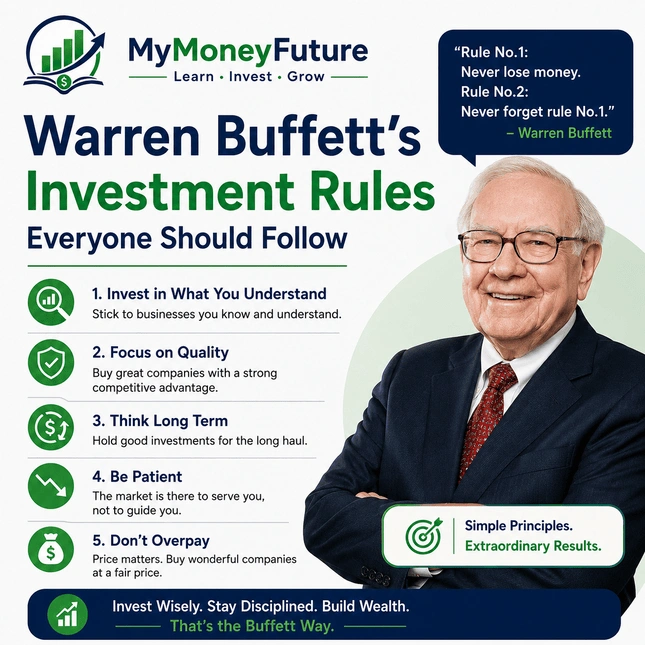
Warren Buffett is probably the most researched investor in the world, but the essence of his investment ideas is shockingly simple. He buys companies, not ticker symbols. He likes to wait, rather than act. He avoids what he doesn’t understand. And he is quite price sensitive.
That’s not to say investing like Buffett is easy. The guidelines are easy to explain but tough to follow when markets are moving quickly and everyone seems to have a heated opinion.
This article deconstructs Warren Buffett’s investment guidelines to simple English that beginners can use the attitude without claiming to mimic every Berkshire Hathaway action.
Fast answer
Warren Buffett’s rules of investment are buy good firms at realistic prices you understand, hold them for the long term, don’t borrow money unnecessarily, be patient, ignore market noise and safeguard your cash. The secret is to think like a business owner, not like a short-term trader.
Highlights
| Rule | Beginner’s Definition |
| Buy businesses, not stocks | Know the company’s business before investing. |
| Stay inside your circle of competence | Don’t buy anything you don’t understand.” |
| Search for quality | Like good enterprises with durable advantages. |
| Pay a reasonable price | Even an overpaid great firm makes a bad investment. |
| Have patience | Compounding takes time. |
| Don’t go into debt too much | “Debt can turn a temporary mistake into a permanent one.” |
Rule 1 – Think like a business owner
Buffett doesn’t think of equities as lottery tickets. He sees them as proprietary parts of genuine businesses.
That perspective alters everything. Instead of asking yourself if a stock will go up next week, you question if the business will make more money over many years.
A business-owner mindset is about looking at products, customers, management, earnings, debt, competition and long-term demand.
Warren Buffett’s yearly shareholder letters (official shareholder letters archive) The letters are full with examples of how he thinks about firms, managers, risk and long term ownership.
This is a great rule for beginners since it forces you to slow down. If you cannot describe how a company produces money, why customers like it, and what could hurt it, you probably do not know it well enough.
Rule 2: Stay Within Your Circle of Competence
The circle of competence is the area that you understand well enough to make appropriate decisions.
That might be banking, consumer brands and insurance for one investor. For one, it can be software, healthcare or real estate.
The thing is not how big is your circle. The main thing is to understand its limitations.
Many investment mistakes are made when people buy something because it is popular rather than because they know anything about it. A rookie can buy a biotech stock, a crypto coin or a fancy ETF without understanding the underlying hazards.
It is a weapon of protection and it is called Buffett’s rule. It helps you steer away of investments that sound thrilling but are murky.
Rule 3: Buy Good Businesses
Buffett loves businesses that can withstand competition and continue to make money thru time.
A good firm can have good brands, loyal consumers, pricing power, low costs, scale benefits, excellent distribution or a service people keep using.
Quality doesn’t mean the stock price never falls. Even solid companies can falter in bear markets, recessions or transitory issues.
Quality means the business has a higher chance to recover, adapt and continue to make cash over the long haul.
Beginners tend to seek the quickest growing tale. Buffett’s approach is down to earth. He wants a firm with an economic rationale, not just a supply of eyeballs.
Rule 4. Pay a Reasonable Price
A great firm might be a bad investment if you are paying too much for it.
This is where a lot of novices get it wrong. They like a firm and feel the stock must be a solid investment at any price.
Buffett’s method is of a different kind. He wants the price to be reasonable in relation to the value of the firm.
No need to develop a sophisticated valuation model on day 1. But you should know the basic questions: Is the company profitable? Are sales increasing? Is debt an issue? Is the stock trading well above reasonable expectations?
Price matters because future profits are a function not only of business quality but also of what you paid to possess it.
Rule 5: Let compounding do its stuff – be patient.
Buffett’s greatest successes were due to long-term compounding.
Compounding implies your returns can return returns for you. But compounding takes time. Constant buying and selling may interfere with that process.
Being patient is not the same as doing nothing. That means holding strong investments long enough for the business results to matter.
A newcomer can look at the pricing every day and feel pressure to do anything. Buffett’s philosophy is the opposite: spend more time learning about the business and less time reacting to price movement.
If your time horizon is simply a couple of weeks then you are not investing like Buffett. You’re trading.
Rule 6: Stay Away From Speculation Masquerading as Investing
Speculation sounds exciting. A stock is going to explode. A currency is going to moon. A company is the next big thing.
Buffett isn’t a fan of this kind of thinking. He likes investments that are backed by earnings, assets, cash flow and lasting economics.
That is not to say that every speculative investment fails. Some fare quite well. But speculation tends to be more concerned with what someone else will pay later than with what the item itself produces.
Beginners should beware of investments they cannot value. If the main justification for buying is that “someone else will buy it higher” then the risk is substantially larger.
Rule 7: Be Cash Rich and Avoid Forced Selling
For years Mr. Buffett has prioritized financial strength. Berkshire maintains a lot of cash on hand because opportunities and emergencies both strike unexpectedly.
The same applies to private investors. If you invest all your dollars and have no emergency reserve, you may be compelled to sell stocks at a poor time.
Cash may not bring home the bacon over the long haul, but it gives you flexibility. It can help you weather job loss, medical bills, auto repairs, market crashes, without panicking and selling.
For novices, the message is easy: don’t invest money you may need in the near term. Build a cash cushion, then invest for long term goals.
Carefully Rule 8: Be Greedy When Others Are Fearful
One of Buffett’s most renowned concepts is: be afraid when others are greedy, and greedy when others are fearful.
This does not mean to buy every falling stock. Some stocks decline because the firm is in trouble.
The main lesson is emotional discipline.” Markets might get excessively exuberant during bubbles and too pessimistic during collapses.
The disciplined investor maintains a watchlist, researches businesses and waits for excellent prices. They are ready when fear produces opportunity.
Beginners should not convert this rule into blind dip-buying. Fear alone doesn’t make things cheap. You still want quality and value.
Rule 9: Think and Read More Than You Trade
Buffett is a voracious reader. He looks at yearly reports, the history of the business, the industry structure and financial statements.
Most retail investors do the opposite.” They read less than they trade.
Reading makes you slower It helps you understand how a company produces money, what risks it faces and if management communicates honestly.
Start with annual reports, shareholder letters, investor presentations and simple financials. You don’t need to understand everything first time. Over time the patterns emerge.
The better you understand, the less inclined you are to fear about headlines.
Rule 10: Don’t Use Debt Recklessly to Invest
Using borrowed money to buy investments can amplify your gains, but it can also increase your losses.
Buffett has long warned of the dangers of leverage. If the market drops and you need to sell, a short-term loss can become permanent.
To start with, margin investing is not often a must. The keys to building wealth are regular contributions, diverse funds and patience.
Debt is stressful. Pressure is detrimental for decision-making. It’s preferable to have a simple portfolio that you can hold throughout downturns rather than an ambitious strategy that’s funded with borrowed money.
Rule 11: Many People Don’t Need More Than Index Funds
Buffett has long advocated low-cost index funds for ordinary investors. That surprises some people, as he is known for choosing stocks.
Practical rationality. Most people don’t have the time, desire or temperament to examine particular companies.
A low-cost index fund provides wide market exposure, immediate diversification and easy long-term participation in business growth.
In Berkshire’s 2013 letter, Buffett outlined a basic long-term method of a low-cost S&P 500 index fund for his own estate planning situation. The larger lesson is that when discipline is strong, simple can beat clever.
If you are a newbie, you don’t feel any pressure to pick individual stocks. Even so, Buffett’s rules can help you make the smart choice of simple diversified investments.
How Buffett’s Rules Can Assist Beginners
| Action Start-up | The Buffett Reason |
| First, pay off your emergency fund. | Don’t sell because you need to. |
| Only bet what you can afford to lose | Allow for time to compound. |
| Choose cheap diversified funds | The plan should be basic. |
| Do Your Homework on Stocks Before Buying | Be an owner. |
| Don’t jump on the hype train | Stay inside your circle of competency. |
| Track taxes and fees | Small costs might impact results. |
| Review But don’t overtrade | Patience is a key ingredient in compounding. |
Things to Avoid When Following Buffett
The first mistake is quoting Buffett then trying to be a trader. If you purchase and sell on the basis on weekly headlines, you are not applying his philosophy.
The second is to acquire a stock only because Buffett owns it. Berkshire’s holdings may be sized to match its own capital, tax condition and business demands. You may have various needs.
Mistake #3 – Overlooking Valuation
If everybody enjoys a great business, it might get overpriced.
Mistake #4: Mixing Up Patience With Stubbornness
There can be a case for holding a solid business thru turmoil. Another thing is running a business that’s destroyed forever because you can’t admit you made a mistake.
Mistake #5: Using too much concentration too soon
Buffett knows business well and has decades of experience, which helps him stay focused. Newcomers may need a wider diversity.
A Buffett Simple Portfolio Approach
You don’t need a sophisticated portfolio to be Buffett type thinking for a novice. Complexity can really be the adversary of consistency.
One basic strategy may be to have an emergency fund, employer retirement contributions, a low-cost diversified index fund and a rule that you don’t invest in specific companies unless you can explain them effectively.
If you later decide to buy particular equities, keep position sizes sensible. No stock should be able to ruin your entire financial life.”
A Buffett style portfolio does not mean buying the same stocks as Berkshire. It’s about owning what you know, keeping costs down, avoiding panic and allowing time do its thing.
How To Analyze A Business Like A Business Owner
Read the annual report of a corporation before buying its stock. Learn how the company makes money, who its customers are and what risks management identifies and how the business has performed over a number of years.
Revenues, profits, debt, cash flow, margins and return on capital And compare those figures to competitors.
Ask easy questions. Does the company have loyal customers? Can it push prices up? Is the industry expanding? Are managers honest about mistakes? Can you handle debt in a bad economy?
Don’t invest if you can’t see a clear answer. Buffett’s discipline is not just knowing what to buy. It is knowing what to overlook.
FAQ Section
Q: What is Warren Buffett’s number one investing rule?
His most famous guideline is generally quoted as ‘do not lose money’ followed by ‘do not forget rule number one’ . For a newbie, the practical meaning is to preserve your wealth by avoiding irresponsible risks, hype, and investments you don’t comprehend.
Q: What does Warren Buffett think of index funds?
Yes, Buffett has frequently advised low-cost index funds for most individual investors because they are straightforward, diversified and tough for many active investors to beat over extended periods.
Q: Can a rookie invest like Warren Buffett?
Buffett’s methods can be applied by beginners but not every Berkshire investment can be replicated. Have patient, diversify, choose basic funds and focus on quality.
Q: What is circle of competence?
Which implies investing in only those firms or assets that you understand well enough to evaluate. The aim is not to know everything, but to know what you don’t know.
Q: Is value investing still relevant?
Yeah. The underlying principle of paying a realistic price for future cash flows is still useful. Price and value still count. The industry and the accounting may be different.
Berkshire Hathaway shares are not a good investment right now.
That depends on your goals, risk tolerance, portfolio, valuation view and financial strategy. This essay is for educational purposes only and not a recommendation.
Conclusion
Warren Buffett’s investment rules are not hidden formulas. It has to do with discipline.
Imagine yourself as a business owner. Play to your strengths. Buy quality for a fair price. Keep cash for safety. Don’t go into foolish debt. Let time and compound interest work their magic.
For most beginning, the simplest Buffett-style approach might be just that: Build a good financial base, use low-cost diversification, and don’t let fear or greed rule the day.
You don’t have to be Warren Buffett to profit from his guidelines. You just have to use them to make fewer poor ones, more patient ones.
Educational Disclaimer
This material is intended for educational and informational purposes only. This is not financial, investing, tax, legal or customized advice. Investments are subject to risk, including the possible loss of capital. Always examine your objectives, risk tolerance, time horizon and financial status before making any investment decisions.
