
Introduction
The 50/30/20 budget rule is a simple budget strategy that divides your after-tax income into three parts: needs, wants, and savings or debt repayment.
It’s popular because, for beginners, you don’t need a complicated spreadsheet to get started. All you need to know is how much money is coming in, where it’s going, and what costs go in each bucket.
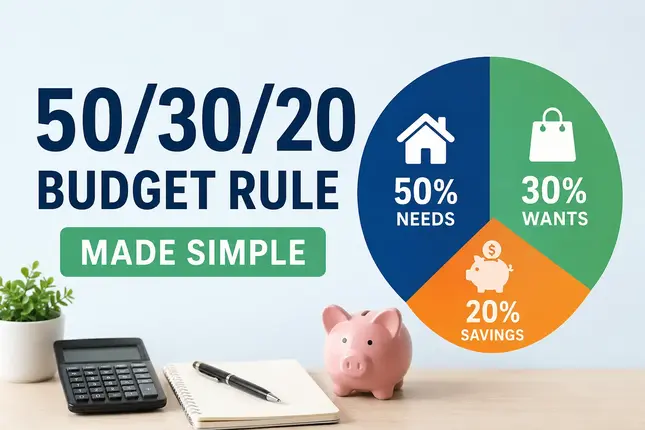
The basic idea is easy to recall. The average American spends 50% of their take-home pay on needs, 30% on wants, and 20% on savings, investing, or extra debt payments.
But that doesn’t mean you have to follow the rule to a T with your budget every month. Life is rarely that tidy. The figures can be affected by rent, debt, family expenses, and changes in income.
Think of the 50/30/20 budget rule as a starting point. It gives your money structure before you move into a more detailed budget.
Short Answer
The 50/30/20 budget rule is a budgeting method that divides after-tax income into 50% for needs, 30% for wants, and 20% for savings or debt repayment. Beginners can organize money by separating essential expenses, lifestyle spending and future goals into different categories.
Key Points
- The 50/30/20 budget rule uses after-tax income for needs, wants and savings or debt repayment.
- Generally, needs include the basic costs of housing, food, utilities, insurance, and transportation.
- Non-essential spending includes things like eating out, shopping, subscriptions, travel, and entertainment.
- The 20% category can be used for emergency savings, retirement, investing, or extra debt payments.
- That rule is a guideline, not a hard and fast law. You can customize it to your income, city, debt level, and goals.
What the Rule Means
The 50/30/20 budget rule helps you organize your money into three broad categories.
Needs are the expenses you must pay to live, work, and stay protected. Wants are optional costs that make life more enjoyable. Savings and debt repayment help you prepare for the future.
The method is useful because it keeps budgeting simple. Instead of tracking twenty different categories from the start, you begin with three.
That makes it easier to see the real problem.
For example, if your needs take 70% of your income, the issue may not be small purchases. Your fixed costs may be too high. If your wants take 45%, lifestyle spending may need more control.
According to the UNFCU 50/30/20 rule guide, the rule recommends putting 50% of money toward needs, 30% toward wants, and 20% toward savings.
That simple structure is the reason many beginners use it as their first budgeting method.
How to Divide Your Money
1. Needs: 50%
Needs are essential expenses. These are the costs you must pay to live safely, maintain your job, and meet basic responsibilities.
Common needs include:
| Need Category | Examples |
| Housing | Rent, mortgage, property taxes, basic repairs |
| Utilities | Electricity, water, gas, internet, phone |
| Food | Groceries and basic household supplies |
| Transportation | Fuel, public transport, car payment, basic maintenance |
| Insurance | Health, auto, renters, homeowners |
| Healthcare | Prescriptions, doctor visits, basic medical costs |
| Minimum debt payments | Required monthly payments on loans or credit cards |
A useful question is: “Would missing this payment seriously affect my home, health, job, or basic safety?”
If the answer is yes, it probably belongs in needs.
Still, not every “important” expense is a need. A basic phone plan may be a need. A premium phone upgrade every year is usually a want.
2. Wants: 30%
Wants are things you like but can do without if money gets tight.
This category refers to the spending on lifestyle. It lets you play with your money, without letting discretionary spending dominate your budget.
Common wants include:
| Want Category | Examples |
| Dining out | Restaurants, coffee shops, food delivery |
| Entertainment | Movies, concerts, games, events |
| Shopping | Clothes beyond basics, gadgets, home decor |
| Subscriptions | Streaming, apps, memberships |
| Travel | Vacations, weekend trips, hotel stays |
| Hobbies | Sports, books, crafts, gaming, fitness extras |
| Upgrades | Premium brands, luxury items, convenience spending |
The wants category matters because a budget that removes all enjoyment is hard to follow.
If you cut too much too quickly, you may stick to the plan for two weeks and then give up. The 30% bucket gives you freedom, but within a limit.
3. Savings and Debt Repayment: 20%
The final 20% goes toward building financial stability.
This bucket can include:
| Savings or Debt Goal | Examples |
| Emergency fund | Cash saved for job loss, repairs, medical bills |
| Retirement | 401(k), IRA, pension, NPS, or other retirement accounts |
| Investing | Index funds, mutual funds, ETFs, long-term investments |
| Extra debt payoff | Credit card debt, personal loans, student loans |
| Short-term goals | Moving costs, wedding savings, car down payment |
| Sinking funds | Annual insurance, school fees, holiday spending |
Minimum debt payments are generally considered a need because you have to pay them. Extra debt payments go into the 20% bucket.
If you have debt with high interest rates, you may need to focus this part of your budget on paying off the debt before you begin to invest aggressively.
That doesn’t mean we should ignore saving. A little emergency fund can keep you from using credit cards when an unexpected bill comes in.
Simple Example
Let’s say your monthly after-tax income is $4,000.
Using the 50/30/20 budget rule, your money would be divided like this:
| Category | Percentage | Example Amount on $4,000 Income |
| Needs | 50% | $2,000 |
| Wants | 30% | $1,200 |
| Savings/Debt | 20% | $800 |
This is only a starting point.
If you have a high rent, your needs could easily be over $2000. If so, you may need to cut wants or change the percentages but still save something.
The beginner must not feel guilty for not using the rule. Use it to see what’s happening.
The point is progress, not a perfect graph.
How To Use It Step By Step.
Step 1: Know What You Take Home After Taxes
Calculate the actual money you take home after taxes and deductions.
This is also referred to as take-home pay or net income.
Don’t use your gross salary, because that’s not the amount you have to pay bills, save and spend.
If you have a fixed salary, this step is easy. Review your monthly salary deposits.
If your income changes, use an average from the last three to six months. If your income is very irregular, use your lowest normal month to build a safer budget.
Step 2: Track Your Current Spending
Before changing your budget, find out where your money already goes.
Review your bank account, credit card statements, payment apps, and cash spending from the last two or three months.
Then place each expense into one of the three buckets:
| Expense | Category |
| Rent | Need |
| Groceries | Need |
| Netflix | Want |
| Restaurant meal | Want |
| Emergency fund transfer | Savings |
| Extra credit card payment | Savings/Debt |
| Car insurance | Need |
Do not worry if the numbers look messy at first. Most people discover at least one spending habit they did not notice.
That is the point of the exercise.
Step 3: Compare Your Spending to the Rule
Now compare your actual spending to the 50/30/20 split.
Ask three questions:
- Are my needs close to 50%?
- Are my wants staying near 30%?
- Am I saving or paying extra debt with around 20%?
If you are too high on your needs start with fixed costs. Housing, car payments, insurance and subscriptions can eat up a budget without saying a word.
If your wants are too high, limit categories like dining out, shopping, and delivery apps.
If you don’t have enough saved up, automate a little first. Even $25 or $50 per pay cheque can get you into the habit.
Step 4: Adjust Over Time
Your first 50/30/20 budget will not be perfect.
Life is life. Your budget should be different, too.
A new job, a rent increase, a baby, a move, medical expenses, or a debt payoff plan can impact your percentages.
The best budget isn’t the one that looks good on paper. This is the one you can really follow.
Review your budget once a month. Make small changes before problems become bigger.
When the Rule Works Best
The 50/30/20 budget rule works best for people who want a simple structure.
It is especially helpful if you are new to budgeting and feel overwhelmed by detailed tracking systems.
It can also work well if:
| Situation | Why the Rule Helps |
| You have stable income | Percentages are easier to plan |
| You are new to budgeting | Three categories are simple to understand |
| You want balance | The rule includes both lifestyle spending and saving |
| You need spending awareness | It shows whether needs or wants are too high |
| You want to save consistently | The 20% bucket gives savings a clear place |
This budgeting method is not only about restriction. It is about giving every part of your money a role.
You spend on life today, but you also protect your future.
When It May Need Adjustment
The 50/30/20 budget rule does not fit every household perfectly.
In high-cost cities, housing alone can take a large part of income. A person with major student loans or medical bills may also need a different split.
HSBC explains the 50/30/20 budget as a guide for dividing income into needs, wants, and future goals, including debt repayment and savings. You can read their explanation of the 50/30/20 budgeting method for another simple breakdown.
Here are common situations where you may need to adjust the rule:
| Situation | Possible Adjustment |
| Rent is very high | Use 60/20/20 or reduce wants temporarily |
| High-interest debt | Put more than 20% toward debt payoff if possible |
| Low income | Focus first on essentials and a small starter emergency fund |
| Irregular income | Budget from your lowest normal monthly income |
| No emergency fund | Use most of the 20% bucket for cash savings first |
| Strong savings already | Use more of the 20% bucket for investing or extra debt payoff |
The rule should help you choose better. It shouldn’t make you feel like a failure if your rent or bills are higher than average.
Start with what is possible, then get better from there.
Common Mistakes
Treating the Rule Like a Strict Law
The 50/30/20 budget rule is a rule of thumb.
If you need 55% for a few months, it doesn’t mean you failed. That means you have to understand why, and decide what can change.
A flexible budget is generally easier to maintain than a perfect budget.
Calling Wants “Needs”
This is one of the biggest errors.
A basic grocery bill is a must. Most of the time, takeout is a want. You may need a basic phone plan. The newest phone upgrade is usually a want.
The budget only works if you are honest about the categories.
Forgetting Irregular Expenses
Many people budget for monthly bills but forget annual or occasional costs.
Examples include:
| Irregular Cost | Why It Matters |
| Car repairs | Can create credit card debt if ignored |
| Annual insurance | May be expensive when paid once or twice a year |
| School fees | Can disrupt monthly cash flow |
| Gifts and holidays | Often lead to overspending |
| Medical costs | Can appear suddenly |
| Home repairs | Usually cost more than expected |
Set aside a small amount each month for these costs. This is often called a sinking fund.
Saving Only What Is Left
If you wait until the end of the month to save, there might be nothing left.
When you can, pay yourself first.
Automatically transfer savings after payday, even if it’s a small amount. This means that saving is part of the system, not a decision that’s left over.
Ignoring High-Interest Debt
While saving is important, high interest debt can slow you down.
Putting extra money toward a credit card with a high interest rate can help your cash flow over the long term.
A good starter plan could be a small emergency fund and a targeted debt payoff plan.
Not Reviewing the Budget
A budget is not something you set once and forget.
Check it out every month.Look at what changed, what worked, and what needs adjustment.
Small monthly reviews are better than waiting until money feels out of control.
Pros and Cons
| Pros | Cons |
| Easy for beginners to understand | May not fit high-cost cities |
| Uses only three main categories | Too broad for complex finances |
| Helps balance spending and saving | Does not automatically stop overspending |
| Gives wants a clear limit | Needs honest tracking to work |
| Encourages regular savings | May need adjustment for debt-heavy households |
| Can be used without special software | Irregular income can make it harder |
The main advantage is simplicity.
The main weakness is that life is not always simple.
That is why the rule works best as a starting framework, not a permanent rule for every situation.
Expert Tips
- Rough numbers first. You can fine-tune accuracy later.
- Automate your savings so you’re not depending on willpower each month.
- Build a starter emergency fund before you start investing aggressively.
- If you have high-interest debt, use some or all of the 20% bucket to make extra payments.
- If it helps you stay organized, open different accounts for your bills, spending, and savings.
- Review your budget every month, especially after changes in income or expenses.
- “Don’t use the wants category as a guilt-free overspending zone. Still limited.
- Do not use the needs category as a cover for lifestyle upgrades.
A good way to think about the 50/30/20 budget rule is this: it is a training wheel. It helps you build awareness and control before you move to a more customized money system.
Practical Beginner Plan
If you want to start today, use this simple plan:
| Day | Action |
| Day 1 | Write down your monthly take-home income |
| Day 2 | List all fixed bills |
| Day 3 | Review last month’s spending |
| Day 4 | Sort expenses into needs, wants, and savings/debt |
| Day 5 | Compare totals to 50/30/20 |
| Day 6 | Choose one category to improve |
| Day 7 | Set one automatic savings or debt payment |
Do not try to fix everything in one week.
Start with one change that you can repeat.
For example, you might reduce food delivery by $100 and move that money into an emergency fund. That single change is more useful than making a perfect spreadsheet that you never use.
FAQ Section
Q: What is the 50/30/20 budget rule?
A: The 50/30/20 budget rule is a budgeting method that allocates post-tax income into 50% needs, 30% wants, 20% savings or debt payoff.
A. No, the 20% savings does not incorporate payments on debt.
A: Yes. The 20% bucket can be used for emergency savings, retirement, investing, and extra debt payments. Minimum debt payments are typically needs because they’re required bills.
Q. What is a need?
A: Needs are things you have to have, like rent or mortgage, groceries, utilities, transportation, insurance, basic health care and minimum debt payments.
Q: What is considered a want?
A: Wants are optional costs such as dining out, streaming services, travel, hobbies, entertainment, shopping, and lifestyle upgrades.
Q: Is the 50/30/20 rule good for starters?
A: Yes. It’s one of the easiest budgeting methods for beginners because it requires only three categories and you don’t have to track every single thing from day one.
Q. What if my needs are more than 50%?
A: Don’t panic if your needs are more than 50%. Check your fixed costs, cut back on wants where you can, and try to save a little amount consistently. You can also take a modification of the rule.
Q: Should I save 20% before paying debt?
A: If you have high-interest debt, you might want to use some of that 20% to pay off your debt. Even a simple emergency fund can keep you from incurring new debt.
Q: My income varies from month to month. Can I still use the rule?
A. Yes, but be conservative in your income estimate. Budget for your lowest typical month or average of recent months, and put any extra income you have in stronger months into savings.
Q: Is the 50/30/20 rule better than zero-based budgeting?
Q: Not always. 50/30/20 rule is easier and better for novices. Zero-based budgeting is more detailed and may be better for people who want to assign every dollar a specific job.
Q: How do I apply the rule today?
A: Begin with your net income. Then sort last month’s spending into needs, wants, and savings or debt. Compare your totals to the 50/30/20 split, and make one practical change for next month.
Conclusion
The 50/30/20 budget rule is one of the simplest ways to manage money because it turns budgeting into three clear decisions.
You decide what is essential, what is optional, and what should go toward your future.
The rule will not fit every person perfectly. That is fine. A useful budget should fit real life, not just a textbook example.
Use the 50/30/20 budget rule to understand your spending, build savings, manage debt, and create a money system you can actually follow.
For beginners, that is a strong place to start.
Educational Disclaimer
This article is for educational purposes only and does not provide personalized financial, tax, legal, or investment advice. Your budget should reflect your income, location, debt level, family situation, and goals. Consider speaking with a qualified financial professional before making major financial decisions.
