
Most people want to save money, but many don’t know how to create a monthly budget that actually works. By the end of the month, their salary is gone, and they wonder where the money went.
You’re not alone. A 2023 survey by the Consumer Financial Protection Bureau (CFPB) found that many Americans have lived paycheck to paycheck at some point during the year.
Consumer Financial Protection Bureau (CFPB) Financial Well-Being Resources
The good news is that a simple monthly budget planner can help you take control of your finances. Whether you’re creating a household budget 2026 plan, using a budget planner UK template, or simply looking for budgeting tips for beginners, the process remains the same.
This guide explains how to create a monthly budget, choose the right budgeting system, and learn how to save money monthly without feeling restricted.
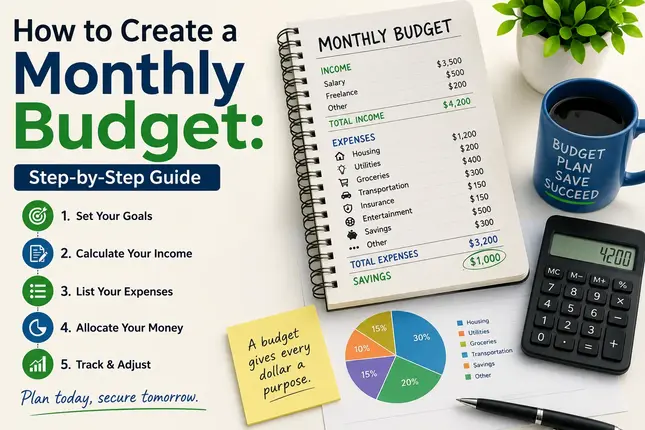
What Is a Monthly Budget (And Why Does It Actually Matter)?
A monthly budget is a financial plan that helps you manage your income, expenses, savings, and financial goals over a 30-day period. Its primary purpose is to ensure that more money is coming in than going out.
But beyond the math, budgeting gives you something harder to quantify — control. When you control your money and stop buying things that you do not actually need in the present, and start buying things that serve your actual needs.
Example: Sara, a teacher in Chicago earning $52,000 per year, thought she could not afford to save because of her low salary. However, after monitoring her expenses for a month, she understood that she spent $310 per month on ordering food and $180 per month on unused subscriptions. Reducing expenses by half helped her save $245 per month, which is enough to build a $3,000 emergency fund in a year.
The changes may not be so radical, but they will appear.
- Before You Begin: Materials You Will Need
- Collect the following materials before you begin budget planning:
- Bank statements for the last 2–3 months (from checking and savings accounts)
- Credit card statements for the last 2–3 months
- Most recent paycheck stubs or any proofs of your income (including extra income)
- List of all monthly obligations (rent, insurance, loan payments, etc.)
- Receipts or records of irregular purchases
You can use a notebook, budgeting app, budget spreadsheet, or personal budget template to organize your finances. Choose the method that you will realistically maintain every month.
Step 1: Determine Your Real Monthly Net Income
It sounds easy, but it is usually miscalculated. Your budget has to be based on your take-home pay, which means net income, not gross salary.
How to determine:
If you’re a salaried employee, the monthly amount of money you deposit in your bank account
If you earn hourly wages, multiply your average weekly working hours by your hourly wage, and multiply the result by 4.33 (it’s an average number of weeks in a month); estimate the taxes you’ll pay
If you’re self-employed/a freelancer, use your average monthly income for the last 3-6 months; consider the lowest month, not the average.
- List all income sources:
- Salary/wages you receive regularly
- Any part-time jobs/freelance
- Rental income
- Child support/alimony
- Any government assistance (e.g., Universal Credit in the UK, SNAP/Disability in the US)
- Dividends on investments (regular ones)
Pro tip: if your income fluctuates depending on the month, create your budget based on your lowest income month and treat any income above it as extra money to save or pay off debts.
Step 2: List All Fixed Expenses
Your fixed expenses will remain more or less stable during the year, but they have to be listed anyway, along with the amount.
Common fixed expenses include:
- Rent/mortgage
- Car payment
- Student loan payments
- Health/car/renter/life insurance premium
- Various subscriptions (streaming services, gym membership, software)
- Minimum credit card payments
- Phone bills
- Internet bills
- Child care/school expenses
Remember about annual expenses. Expenses like car registration, annual insurance premiums, holiday spending, and school supplies are all fixed since you know exactly how much you’ll have to spend on them; you simply need to divide that amount by 12 and save that sum of money every month.
For example, if your annual car insurance premium is $960, you’ll have to save $80 per month.
Here is the example table you can make to check your yearly expenses:
| Month | Expenses | Total Cost |
| January | Car Insurance + Property Tax | $2,000 |
| February | School Books & Supplies | $300 |
| March | Vehicle Service + Tax Preparation | $650 |
| April | Summer Vacation Fund | $1,500 |
| May | Home Repairs + Seasonal Clothing | $900 |
| June | School Fees + Uniforms | $1,250 |
| July | Vehicle Registration + Health Insurance | $2,000 |
| August | Festivals + Gifts + Donations | $500 |
| September | Mobile Replacement Fund | $800 |
| October | Holiday Travel + Festival Shopping | $2,700 |
| November | Laptop + Appliance Replacement Fund | $1,700 |
| December | Christmas/New Year Gifts + Emergency Fund | $1,600 |
| Annual Total | All Planned Irregular Expenses | $15,900 |
Step 3: Track and Categorize Variable Expenses
The variable expenses vary from one month to another. That’s where people fail with their budgets – they always underestimate variable expenses.
Common variable expense categories:
- Groceries
- Dining out / food delivery
- Gas or transportation
- Clothing
- Personal care (haircuts, toiletries)
- Entertainment (movies, concerts, hobbies)
- Home supplies and maintenance
- Medical copays or prescriptions
- Pet care
- Gifts
How to estimate accurately:
Review your bank accounts and credit cards for the past 2–3 months and add all expenses you have for each expense category. Most likely, you’ll find out that you spend 20–40% more on average in at least two categories.
Pro tip: Do not round down when budgeting. You spent $287 on food last month – budget $290, not $250.
Step 4: Budgeting Tips for Beginners — Choose the Right Budgeting Method
No universal method exists for choosing a budgeting system – the answer to this question should be tailored to the person in particular. Here is a list of the three most reliable methods:
The 50/30/20 Rule Budget
If you’re wondering what the 50 30 20 rule is, it is one of the most popular budgeting systems for beginners.
- 50% – needs (rent, utilities, food, transport, minimal debt payments)
- 30% – wants (fun, leisure, vacations, shopping)
- 20% – savings and additional debt payments other than minimal ones
Good for: Beginners who need an easy-to-follow structure but do not have to account for every penny.
Disadvantage: When living in big, expensive cities, such as London, New York, and San Francisco, your rent may take from 40% to 50% of your income.
Zero-Based Budgeting
Zero-based budgeting is one of the most effective methods for people who want complete control over every dollar they earn.
Allocating every dollar of income to some category until the sum equals zero: income – all allocations = 0
It does not mean spending all of your earnings, but assigning every dollar its function, including savings.
Good for: People having unpredictable expenses or who wish to have full control over every category.
Drawback: More demanding in terms of time and discipline. Should work better with budgeting software such as YNAB (You Need a Budget)
The Pay-Yourself-First Method
Before any other expense, you automatically transfer a set amount to savings or investments. You live on what remains.
Example: If you earn $4,000/month after tax, you automatically move $600 to savings on payday, then budget the remaining $3,400.
Best for: People who consistently spend everything available and struggle to save after the fact.
Expert insight: This method is behaviorally powerful because it removes the decision from your hands. Automating savings sidesteps willpower entirely.
Step 5: Build Your Budget (With Real Numbers)
Now it’s time to build your monthly budget planner using real numbers. Whether you’re using a budget spreadsheet, budgeting app, or personal budget template, the goal is the same: assign every dollar a purpose.
| Category | Monthly Budget |
| INCOME | $5,000 |
| FIXED EXPENSES | |
| Rent | $1,400 |
| Car payment | $320 |
| Car insurance | $110 |
| Health insurance | $180 |
| Student loan | $200 |
| Phone | $85 |
| Internet | $60 |
| Streaming subscriptions | $40 |
| Fixed Total | $2,395 |
| VARIABLE EXPENSES | |
| Groceries | $400 |
| Gas | $120 |
| Dining out | $200 |
| Entertainment | $100 |
| Clothing | $75 |
| Personal care | $50 |
| Medical/pharmacy | $40 |
| Miscellaneous | $60 |
| Variable Total | $1,045 |
| SAVINGS & GOALS | |
| Emergency fund | $200 |
| Retirement (IRA/401k) | $250 |
| Vacation fund | $110 |
| Savings Total | $560 |
| TOTAL ALLOCATED | $4,000 |
| BUFFER/UNALLOCATED | $1,000 |
Observe that there is still $1,000 left. It is not considered spending money; rather, it is extra payments towards debt, sinking funds for periodic expenses, or funds for times when variable expenses increase.
Step 6: Handle Irregular and Surprise Expenses
Among the most frequent mistakes made while budgeting, people make a perfect plan for their regular expenses, but have to face such unpleasant surprises as car repairs, medical expenses, and other types of unexpected costs.
Create sinking funds for predictable future expenses. A sinking fund helps you prepare for costs such as holidays, car repairs, insurance premiums, and home maintenance without disrupting your monthly budget.
Alongside your sinking fund strategy, prioritize emergency fund savings to protect yourself against unexpected financial setbacks.
| Irregular Expense | Annual Estimate | Monthly Set-Aside |
| Car maintenance | $600 | $50 |
| Holiday gifts | $500 | $42 |
| Annual subscriptions | $200 | $17 |
| Medical deductible | $500 | $42 |
| Home repairs | $800 | $67 |
A separate account is best for your sinking fund(s), such as a high-yield savings account (HYSA), as it will earn you some interest while leaving it in a savings account.
Step 7: Review and Adjust Monthly
Check your budget monthly – both what you budgeted and how much you spent.
Every month, create 20 minutes of “money date” time. At this time, you will:
- Review how last month went, comparing actual spending to your budgeted number for the month.
- Identify where you overspent or underspent.
- Adjust next month’s allocations based on what you learned.
- Look ahead at any upcoming irregular expenses.
Don’t quit after a bad month. Most people ditch their budgets after one faulty month. The point is not perfection; the point is progress. That month when you blew your budget in restaurants is still a month that you had a budget.
## Best Budgeting Apps in 2026
| Tool | Best For | Cost |
| YNAB budget app (You Need a Budget) | Zero-based budgeting, detailed tracking | ~$14.99/month |
| Monarch Money | Couples and households | ~$14.99/month |
| Copilot (US, iOS) | Clean UI, automatic categorization | ~$13/month |
| Emma (UK/US) | Multi-bank aggregation, subscription tracking | Free / Premium |
| Google Sheets | Custom control, no cost | Free |
| Spreadsheet templates | Beginners who want simple structure | Free |
Expert tip: If you’re new to budgeting, start with a spreadsheet. Apps add value once you’ve built the habit — but the habit doesn’t require an app.
Pros and Cons of Monthly Budgeting
Pros
- Financial clarity: You always know where you stand
- Reduced financial stress: Having a budget puts you in a better position financially – there are studies that show creating a budget can help reduce anxiety from financial sources and/or having a decrease in income.
- Faster goal achievement: Creating a plan for savings will help to reach/look forward to goals of saving to have an emergency fund, saving for trips, and saving for a house buy faster than without a plan.
- Debt reduction: Having a surplus of money will help to pay down high-interest debt.
- Better financial decisions: You pause before buying something outside the plan
Cons
- Time investment: Takes 2–4 hours to set up initially and 20–30 minutes monthly to maintain
- Learning curve: The first 2–3 months often feel awkward as categories get calibrated
- Requires consistent tracking: If you stop logging expenses, the budget becomes inaccurate
- Can feel restrictive: Some people experience “budget fatigue” if they feel too constrained in their wants categories.
Common Budgeting Mistakes to Avoid
1. Budgeting using gross rather than net income. You cannot spend the income taken by the government.
2. Missing annual expenses. They are predictable; include them in the plan as monthly contributions.
3. Considering savings optional. Savings need to be a budgeting line item, not “whatever remains.”
4. Having no miscellaneous category. Things happen unexpectedly, budget $50-100/month for anything that does not belong to other categories.
5. Making up a budget that you will not stick to. $100/month food budget looks reasonable, but not if your reality is $350 – start with $350 and gradually reduce.
6. Not budgeting together with your partner. Budgeting couples argue about finances less. A 2022 Fidelity survey found that 38% of couples see money issues as their main cause of arguments — budgeting is a communication tool, not a spreadsheet.
Budgeting for Low-Income Households
Budgeting for low-income households is not simply about cutting expenses. It’s about prioritizing necessities and making every dollar count.
Research from the Money and Pensions Service (MaPS) found that around 11.5 million UK adults have less than £100 in savings, demonstrating why budgeting remains essential for low-income households.
Priorities list for low-income budgeting:
- 1st priority – shelter (rent/mortgage, always first),
- health/safety utilities (electricity, heat, water),
- food (groceries before eating out),
- transportation to work,
- minimum required debt payments to avoid penalties,
- and everything else.
- If your income is not enough to cover basic necessities, consider:
- income-based student loan repayment programs (US),
- Universal Credit (UK),
- food banks,
- utility assistance programs (LIHEAP in the US),
- community help.
Unpredictable income (e.g., freelance, gig, seasonally): make two budgets – a slim budget for low-income months and a full one for high-income months. Always operate on a slim budget unless high income is already deposited in your bank account.
FAQ: Monthly Budgeting
Q: How long until budgeting becomes automatic?
A: According to most financial educators, the answer is 3-4 months. The first month is discovery, the second one is adaptation, and starting from the third or fourth month, the process becomes automatic rather than stressful.
Q: What is the 50/30/20 rule?
A: The 50/30/20 rule budget recommends allocating 50% of income to needs, 30% to wants, and 20% to savings and debt repayment.
Q: How do I budget paycheck to paycheck?
A: If you’re wondering how to budget paycheck to paycheck, start by covering essentials first, tracking every expense, and building a small emergency fund. Even saving a small amount consistently can make a difference.
Q: How do I start a budget with no money?
A: If you’re asking how to start a budget with no money, begin by tracking your income and expenses. A budget helps identify spending leaks and opportunities to improve cash flow.
Q: How much should I spend on groceries each month?
A: There is no universal answer to how much to spend on groceries. A common guideline is 10–15% of take-home income, but the right amount depends on household size, location, and dietary needs.
Q: Should I do budgeting on a weekly or monthly basis?
A: Both approaches work fine. Monthly budgeting is easier and follows most billing periods. Weekly budgeting is helpful in case you tend to overspend halfway through the month and forget about your budget constraints. Some people combine monthly budgeting with weekly checks.
Q: My income and expenses leave no place for savings. Should I start with something?
A: Yes, try to allocate $10-25 per month for your emergency fund. Building a habit of saving money is more important than the sum initially. As soon as you identify some unnecessary spending or your income increases, you can increase your savings amount. Having an emergency fund worth even $500 protects you from any disruptions.
Q: Is it realistic to follow the 50/30/20 budgeting rule in expensive cities?
A: In most cases, no, but that is alright. If 40% of your take-home pay goes for your housing expenses, then you need to change this framework. The essence of this rule (needs/wants/savings) remains unchanged despite different percentage splits.
Q: Should I pay off my debts first or build savings?
A: High-interest debts (such as credit card debts, payday loans, anything with an interest rate above ~7-8%) should be paid off before saving while keeping an emergency fund of $500-$1,000. Low-interest debts (e.g., mortgage, federal student loan) require saving simultaneously (and that would be more profitable mathematically).
Q: Should I track all my expenses?
A: Not really. While some people track everything, others set up category-based budget limits. The important thing here is that you have to know when you run out of the limit for your category. If you can do it without tracking every $4 coffee, then you have done it right.
Q: What’s the difference between a budget and a spending tracker?
A: A budget is a plan made in advance. A spending tracker records what actually happened. Both are useful — a budget without tracking is just wishful thinking, and tracking without a budget doesn’t tell you what to change.
Key Statistics to Know
- According to the US Bureau of Labour Statistics Consumer Expenditure Survey (2023), the average US household spends an average of $72,967 per year, with housing representing 33% of that expense.
- According to the Federal Reserve’s 2023 SHED Report, 37% of Americans would struggle to cover an unexpected $400 expense, highlighting the importance of emergency fund savings. Federal Reserve SHED Report
- A survey performed by the Money and Pensions Service (MaPS) UK stated that there were 11.5 million UK adults who had less than £100 in savings.
- According to the National Endowment for Financial Education research, people who maintain a written budget feel more secure financially and tend not to carry forward credit card debt.
Final Thoughts: You do not have to use fancy software tools, expensive apps, or have advanced financial expertise to create a monthly budget in 2026. If you’ve been wondering how to create a monthly budget, the most important step is simply getting started. Your first budget doesn’t need to be perfect; it just needs to be realistic.
References
- Consumer Financial Protection Bureau (CFPB). Financial Well-Being in America. cfpb.gov
- U.S. Bureau of Labor Statistics. Consumer Expenditure Survey, 2023. bls.gov/cex
- Board of Governors of the Federal Reserve System. Report on the Economic Well-Being of U.S. Households (SHED), 2023. federalreserve.gov
- Money and Pensions Service (MaPS), UK. Financial Wellbeing Survey. moneyandpensionsservice.org.uk.
- National Endowment for Financial Education (NEFE). Research on Budgeting Behaviors and Financial Confidence. nefe.org.
- Fidelity Investments. Couples and Money Survey, 2022. fidelity.com.
- Warren, Elizabeth & Warren Tyagi, Amelia. All Your Worth: The Ultimate Lifetime Money Plan. Free Press, 2005.
Disclaimer: The purpose of this article is to inform and educate the reader about the topic discussed herein; we attempt to provide up-to-date factual material that is accurate; however, we do not guarantee any of this information as complete or correct; you must make your own financial decisions based upon your own situation (e.g., your financial goals) and willingness to take on risk; any actions you take as a consequence of this article’s contents are at YOUR RISK.
