
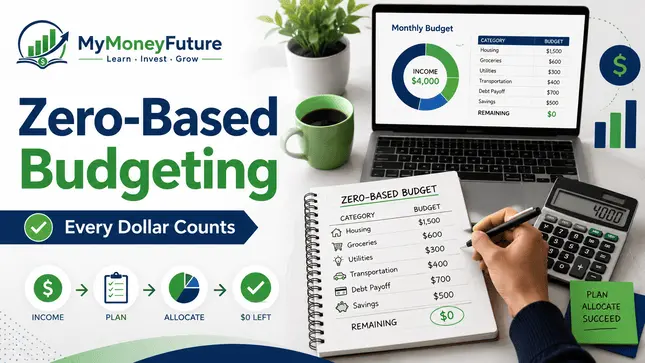
Zero-based budgeting is a money management method in which every dollar of income is assigned a purpose before the month begins.
Instead of paying bills, spending as usual, and hoping there is money left for savings, you decide in advance where your income should go. Your income minus planned spending, savings, investing, and debt payments should equal zero.
That does not mean you spend your bank account down to nothing. It means there is no money left without a planned job.
For example, money you do not need for bills could be assigned to an emergency fund, retirement account, future vacation, car repair fund, or extra credit card payment. Saving is part of the plan rather than something you attempt with whatever happens to remain at the end of the month.
This budgeting method is more detailed than many simple budgeting rules. It takes some work, especially during the first few months. But for people who regularly wonder where their money went, the extra detail can create much-needed clarity.
Quick Answer
Zero-based budgeting means planning how every dollar of take-home income will be used. You enter your income, your bills, your day-to-day expenses, your savings goals, and your debt payments, then tweak the categories until planned income minus planned outflows equals zero.
The idea is to be purposeful with your money, not to spend every penny you earn.
Key Takeaways
- Every dollar is assigned a purpose before it’s spent.
- The budget has savings, investments and extra debt payments.
- The budget is recreated or looked at for each new month.
- A little buffer will keep a small surprise from spoiling the plan.
- This method gives you more control, but you’ll need to track your expenses regularly.
- People who have irregular income can make use of it by budgeting from a conservative estimate of income.
- The plan should reflect real spending habits, not an unrealistically perfect month.
What Is Zero-Based Budgeting?
Zero-based budgeting is a system in which you deliberately justify and assign your available money rather than automatically repeating every previous expense.
The idea originally became well known as a business budgeting approach. Under the business version, departments do not automatically receive the same funding simply because they had it last year. Expenses are reviewed and justified based on current needs and priorities.
As Deloitte’s explanation of zero-based budgeting notes, traditional budgets often begin with previous spending, while zero-based approaches require expenses to be reviewed from the beginning of each budget cycle.
The personal finance version applies the same basic idea to household money.
You do not have to cancel every expense or defend a grocery purchase like you are presenting it to a board of directors. You simply look at your expected income and decide what deserves funding this month.
Your budget might include:
- Housing
- Utilities
- Groceries
- Transportation
- Insurance
- Minimum debt payments
- Extra debt repayment
- Emergency savings
- Retirement contributions
- Entertainment
- Gifts
- Annual expenses
- A miscellaneous buffer
The formula is simple:
Income − expenses − savings − investing − debt payments = $0
What “Giving Every Dollar a Job” Really Means
Giving every dollar a job means deciding what money is for before you use it.
Imagine your monthly take-home income is $4,000. So after all your regular expenses and savings, you have $250 left over.
In a loose budget, that $250 may remain in your checking account. You might spend $40 here, $60 there, order extra takeout, and eventually lose track of it.
In a zero-based budget, you give the $250 a specific purpose. You could assign:
- $100 to an emergency fund
- $75 to extra debt repayment
- $50 to a holiday fund
- $25 to entertainment
You still have freedom to enjoy your money. The difference is that the decision happens intentionally rather than accidentally.
Zero-Based Budgeting Example
Suppose a household receives $4,000 in take-home income during the month.
A balanced budget could look like this:
| Category | Planned amount |
|---|---|
| Rent or mortgage | $1,200 |
| Utilities and internet | $180 |
| Groceries | $450 |
| Transportation | $250 |
| Insurance | $170 |
| Minimum debt payments | $250 |
| Extra debt payment | $200 |
| Emergency fund | $300 |
| Retirement investing | $400 |
| Wants and entertainment | $300 |
| Sinking funds | $250 |
| Miscellaneous buffer | $50 |
| Total assigned | $4,000 |
The household has not spent all $4,000. Total allocated to extra debt payments, emergency savings, retirement investing & sinking funds: $950
Part of the money is still being used productively, but part of it is still in savings or investment accounts.
What Happens If You Spend Less Than Planned?
Suppose the household budgets $450 for groceries but spends only $410.
The remaining $40 should be given another job. It could be moved to:
- Next month’s grocery category
- Emergency savings
- A future car repair
- Extra debt repayment
- A holiday fund
The important point is not that every category must be emptied. The point is that money should not become invisible simply because it was not spent as expected.
How to Create a Zero-Based Budget Step by Step
Step 1: Calculate Your Monthly Take-Home Income
Start with the amount that actually reaches your bank account after taxes, insurance deductions, retirement contributions, and other payroll deductions.
Think of reliable income such as:
- Salary or wages
- Freelance income
- Business income
- Benefits
- Pension income
- Regular child support or maintenance payments
- Rental income
- Predictable side-hustle earnings
If you do not personally receive and manage the entire gross salary, do not build the budget off gross salary.
If your income fluctuates, be conservative. It’s better to budget using a lower number and add income when it comes in than to promise things based on money that might not materialize.
Step 2: The Fixed Expenses List
Fixed expenses are bills that stay pretty much the same.
Examples include:
- Rent or mortgage
- Car payments
- Insurance premiums
- Childcare
- Internet
- Phone service
- Loan payments
- Subscription services
Review these expenses instead of copying them without thinking. A recurring expense is not automatically necessary just because you paid it last month.
You might discover an inactive subscription, duplicate insurance or a service you can renegotiate.
Step 3: Estimate Variable Costs
Variable costs are the ones that change from month to month.
These may include:
- Groceries
- Fuel
- Electricity
- Dining out
- Clothing
- Personal care
- Entertainment
- Household supplies
- Pet expenses
Use recent bank and credit card statements to estimate realistic amounts.
This is where many first budgets go wrong. Someone who normally spends $600 on groceries may enter $300 because it looks better on paper. The budget then fails halfway through the month.
Begin with the truth. You can reduce a category gradually after you understand what drives the spending.
Step 4: Include Irregular Expenses
Not every expense arrives monthly, but irregular costs are still part of life.
Here are some common examples:
- Annual insurance premiums
- Vehicle registration
- School costs
- Holiday gifts
- Medical deductibles
- Home repairs
- Car maintenance
- Professional membership fees
- Annual software subscriptions
- Birthdays and celebrations
Set up sinking funds for these expenses.
A sinking fund is a way of saving up money over time for a known future expense . If you have to pay $ 1200 for car insurance every 12 months, then saving up $ 100 per month makes the bill a little easier to swallow .
Without sinking funds, predictable expenses can feel like emergencies even though you knew they were coming.
Step 5: Add Savings and Investing
Do not wait to see what is left after spending.
Include financial goals directly in the monthly budget, such as:
- Emergency fund contributions
- Retirement investing
- House deposit savings
- Education savings
- Travel savings
- Replacement vehicle fund
- Home repair fund
This is often called “paying yourself first,” but the amount must still be realistic. A savings target that causes you to use a credit card for groceries is not helping.
Step 6: Add Debt Payments
Include all required minimum payments. Then decide whether you can make additional payments toward high-interest debt.
| Debt Payment | Amount |
|---|---|
| Credit Card Minimum | $100 |
| Personal Loan Payment | $200 |
| Student Loan Payment | $150 |
| Extra Credit Card Payment | $250 |
| Total Debt Payments | $700 |
Seeing the minimum and extra payments side by side makes your progress more obvious.
Step 7: Leave Some Breathing Room
A budget that leaves no wiggle room might seem efficient, but life isn’t always a neat spreadsheet.
Allow some room for small unplanned expenses. Depending on your income, that might be $25, $50, $100, or more.
The buffer is not a replacement for an emergency fund. It is for ordinary surprises, such as a higher utility bill, an unplanned school expense, or a small price increase.
Step 8: Adjust Until the Budget Equals Zero
Add all planned categories and compare them with your take-home income.
If you have $200 left, assign it to a goal.
If you are short by $200, the budget is asking you to spend more than you earn. You will need to reduce categories, lower savings temporarily, increase income, or reconsider a financial commitment.
A budget should not be forced to zero using made-up numbers. It must balance using realistic income and expenses.
Step 9: Track Spending During the Month
Creating the budget is only the first half of the process.
As you spend, update the remaining amounts in each category. You can use:
- A budgeting app
- A spreadsheet
- A notebook
- Bank account categories
- The envelope system
According to Fidelity’s guide to zero-based budgeting, the method requires you to consider how each dollar of monthly income will be used, including income from sources such as gig work and money already directed toward workplace retirement plans.
Reviewing the plan regularly helps you make adjustments before a small overspending problem becomes a large one.
How Zero-Based Budgeting Works With Irregular Income
Budgeting is more difficult when income changes, but the method can still work.
Start with the lowest reliable amount you expect to receive.
Suppose your recent monthly income was:
| Month | Take-home income |
|---|---|
| January | $4,500 |
| February | $3,700 |
| March | $5,100 |
| April | $4,000 |
You might build your basic monthly budget around $3,700 rather than the average.
Rank expenses in the following order:
- Housing and basic utilities
- Food and basic transportation
- Insurance and minimum debt payments
- Necessary family expenses
- Emergency savings
- Other savings and investing
- Wants and discretionary spending
When extra income comes in, allocate it according to the list you’ve prepared instead of treating it as free spending money.
For example, extra income could be divided among:
- Tax savings
- Emergency savings
- Debt repayment
- Retirement
- Upcoming irregular bills
- Personal spending
Freelancers and self-employed workers should also separate money that may be owed for taxes. Revenue received is not always the same as spendable personal income.
Zero-Based Budgeting vs. Other Budgeting Methods
No budgeting system works best for everyone.
| Method | How it works | Best for | Main drawback |
|---|---|---|---|
| Zero-based budget | Assigns each dollar to a category | People who want precise control | Needs to be tracked regularly |
| 50/30/20 budget | Allocates income between needs, wants and savings | Beginners who want simplicity | Percentages may not work for all households |
| Envelope method | Limits spending with physical or digital envelopes | People who overspend in certain categories | May be inconvenient to use for online payments |
| Pay-yourself-first | Automatically saves before spending | People who are focused on saving consistency | May provide less spending detail |
| Traditional budget | Starts with previous spending | Households with steady expenses | Can allow wasteful costs to continue |
You can also mix-and-match.
So for example you might set big goals with the 50/30/20 rule, then use a zero-based plan to break down each category to specific amounts.
Who Should Use Zero-Based Budgeting?
This method might be just right for you if:
- You often wonder where your money went.
- You are trying to pay off debt.
- You need to control variable spending.
- You have several competing savings goals.
- You want detailed visibility over household finances.
- Your income is sufficient, but savings never seem to grow.
- You prefer active financial planning.
It may be less appropriate if you are not comfortable and do not have to track expenses in detail.
If you are the type of person that already saves consistently, stays away from high-interest debt and spends well below your income then you may prefer a simpler system.
Pros and Cons of Zero-Based Budgeting
Pros
Every Dollar Has a Job
Money that doesn’t have a job is more likely to go poof on impulse purchases and forgotten subscriptions.
Savings get scheduled as an expense, not an optional use of leftover cash.
It Reveals Spending Patterns
Detailed expense tracking can show where your lifestyle habits do not match your priorities.
It Helps Pay Down Debt
You can steer extra payments before discretionary spending eats away at the cash.
It can be re-designed to meet changing goals
If income, household needs or financial priorities change, you can re-design the plan.
Cons
Takes Time
You have to make categories, track transactions and update the budget during the month.
Beginners May Create Too Many Categories
It can be tiring to track dozens of small categories.
It Can Be Restrictive
Some people don’t like that every purchase is tied to a certain limit.
Variable Income Requires More Planning
Freelancers and commission workers need conservative estimates and a clear system of priorities.
It Won’t Create An Income Shortfall
No budgeting method will create enough income to cover expenses that are consistently greater than income. If that is the case, you may need to cut spending, restructure debt, earn more, or get help from a professional.
Common Zero-Based Budgeting Mistakes
Confusing Zero With an Empty Bank Account
You do not need to spend your entire balance. Money assigned to savings is still doing a job.
Forget Annual & Irregular Bills
Avoidable financial crises arise from skipping expected non-monthly expenses.
Too Strict Budget
A plan that doesn’t include entertainment, flexibility or personal spending can be difficult to stick with.
Using Ideal Numbers Instead of Real Numbers
If your budget is based on who you wish you were rather than how you currently spend, it will probably fail.
Creating Too Many Categories
You do not need separate categories for coffee, snacks, lunch, dinner, and desserts unless that level of detail genuinely helps you.
Ignoring Small Purchases
Several small transactions can quietly consume a large category.
Failing to Update the Plan
A budget created on the first day of the month will become outdated if bills, income, or priorities change.
Treating Overspending as Failure
You will probably misjudge some categories in the beginning. That is normal.
The useful question is not, “Why am I bad at budgeting?” It is, “What made this category unrealistic, and what should I change next month?”
Expert Tips for Making the Method Easier
Use Fewer Categories at First
Start with broad categories and add detail only where it helps you make decisions.
Review the Budget Weekly
A 10-minute weekly check is often more manageable than reviewing an entire month of transactions at once.
Automate Important Goals
Automatic transfers can move money to savings, investing, and debt payments before it is spent elsewhere.
Use Sinking Funds
Sinking funds make large but predictable expenses easier to handle.
Budget With Your Partner
Couples should agree on the major goals, category limits, and how personal spending money will be handled.
Keep Personal Spending Money
Giving each partner a reasonable amount of no-questions-asked spending money can reduce conflict and make the plan feel less controlling.
Plan for a Normal Month, Not a Perfect Month
People attend birthdays, replace worn-out shoes, order food when they are tired, and occasionally spend more than expected. A useful budget leaves room for real life.
Frequently Asked Questions
1. Zero-based budgeting is, simply stated, what is it?
It is a budgeting strategy that involves deciding where every dollar of your net income will go before the month even starts – whether it’s for spending, saving, investing or paying off debt.
2. Why is it called zero-based budgeting?
It is called zero-based because you build the plan from the beginning and continue assigning money until income minus all planned uses equals zero.
3. Does zero-based budgeting require you to spend all your money?
No. All money put into an emergency fund, retirement account, sinking fund or other savings goal has not been wasted or spent. It has just been given a purpose.
4. What is zero budgeting and is it a good idea for beginners?
Yes, especially for people who are new to budgeting and need to know where their money is going. It does take more work than a simple percentage based budget though.
5. Is zero based budgeting the same as the 50/30/20 rule?
No. The 50/30/20 rule is a broad percentage for needs, wants and savings. A zero-based plan is assigning exact amounts to individual categories until there is no income left unassigned.
6. Can zero-based budgeting help you get out of debt?
Yes. You can prioritize additional debt payments before money is allocated to less critical items. The method also helps to identify costs that might be reduced.
7. How Do I Zero-Based Budget With an Inconsistent Income?
Create a budget based on a conservative estimate of your income and prioritize essential expenses. Only budget for any additional income when it is received.
8. How frequently should I revise my budget?
Start each month having built or updated the plan. Review it at least once a week at the beginning and revise it any time income or expenses change.
9. What happens if I go over in one category?
Don’t just forget about the problem, shift money from another category. Then ask yourself whether the initial amount was unrealistic and needs to be corrected next month.
10. A savings account is not an expense.
Yes, we need to plan for emergency savings, retirement contributions and other financial objectives besides regular expenses.
11. Do I need an app for zero-based budgeting?
No. You can use a spreadsheet, a notebook, a budgeting app, or a digital envelope system. The best tool is one you will update consistently.
12. What happens if I spend more than I earn?
Begin with the basics: housing, food, utilities, insurance, minimum debt payments. Then cut back on optional items. Review large fixed costs. Find practical ways to boost income. A budget can’t be maintained if planned expenses routinely exceed income.
Conclusion
Zero-based budgeting can change the way you handle your money by replacing vague intentions with concrete decisions.
Rather than hoping to save whatever remains at the end of the month, you decide how much to save in advance. Instead of wondering whether you can afford another purchase, you check the category that was created for it.
The method takes more effort than a loose monthly budget, and it may require several months of adjustments before the numbers feel realistic. That does not mean you are doing it wrong. A useful budget improves as you learn more about your actual spending.
If you want greater control, clearer financial priorities, and a system that gives every dollar a job, zero-based budgeting is worth trying. Start with your next month’s take-home income, keep the categories manageable, and remember that the purpose is not perfection. It is making your money more intentional.
Educational Disclaimer
This article is for educational and informational purposes only and does not provide personalized financial, tax, investment, credit, or legal advice. Budgeting decisions should reflect your income, household obligations, debt, savings needs, and financial goals. If you are dealing with serious debt, financial hardship, tax problems or other complex situations you should consider talking to a qualified financial professional.
