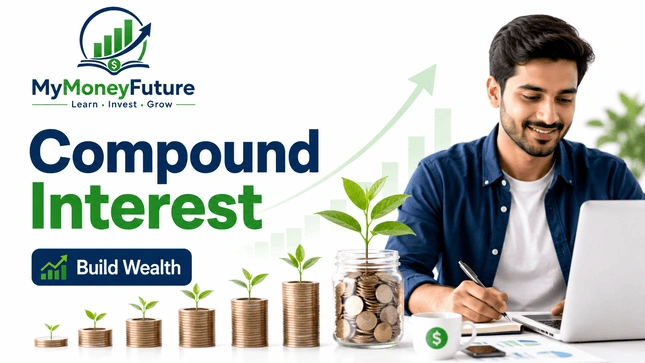
Compound interest is one of the most powerful ideas in personal finance. It works by making money, and then that money makes money over time.
That results in a snowball effect. At first, growth could seem sluggish but might become very obvious after years or decades.
Interest earned on money in interest-bearing savings accounts, certificates of deposit and some bonds can work to your advantage. A similar impact can occur in investment accounts if dividends, interest and capital gains are left invested rather than withdrawn.
But compound growth isn’t automatic or assured. Your beginning balance, how much you contribute, rate of return, fees, taxes, withdrawals and how long your money remains invested will all affect the answer.
Whether you’re creating an emergency fund, saving for retirement, or investing for long-term financial freedom, understanding compound interest may help you make smarter choices with your money.
Short answer
Compound interest is when you earn interest on your money and on the interest that was added to your investment previously.
For example, if you put $10,000 into an account that pays 5% every year, you’ll receive $500 in the first year. If that money is left in the account, the interest for the second year would be calculated on $10,500, not only the original $10,000.
Compounding can also refer to the growth of investments while returns are left invested. You can’t take dividend interest in stocks or funds to the bank, but reinvested dividends and investment gains can provide a similar effect of compound growth.
The longer your money is invested or saved, the more opportunity it has to compound.
Key Takeaways
| Key Point Summary | Key Point Summary |
|---|---|
| Compound interest is interest on interest | Earnings are added to the balance and can earn future earnings. |
| Time is money | Longer time periods allow for greater compounding chances. |
| Regular contributions can help grow faster | Each contribution adds more money that can potentially earn returns. |
| Getting a head start can be advantageous | Contributions made early have more time to flourish. |
| Reinvesting allows compounding | Withdrawing earnings limits their future growth potential. |
| Fees and taxes reduce outcomes | Money paid out in costs is no longer available to compound. |
| There is no guarantee you will get a return on your investment. | Market values and investment returns might go up and down. |
Compound Interest Explained
Compound interest is interest upon the initial principal, which also includes all of the accumulated interest from earlier periods on a deposit or loan.
The principal is the amount of money you put down, saved, borrowed or invested.
So let’s say you put $1,000 into a savings account that gives you 5% interest per year.
After year one:
$1,000 × 5% = $50
Your new balance is:
$1,000 + $50 = $1,050
Now, interest for the second year is paid on $1,050, not just the original $1,000.
$1,050 × 5% = $52.50
Your balance is:
$1,102.50
You didn add any money and still you made $ 2.50 more in the second year . That extra was earned from interest on the interest from the year before.
The Consumer Financial Protection Bureau provides a similar explanation in its guide to how compound interest works : “Compounding enables savers to earn interest on the money they deposit and on the interest they receive.
How does Compound Interest work
Compound interest is determined by numerous variables:
- Your beginning balance
- The rate of interest or return on investments
- How often the compounding is done
- Any further contributions you make
- How long the money is kept in the account
- Whether you take out any earnings
- Taxes and fees
The larger the ending value will be, the larger the balance, the longer the time horizon, the higher the rate and the more frequent the compounding.
But there’s a crucial difference between saving and investing.
Savings Account Compound Interest
A savings account may pay a stated rate of interest. Interest is calculated and credited by the bank or credit union according to the terms of the account.
If your deposit is at an eligible institution, your deposit may be insured up to the federal deposit insurance limitations.
Compound In Investments
Stocks, mutual funds and exchange-traded funds often don’t pay fixed compound interest rates.
They can increase their worth by:
- Price appreciation
- Dividends
- Distributions of interest
- Capital gains reinvested
- Additional contributions
These returns can be reinvested to produce additional returns. This is sometimes referred to as compound growth or compound returns.
Interest on a guaranteed deposit account is positive . Investment returns can be positive or negative .
The formula for compound interest
The usual formula for compound interest is:
A = P (1 + r/n)^(n t)
Where:
- A = future value
- P = principle or beginning amount
- r = yearly rate of interest expressed as a decimal
- n = number of compounding periods each year
- t = time in years
Suppose you invest $1,000 for 20 years and it earns an assumed yearly return of 5%, compounded annually.
The computation would be:
A = $1,000(1 + .05)^20
That would be the projected future value:
A = $2,653.30
That means the original $1,000 produced about $1,653.30 in growth with no extra contributions.
This is a simplified example assuming a constant return, no taxes, no fees, and no withdrawals. Real world financial results are seldom this seamless.
Formula with periodic contributions
Now if you add money each month the simple method gets a little more difficult.
Instead of doing all the math yourself, use the Investor.gov Compound Interest Calculator to compare different starting balances, monthly contributions, time periods, estimated rates, and compounding frequencies.
A calculator helps, as each monthly contribution begins compounding at a different period.
Money provided early on has considerably longer to grow than money contributed near the end of your investing time.
An Example of Simple Compound Growth
Let’s say you invest $10,000 and earn an assumed 8 percent per year, compounded annually. You don’t contribute any more money and you don’t take any money out.
Year 1:
Interest received:
$10,000 × .08 = $800
New balance:
$10,800
2nd year
Interest is now calculated on $10,800.
$10,800 x 8% = $864
New balance:
$11,664
The second year investment was $64 more because the $800 earned the first year was still invested.
Long Example
| Year | Estimated Balance |
|---|---|
| Start | $10,000 |
| Year 5 | $14,693 |
| Year 10 | $21,589 |
| Year 20 | $46,610 |
| 30th Year | $100,627 |
The $10,000 grew by approximately $4,693 in the first five years.
It did, though, grow by some $54,017 between Years 20 and 30. More growth was to come, though, because the returns were now being made on a much larger accumulated sum.
This depiction implies a consistent 8% yearly growth, which is not guaranteed. Actual investment results can differ and no assurance can be given that an investor’s investment will be successful.
Simple Interest and Compound Interest
Simple interest is based on the original principal only.
Compound interest is calculated on the principle and also on the accumulated interest of prior periods.
| Feature | Simple Interest | Compound Interest |
|---|---|---|
| Interest on | original principal alone | Principal and accrued interest |
| Growth type | Linear | Accelerating |
| profits from past profits | No | Yes |
| Typical examples | Certain loans and fixed contracts | Savings accounts and reinvested profits |
| Long-term growth potential | Lower at similar terms | Higher at similar terms |
Example: $10,000 at 8% for 30 Years
Using simple interest:
Interest = Principal * Rate * Time
Interest = $10,000 * 0.08 * 30
Interest 24,000
Closing value:
$10,000 + $24,000 = $34,000
If we were to compound annually at the same notional rate, the ending value would be approximately:
$100,627
| Method | Value at End |
|---|---|
| Simple interest | $34,000 |
| Compound Interest | $100,627 |
| Difference | $66,627 |
The difference is even more apparent for longer periods of time.
The role of time
Time is a key element in compounding.
An investment today has more time for growth than an investment made 10 years from now.
Think of two hypothetical investors.
Sarah Starts at 25 Years Old
- Monthly investment $200
- Investment duration 40 years
- Average annual return: 8%
- Amount contributed: $96,000
- Projected Ending Balance $698,202.00
James at 35 Years Old
- Monthly investment: 200$
- Investment duration: 30 years
- Average annual return 8 percent
- Amount contributed $72,000
- Projected Ending Balance $298,072
| Investor | Age of Initial Investment | Years Invested | Total Contributions | Estimated Balance |
|---|---|---|---|---|
| Sarah | 25 | 40 | $96000 | $698,202 |
| James | 35 | 30 | $72,000 | $298,072 |
Sarah has put in an additional $24,000, but her estimated ending balance is about $400,130 higher.
The difference is mainly due to the extra decade of contributions and compounding growth.
These are hypothetical estimates with monthly compounding and 8% constant annual return Actual investment results will vary.
Early Start or Investing Later
It’s good to start early, but it doesn’t indicate that a late starter is incapable to generate riches.
A later investment can do better by:
- Making larger monthly contributions
- Additional contributions following pay increases
- Exploiting employer matching contributions
- Lower costs on investments
- Avoiding needless withdrawals
- Lengthening of the investment horizon
- Taking use of catch-up contributions where possible
Time is a factor but it is not everything. The outcome is influenced also by contribution size, investment returns, costs, taxes and behaviour.
The greatest time to start was probably years ago, but the second best time is to start today, with a sensible strategy.
Regular Contributions are What Matter
The more you contribute, the more force the compound effect has.
Assuming an average yearly rate of return of 8%, compounded monthly, let’s say you invest $300 a month from age 25 to age 65.
40+ years:
- Total donations: $144,000
- Projected final balance: Approximately $1,047,302
- Growth over contributions (est.): ~$903,302
The majority of the predicted ending amount is from compound growth, not the money you put in.
This doesn’t mean the result is guaranteed. And of course a real portfolio would have changing returns, fees, taxes and market drops.
The example also illustrates why contribution consistency and punctuality can be so important.
How Automatic Investing Helps
With automatic contributions, you don’t have to make a fresh saving decision each month.
You can set up transfers to happen:
- Pay day
- One a week
- Fortnightly
- Mensuel
- After the big bills are paid
Automation doesn’t ensure success in investing, but it can make consistency easier.
Understanding Compounding Frequency
Interest can compound:
- Daily.
- Monthly
- Quarterly 2.
- Every six months
- Once a year
Assuming the stated interest rate is the same, more frequent compounding will result in a somewhat greater final balance, all other circumstances being equal.
For example : $ 10,000 yielding 5 % for 10 years would be worth varying amounts depending on the compounding schedule .
| Compounding Frequency | Approximate End Value |
|---|---|
| Annually | $16,289 |
| Quarterly | $16,436 |
| Monthly | $16,470 |
| Daily | $16,487 |
There’s that variation but the annual rate and contribution amount and time horizon are usually way more impactful than modest differences in compounding frequency.
To compare deposit accounts, look at the annual percentage yield, or APY. APY takes compounding into account and might help make it easier to compare accounts.
Real-Life Examples of Compound Growth
Bank Account
Relatively easy access to funds is also available in compound interest savings accounts.
You can use them for:
- Emergency funds
- Short term savings
- Unpaid bills
- Planned purchases
- Funds that you want to protect from market fluctuations
Interest rates on savings accounts can change and future earnings are not guaranteed.
CD (Certificate of Deposit)
A certificate of deposit pays a fixed interest rate for a set period of time.
CDs can give consistent interest, but you could be penalized if you take money before the term is over.
Fixed Income
Some bonds have interest that can be reinvested.
But actual results may be affected by bond prices, credit risk, interest-rate risk, taxes and reinvestment rates.
Accounts for Retirement
You can leave investments in accounts like 401(k)s, traditional IRAs and Roth IRAs for many years.
They can have tax advantages that keep more money invested, but they have different tax treatment, contribution restrictions, fees and withdrawal rules.
“The account doesn’t generate the return. That is where growth comes from . The investments in it .
Mutual Funds & ETFs
Mutual funds and exchange-traded funds may distribute dividends, interest or capital gains.
Distributions are then used to purchase new shares which may then have their own future returns.
Fund values may fall as well as rise and distributions are not guaranteed.
Dividend Paying Stocks
Reinvested dividends can be used to buy additional shares. Those extra shares could mean bigger dividends in years ahead.
The corporation can cut or cancel its dividend and its share price can plummet. Dividend income is not assured.
How to Use Compound Growth to Build Wealth
1. When your finances allow
The sooner you begin, the longer each contribution has to grow.
But, you shouldn’t invest if it means you can’t afford essential requirements or minimum debt payments.
Before you dive into an aggressive investment strategy, be sure you have an emergency fund and have paid off any high-cost debt.
2. Regular Contributions
“A regular habit of contributing is better than waiting for a large sum of money.”
Small contributions might add up over time.
For instance:
- $25 a week is $1300 per year.
- $100 per month = $1,200 per year.
- $250 a month = $3,000 a year.
- $500 per month is $6,000 per year.
The right amount will depend on your income, commitments, debt, emergency savings and your financial goals.
3. Reinvest Profits
By reinvesting interest, dividends and capital-gain distributions, you are putting more money to work for future growth.
If you need the income, it can make sense to take the earnings as cash. But it does lower the amount that can compound for you in the future.
4. Maximize Employer Matching Contributions
Some job retirement plans have employer matching contributions.
For example, your employer may add on top of what you put in, say, a percentage of your pay.
A match takes your money and invests it, allowing that money to compound. Review the vesting and eligibility rules of the plan.
5. Build Contributions Over Time
It may not be possible for you to save a substantial sum when you start.
Consider increasing contributions after:
- Getting a pay rise
- Payment of loan
- Lowering housing costs
- Remove a subscription
- Got bonus
- Job change
- Reducing another cost
Even a 1% increase in your workplace retirement contribution can make a huge difference over a long period.
6. Lower Your Investment Expenses
Fees reduce the money available to provide future profits.
Common costs are:
- Fund expense ratio
- Consulting fees
- Fees on account
- Transaction costs
- Sales Loads
- General and admin. expenditures
A fee may seem minor in one year but its impact might snowball over many decades.
Compare costs with investing strategy, risk, diversity, service & performance.
7. Don’t withdraw money unnecessarily.
When you withdraw money your balance drops quickly and there is no longer any growth potential on it.
Withdrawals from retirement accounts also may incur taxes or penalties, depending on the account and the circumstances.
And have an emergency savings fund so you’re less likely to raid long-term investments for short-term needs.
8. Keep Diversified
Compounding cannot avoid big losses with an undiversified portfolio.
A diversified investment portfolio can help to guard against the poor performance of any one firm, industry or asset class.
Diversification does not eliminate risk but it can make a long term approach more resilient.
9. Focus on Long-Term Goals
Short-term market fluctuations can be unpredictable.
Long term investors are better off sticking to a plan rather than buying and selling in reaction to every headline.
This doesn’t imply you can forget your portfolio. And review it often to make sure it still fits your goals, time horizon and risk tolerance.
How inflation affects compounding growth
Inflation means the value of money falls over time.
If your money grows by 8% in a year and inflation is 3%, you’re really getting approximately 5%.
A better formula would be:
Real Return = (1+Nominal Return)/(1+Rate of Inflation)-1
Assuming 8% return, 3% inflation:
(1.08 / 1.03) – 1 = roughly .0485 or 4.85%
| Inflation | Expected Return | Real Return (approximate) |
|---|---|---|
| 8% | 3% | 4.85% |
| 6% | 4% | 1.92% |
| 4% | 4% | 0% |
If the return on a savings balance is less than inflation, the monetary value of the balance will increase but the buying power will erode.
For example, many people use savings accounts for short-term stability while making diversified investments for long-term gain.
Investing carries increased risk including the potential loss of investment.
Taxes and the Power of Compounding
Taxation might take a bite out of the remaining profit that is available for reinvestment.
In a taxable account, you may be taxed on:
- Interest/
- Dividends
- Distributions of capital gains
- Investment gains realized
Depending on the type of account and the rules surrounding withdrawals, tax-advantaged retirement accounts may allow investments to grow tax-deferred or even tax-free.
You shouldn’t choose an account just for the taxes. Think about access to money, contribution restrictions, advantages your employer provides, investment options, fees and your own tax status.
How Debt Can Be Used to Your Advantage
Compound interest can work for saving or against borrowers.
Interest on an unpaid interest amount that is added to a debt balance may accrue on a bigger amount in the future. This can cause rapid balance growth.
Credit card debt is especially expensive because interest rates can be high, and interest compounds often.
If someone has a $5,000 credit card charge at a 24% annual percentage rate and makes no payments Ignoring costs , and simplifying the math into a monthly estimate , the amount can grow quite a bit over time .
Compound growth working against the borrower.
Compare the uncertain prospective return with the guaranteed interest cost of high-rate debt before spending more money. Good financial reason to pay off pricey debt.
The 72 Rule, what is it?
The Rule of 72 is a quick way to estimate how long it’ll take for your money to double.
Years to double ≈ 72 / Annual return
Examples are:
| Years to Return | Estimated Years to Double |
|---|---|
| 4% | 18 yrs |
| 6% | 12 years |
| 8% | 9 Years |
| 10% | 7.2 years |
An annual return of 8%:
8 years = 72 ÷ 8
9 years
The Rule of 72 is an estimate, not an exact measure. Best for modest fixed positive rates.
Returns on investments vary from year to year thus an actual portfolio may double sooner or later, or not at all.
Mistakes That Hurt Compounding
Waiting For The Right Moment
Some people delay saving because they think their contribution is too tiny or the market is unclear.
Waiting reduces the number of compounding periods.
Ignoring High-Interest Debt
If you have pricey revolving debt, investing will slow your total financial momentum.
Making Frequent Drawings
Taking money out reduces both the current balance and its future earning potential.
Looking for Big Returns
The greater the possible return, the greater the risk.
Be wary of a technique that promises abnormally high, consistent or guaranteed profits.
High Fees
Small percentages can be a big hit to long-term progress.
Not Reinvesting Distributions
Taking dividends or interest as cash means that those revenues are not buying more investments.
Keep All Your Money for the Long-Term
Money is best reserved for emergencies and short-term goals. But holding all your long-term investments in low-yield accounts can make it tough to keep up with inflation.
Risking More Than You Can Afford
A very volatile portfolio may have great theoretical prospects, but it can force you to sell in a downturn.
Pick a plan you can actually stick to.
Assumption of Constant Returns
A set annual rate is typically assumed in illustrations for simplicity. Investment returns are variable and the sequence of investment gains and losses can impact results.
Compound Growth: The Good and The Bad
| Pros | Cons |
|---|---|
| Can accelerate long term wealth creation | Takes time and patience |
| Rewards for regular contributions | No guarantee of investment returns |
| Earnings create further earnings | A loss in the market will reduce the balance |
| Can be used for savings and investment accounts | Results are reduced by fees and tax |
| Early start may reduce what is needed later | Inflation eats into purchasing power |
| Automation can make process easier | Interruption of compounding due to withdrawals |
Pro Tips For Maximizing Your Compound Growth
Automate your contributions
Set up automatic recurring payments so you save and invest before you spend on discretionary expenditure.
Focus on Time, Not Market Timing
Constantly trying to forecast short-term highs and lows is usually less realistic than formulating a solid long-term strategy.
Reinvest When You Don’t Need the Income
The distributions that are reinvested can buy more assets and boost the possibility for growth in the future.
