
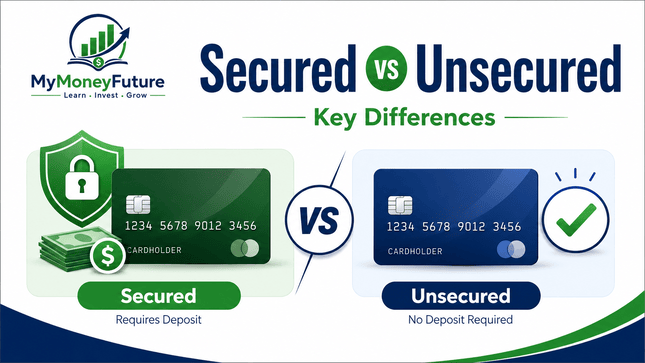
Not all credit cards are the same. Two of the most frequent are unsecured credit cards and secured credit cards.
Both allow you to make purchases, get monthly statements and build a credit history when the issuer reports your account activity. But they do have one significant difference: A secured credit card normally demands a cash deposit that you’ll get back, whereas an unsecured credit card doesn’t.
That variation impacts approval standards, credit limits, upfront expenses, perks, and who each card is best for.
If you don’t have a credit history or have bad credit, a secured card can be a good place to start. Unsecured cards may offer better rewards and higher limits, but they can be harder to qualify for if you don’t have an established credit profile.
In this post we explain how secured and unsecured credit cards work, the basic distinctions between the two, and how to decide which might be best for you.
Short Answer
Secured credit cards demand a refundable security deposit; unsecured credit cards usually do not.
Secured cards can help consumers build or rebuild credit and are frequently easier to apply for. Unsecured cards tend to look more at your credit history, income, debt and overall financial profile.
If the issuer reports account activity and you pay on time, both cards can help you build credit. Which is better depending on your approval alternatives, how much cash you have, card costs and your ability to appropriately manage the loan.
Highlights
| Main Point | Recap |
|---|---|
| Secured cards demand a deposit | The deposit lowers the financial risk for the card issuer. |
| Unsecured cards require no collateral | Approval is usually more dependent on credit history and income. |
| Both can help establish credit | The issuer has to disclose your account activity to credit bureaus. |
| Secured cards can work for credit newbies | They can help build or re-establish credit. |
| Unsecured cards tend to give more benefits | Rewards, higher limits and special offers are available to qualified candidates. |
| The deposit does not settle your debt | Secured cardholders are still need to make their payments regularly. |
| Fees count | Compare annual fees, APRs, maintenance charges and other costs before you apply |
What is a Secured Credit Card?
A secured credit card is a credit card that is backed by a cash deposit.
The deposit protects the card issuer if you don’t pay back the money you borrow. Secured cards may be available to those who can’t qualify for traditional unsecured cards because the issuer is protected financially.
Let’s say you put down a $300 deposit; you may get a $300 line of credit.
The exact link between the deposit and credit limit depends on the card. Some issuers may allow for a limit above or below the deposit but many secured cards use the deposit to determine the initial limit.
A secured credit card is usually a normal credit card with the exception of the deposit:
- You use the card to buy things.
- The issuer will send you a monthly statement.
- Make at least the minimum payment by the due date.
- You may be charged interest if you carry a balance.
- We may submit information about your account to credit bureaus.
A secured credit card is not a prepaid card.
Prepaid cards work by loading money onto the card and spending from that balance. It ‘s called a secured credit card . You borrow against a credit line and get a bill you have to pay .
Unsecured Credit Card Definition
An unsecured credit card doesn’t require a security deposit or other collateral.
Approval is at the discretion of the issuer and may be based on factors including:
- History of credit
- Credit Rating
- Earnings
- Work
- Foreign debt
- Payment history
- Recent credit inquiries
- Overall, repayment ability
The issuer has no deposit and hence assumes higher financial risk. If you have a good credit score , then you typically qualify for better unsecured cards , lower interest rates , bigger limits and more useful benefits .
Unsecured cards come with:
| Feature | Examples |
|---|---|
| Higher credit limits | More credit accessible to suitable applicants |
| Rewards | Cashback, points, travel miles |
| Introductory Offers | Bonus Incentives or Short-term 0% apr windows |
| No annual cost | Common on many competitive cards |
| Purchase safeguards | Fraud protections or extended warranties |
| Travel perks | Rental car insurance, travel credits or airport perks |
| Upgrade options | Receive more valuable cards over time |
Some unsecured cards don’t have great terms.
Some unsecured cards offered to persons with weak credit have hefty annual fees, monthly maintenance costs, application fees, or very high interest rates. Sometimes a low cost secured card is better than a high cost unsecured card because there is no deposit.
Difference between Secured and Unsecured Credit Cards
The big difference is the security deposit but there are other things to consider well.
| Feature | Secured Credit Card | Unsecured Credit Card |
|---|---|---|
| Security deposit | Usually required | No requirement |
| Difficulty of approval | Usually easier | More often reliant on creditworthiness |
| Best for | No, limited or damaged credit | Limited, fair, good or outstanding credit |
| Starting credit limit | Typically based on deposit | Determined by issuer |
| Rewards | Less common, although on some cards | More common |
| Annual fees | Depends on the card | Depends on the card |
| Credit reporting | Depends on issuer | Depends on issuer |
| Build credit | Possible with responsible use | Possible with careful use |
| Deposit refund | Available after closure or graduating in good standing | Not applicable |
| Upgrade potential | Could move to unsecured | Might qualify for better cards later |
| Interest charges | Charged if you carry a balance | Charged if you carry a balance |
Neither card type has a built-in benefit.
A secured card with no annual cost, credit reporting and an easy upgrade path may be more beneficial than an unsecured card with hefty monthly fees. Likewise, an individual who is eligible for a no-annual-fee unsecured rewards card could have no motivation to lock up funds in a secured deposit.
How Does a Secured Credit Card Deposit Work
Usually, you have to put down a security deposit before they’ll open the account.
The issuer holds the money for the duration that the secured card is open.
| Security Deposit | Credit Limit, Possible |
|---|---|
| $200 | $200 |
| $300 | $300 |
| $500 | $500 |
| $1,000 | $1,000 |
These figures are for example only. Actual deposit requirements and credit limitations vary by credit card company.
The Deposit Is Not Monthly Payment
Generally, your security deposit does not cover your purchases.
You put down a deposit of $300, and then charge $100 to the card. When your statement comes in you still owe the $100 debt .
The security deposit of $300 is held by the issuer. If you don’t pay the account and leave an unpaid balance, the company may use some or all of that money.
Can I get my deposit back?
The deposit will be refunded subject to the following conditions:
- You close the account with a zero balance.
- The issuer will upgrade the account to an unsecured card.
- You meet the requirements of the issuer for a refund.
Be sure to read the card agreement thoroughly before you apply. Learn when the deposit can be refunded, how long it takes to get a refund, and if the account is automatically reviewed for an upgrade.
Unless it fits your credit strategy, don’t close the card soon after you receive the deposit refund. Closing an account may limit the overall amount of credit you have available and therefore impact your credit profile.
Which Card Is Easier To Get Approved?
The deposit helps reduce the risk to the issuer, making it easier to qualify for a secured credit card.
When to consider a secured card:
| Situation | How a Secured Card Can Help You |
|---|---|
| You have no credit history | It may help you develop a credit history |
| If you have a low credit score | A deposit can assist your chances of approval |
| You were turned down for unsecured cards | It may be a more realistic starting option |
| Rebuilding after missing payments | Responsible use can produce positive account activity |
| You recently filed bankruptcy | Some secured options may be available after discharge |
| You want a controlled limit | A lower limit may reduce the risk of overspending |
Deposit does not guarantee acceptance.
The issuer can also look at your income, identity, banking history, prior accounts with the issuer, unresolved fraud issues or negative credit information that is serious in nature.
Approval Of Unsecured Card
Unsecured card issuers may consider:
| Factor | Why it’s important |
|---|---|
| Payment history | Indicates if you have paid your past accounts on time |
| Credit utilization | Shows the percentage of your available revolving credit that you use |
| Length of credit history | Tells you how long you’ve been managing credit |
| Income | Assists the issuer to assess the ability to repay |
| Existing debt | Heavy liabilities may restrict free cash flow |
| Recent applications | Multiple applications may imply a higher risk of borrowing |
| Negative records | Collections, defaults or bankruptcies can hinder approval |
You don’t necessary need great credit to qualify for every unsecured card. Student cards, starter cards and some products for fair credit can be available to students, beginners and people with short or imperfect credit histories.
But check the charges carefully. Some unsecured products targeted toward poor-credit consumers can be even more costly than secured cards.
Do Both Types of Cards Build Credit?
To build credit, both secured and unsecured credit cards can help, as long as the card issuer reports your account activity to the nationwide credit bureaus.
The label on the card is less important than what you do with it.
According to the Consumer Financial Protection Bureau, “To build or rebuild credit you need positive payment activity to show up on your credit reports. It also points out that you don’t have to carry a debt to build credit; low balances and timely payments are more helpful behaviors.
Before you apply for a secured card, check which credit bureaus the issuer reports to. Reporting to all three national credit bureaus may help you establish a more complete credit history.
Credit Habits Worth Caring About
| Habit | Why It Is Important |
|---|---|
| Pay all bills on time | Late payments can set back credit improvement greatly |
| Keep balances low | Lower utilization generally minimizes the look of borrowing stress |
| Pay in full when you can | Stops interest and prevents balances from increasing |
| Regularly uses account | Generates reportable account activity |
| Don’t apply for too many | Fewer hard inquiries and new-account activity |
| Review statements | Helps identify errors, fraud or unexpected charges |
| Update contact info | Minimizes risk of missing account notifications |
When used responsibly, a secured card can build a stronger credit history than an unsecured card that is often paid late or kept close to its limit.
What is Credit Utilization?
Your credit utilization is the percentage of your available revolving credit that you have in use right now.
The formula goes:
Credit Utilization = Reported Balance on Credit Card ÷ Credit Limit x 100
Suppose you have a secured card with a $300 limit and a reported balance of $150.
$150 / $300 x 100 = 50% Utilization
Low limit might increase utilization quickly. One trip to the grocery store could eat up a big percentage of the credit available.
There is no one utilization percentage that ensures a specific credit score. Cards that are far from their limits are, as a rule, better than cards that show higher balances.
The frequently quoted 30% guideline is not a threshold at which utilization automatically turns good or bad. It’s best to maintain the balance you report as low as you can while still utilizing the account once in a while.
You can control utilization by:
- making small purchases
- Paying more than once a month
- Paying before the statement is closed
- Staying away from charges around the limit
- Request a limit increase once you have a decent history
- Using numerous cards judiciously once your credit improves
You don’t have to spend a lot of money to create credit. A small recurring expense paid on time may be enough to demonstrate responsible use.
Compare Costs and Fees
Fees may apply to both secured and unsecured credit cards.
Don’t assume a secured card is cheap because you have to put down a deposit. Likewise, don’t assume an unsecured card is a great deal just because there’s no collateral required up front.
Review of fees
| Fee or Cost | What to Look For |
|---|---|
| Annual fee | Fee charged yearly to maintain the account |
| Monthly maintenance fee | Additional recurring charge |
| Application fee | Fee for filing the application |
| Processing fee | Can be charged pre or after approval |
| Late payment fee | Charged when the required payment is missed |
| Returned payment fee | May be applied when a payment is refused |
| Foreign transaction fee | Charged on certain foreign purchases |
| Balance transfer fee | When you move debt to the card, it is charged |
| Cash advance fee | Fee charged for cash withdrawals or similar transactions |
| APR | Interest cost on a balance carried |
| Penalty APR | Higher rate that may be applied following the infraction |
It may not be a negative cost . There may be a time when a deposit is returned . Annual or monthly or processing fees that aren’t refundable are different, because you may never see that money again.
Normally a good starting card should have:
- No yearly fee or reasonable fee
- No monthly maintenance payments that are not needed
- Clear withdrawal requirements
- Reporting to the major credit reporting agencies
- An achievable approach to an unprotected upgrade
- Clear terms for interest and penalties
Benefits of Secured Credit Cards
Simpler Approval
A refundable deposit may make a secured card more accessible to persons with limited or damaged credit.
Ability to Establish Credit
Reported on-time payments might contribute toward positive credit history.
Planned Credit Limit
A relatively low limit may limit the amount of debt a rookie might rack up.
Deposit (Refundable)
Once you close or upgrade the card in good standing you can get the deposit returned.
Potential Upgrade Path
Some issuers periodically assess secured accounts and upgrade responsible cardholders to unsecured products.
Disadvantages of Secured Credit Cards
deposit in advance
You need to fund the account in order to use it. That money could be locked up for months or years.
Don’t use emergency resources for a deposit if it means you won’t be able to afford necessary bills.
Lowered Credit Limits
Low limits can make it hard to manage credit utilization.
Lesser Reward
Some secured cards provide rewards options but they may not be as plentiful.
Costs Could Be Steep
Some cards levy costs on top of the deposit, such as annual, monthly, or application fees.
No Upgrade Promised
Some issuers don’t automatically move secured accounts to a lower rate. You could want to close this card and apply for an unsecured product separately.
Advantages of Unsecured Credit Cards
No Deposit Free Spins
There’s no need to put up cash as collateral.
Higher Potential Limits
Higher credit limits may be available based on creditworthiness and income for qualified applicants.
Additional Bonuses
Unsecured cards often come with cash back, points, miles, welcome bonuses or travel incentives.
Other Product Options
Choices include student cards, starter cards, balance transfer cards, cash-back cards, travel cards and premium products.
Flexibility in the long term
As your credit improves , you may be able to keep the account for years and request upgrades or larger limits.
Disadvantages of Unsecured Credit Cards
More Rigorous Approval
If you have no or bad credit, you may have few options for applying.
Risk of Overspending
It is easier to get into debt if the ceiling is larger.
Expensive Loan
APR can make it expensive to hold a debt on credit cards.
High Cost of Poor-Credit Cards
Some unsecured cards that are promoted to “high risk” applicants include annual fees, monthly fees and other nonrefundable fees.
Rewards Could Lead to Spending
Earning points or cash back is not worth much if it forces you to carry debt and pay interest.
When You Should Get a Secured Credit Card
A protected card might be a better alternative if:
- You have no credit history.
- You have a low credit score.
- You have lately been denied unsecured credit.
- You are recovering from financial difficulties.
- There are no low-cost unsecured solutions.
- You can pay the deposit without dipping into emergency funds.
- The card reports to all three main credit bureaus.
- The prices are quite affordable.
- The issuer has a clear upgrade or refund policy.
Use a prequalification tool, if available, before applying. Prequalification can provide you an idea of how likely you are to be approved without an instant hard credit inquiry, but it doesn’t promise that you will be approved.
When to Get an Unsecured Credit Card
if you: then a secured card could be a good option.
- You qualify for sensible terms with no deposit.
- Your credit is bad, decent, or exceptional.
- You want to keep your financial savings.
- You desire incentives or extra card perks.
- You need to boost your credit limit.
- You can manage spending.
- You’re eligible for a no-annual-fee product.
- You want to keep the account long-term.
Even with no long credit history, a beginning card or student card, which is unsecured, is available for beginners.
But don’t choose an unsecured card just to get out of a deposit if the card imposes large nonrefundable fees. A security deposit, which is refunded eventually, can be less expensive than a few years’ worth of annual and monthly fees.
Common Credit Card Mistakes to Avoid
Believing The Deposit Covers Your Bill
The deposit on a secured card is collateral, not money you’ve prepaid to spend.
You still have to pay for every purchase that shows up on your statement.
How to Build Credit with a Balance
You don’t have to pay interest to build credit.
If your card offers a grace period, you can build a solid payment history and prevent interest charges on purchases by paying the statement balance in full by the due date.
Lost Payments
A late payment can damage the credit history you are trying to build and may cause fees.
Set up automatic payments for at least the minimum. Make an extra payment when you can to pay the whole statement debt.
Maximuming Out Your Credit Limit
A card with a $300 limit can rack up utilization quickly.
Use the card for small, planned expenses, not for the total limit as available income.
Applying for Multiple Cards at the Same Time
Applying for several credit products could lead to multiple hard inquiries and new accounts.
Shop around, consider being prequalified and apply selectively.
No Reporting to Credit Bureaus
If the issuer doesn’t report your account activity, a secured card may have minimal credit-building value.
Be sure to report before paying a deposit.
Choosing a Card That Charges Too Much
Look for products that combine:
- Fees per year
- Monthly service charges
- Application charges
- Transaction fees
- Low credit limits
- High interest rates
The fees can eat up a big chunk of the available credit.
Getting Cash Advances
Cash advances generally start accruing interest immediately, and often come with an extra fee.
They’re usually an expensive way of getting hold of cash.
Gathering the Rewards
If you have debt with a high interest rate, getting 1% or 2% back just doesn’t make sense.
Getting Hooked on Credit-Repair Scams
You can’t legally erase accurate negative material even if it’s hurting your credit. The Federal Trade Commission says credit-repair schemes may ask for a fee upfront to help, persuade individuals to dispute factual information or encourage clients to mislead on credit applications.
Building credit takes good reporting, paying on time, modest debt and time, not some secret shortcut.
How to Compare Credit Cards Before You Apply
Look at the rates and costs with the card, not just the advertising.
| Term | Why It Matters |
|---|---|
| Purchase APR | Reflects the interest rate on balances of purchases outstanding |
| Yearly fee | Defines the recurring yearly expense |
| Cash needed to deposit | Tells you how much cash you need to give up |
| Minimum credit limit | Illustrates your beginning borrowing capacity |
| Deposit refund policy | Explains how and when your money can be refunded |
| Credit bureau reporting | Whether the card can assist create credit |
| Upgrade process | Indicates if the card may be upgraded to unsecured |
| Grace period | Shows whether you can avoid interest by paying in full |
| Penalty Fees | Shows the cost of late or returned payments |
| Rewards | Net of fees and interest |
| Foreign transaction fee | Important for overseas shopping |
| Cash advance terms | Usually pricey, best avoided |
Also, check if the issuer is:
- Free Access to Credit Scores
- Provides automatic payment tools
- Reviews accounts for limit increase
- Has a functional mobile app
- Delivers fraud alerts
- Provides easily accessible client help
- Possible pre-qualifying before applying
Secured vs. Unsecured Credit Cards Example
Consider two imaginary starter cards.
| Feature | Secured Card | Unsecured Starter Card |
|---|---|---|
| Security deposit | $300 | $0 |
| Credit limit | $300 | $1,000 |
| Yearly fee | 0 USD | 0 USD |
| Rewards | None | 1% cashback |
| Approval difficulty | Easy | Moderate |
| Credit reporting | All three agencies | All three agencies |
| Upgrade option | Review after responsible use | Possible future product upgrade |
| Main risk | Deposit remains tied up | Higher limit may encourage overspending |
If you’re not yet qualified for the unsecured product, the secured card might be a better fit.
The unsecured card might be better for someone who qualifies, wants to keep savings, and can responsibly manage the greater amount.
Both are good cards. The result depends on the applicant’s credit history, fees, chances of acceptance and financial tendencies.
How to Use Either Card Wisely
Charge Only Budgeted Expenses
Use the card for expenditures you already planned on making: a minor streaming subscription, fuel purchase or utility bill.
Pay Off the Full Statement Balance
If you pay in whole, you may avoid interest charges and potentially have a good payment history.
Configure Automatic Payments
Automatic minimum payments offer a fundamental safeguard against missing a due date. You can then pay the rest of your statement balance manually.
Watch Statement Closing Date
The balance reported to credit bureaus may be the balance as of statement close, rather than the balance as of the due date.
You might choose to pay off some of the balance early to assist keep the reported use down.
Review Every Statement
Check for:
- Unauthorised purchases
- Unexpected Charges
- Payments made in error
- Renewal of subscriptions
- Interest expenses
- Changes to account conditions
Report any questionable behavior immediately.
Maintain Your Deposit Records
Keep the secured card agreement, deposit receipt, account statements and any correspondence about upgrades or refunds.
Review Your Progress
After six to twelve months of appropriate use, check if:
- You have a better credit profile.
- The issuer will pay you back your deposit.
- You are eligible for an unsecured upgrade.
- There are better no-fee cards available.
- Retain your current card.
Timelines for credit improvement differ. “Responsible use” does not mean a specific improvement in score or endorsement for a different product.
Which Card Should You Pick?
When making a selection consider your present credit position.
| Your situation | Starting possible option |
|---|---|
| No credit history | Secured card or starter unsecured card |
| Bad credit | Secured credit card |
| Recent card application denials | Secured card after reasons review |
| Starter unsecured card | Fair credit |
| Good or exceptional credit | Rewards card (unsecured) |
| Must recover from financial problems | Low-fee secured credit card |
| Want rewards ? | Unsecured card, when you qualify |
| Want to control spending | Secured credit card with low limit |
| No cash for deposit | Unsecured beginning card, if accepted |
| High costs on unsecured choices only | Compare secured cards carefully |
Pick a secured card only if it offers you a safe and reasonable option to build positive credit activity.
If you can get good conditions and manage the account without too much spend, go for an unsecured card.
The point is not to own a secured card forever. “It could be a stepping stone to more robust unsecured products.”
Frequently Asked Questions (FAQs) ?
While secured credit cards require a deposit, unsecured cards do not.
A secured card requires a refundable cash deposit that protects the issuer. An unsecured card does not require collateral and is usually granted based on your credit profile, income, debt and other eligibility criteria.
Is a secured credit card a true credit card?
Yes. It works like a standard credit card for purchases, statements, payments, interest and credit reporting. The only difference is the deposit that is needed.
Are secured credit cards good for building credit?
It can boost your credit if the issuer discloses your account activity to credit bureaus. Pay on time, keep balances low, and avoid taking on debt you don’t need.
Secured credit card vs unsecured card – which is better?
Not necessarily. A unsecured card could provide more perks, but a secured card might be easier to get and cheaper than a high-fee unsecured card if you have bad credit.
Will I get my secured card deposit back?
Depending on the issuer’s rules, you usually get the rest of your deposit back when you close the account in good standing or when you graduate to an unsecured card. The balance due may be withheld.
Could I be refused a secured credit card?
Yes. [END] A deposit does not guarantee acceptance. The issuer may also evaluate income, identity, history of the account, concerns related to fraud or other eligibility reasons.
Are unsecured cards limited to greater limits?
That’s typically the case, especially for those with better credit and greater incomes. Limits, however, vary by issuer and individual applicant.
Beginners: Secured vs. unsecured cards
Beginners with no credit may choose to consider secured cards and unsecured starting cards. Review the approval procedures, fees, reports and upgrade choices before you decide.
Do secured cards have interest?
Yeah. If you carry a balance, a secured card can charge interest. The deposit does not exclude the application of interest.
What is the difference between a secured and an unsecured card?
Some issuers will update after responsible use is shown. The upgrade can mean getting your deposit back while keeping the account open.
Are Secured Credit Cards Safer?
While the lower limitations may limit how much debt a novice might rack up, secured cards should still be used responsibly. Missed payments can result in fees, interest, damage to your credit and loss of deposit.
How does getting a secured card impact credit?
A formal application may trigger a hard credit inquiry. Before applying, see if the issuer offers prequalification.
How Fast Will a Secured Card Build My Credit?
There is no assurance on the timetable or score rise. Improvement is based on your complete credit history, payment behavior, utilization, negative records and other accounts.
What happens to my secured card when I get an unsecured card?
Not always. First, check to see whether the secured card has an annual charge, whether the deposit is refundable via an upgrade and how canceling the account could effect your available credit.
What to look for before applying?
Read about the security deposit, annual fee, monthly fees, APR, credit bureau reporting, credit limit, refund terms, upgrade policy, and penalty charges.
Conclusion
Both secured and unsecured credit cards can be handy, but they’re meant for various financial situations.
For those who are new to credit, seeking to repair a damaged past, or having trouble being approved for affordable unsecured options, a secured credit card is frequently a good solution. The security deposit reduces the risk for the issuer and may boost the prospects for approval.
When you can qualify for decent conditions without having to put down a deposit, a non-secured credit card is usually best. It may provide higher limits and rewards, promotional financing, and more long-term flexibility.
The most essential thing is not whether the card is secured or not. It’s the way you handle the account.
Always make payments on time, keep balances low, avoid unnecessary interest, pay attention to the fees, and never treat a credit limit as extra income.
A credit card should assist you build a better financial history – not build up debt that makes your financial life tougher.
Educational Disclaimer
This post is for educational and informational reasons only and is not intended to be financial, legal, credit, tax or investment advice. The prerequisites to get approved for a credit card, along with deposits, fees, limitations, interest rates, reporting methods and consequences on your credit score, will vary depending on the issuer and your unique financial circumstances. Always read the terms of the card agreement carefully and seek the advice of a certified financial adviser before making any major credit decisions.
