
Introduction
Bitcoin can look thrilling yet complicated. It is discussed as digital money, long term investment, speculative asset and technology experiment. The first hurdle for a newcomer is not to buy Bitcoin. The first problem is how to buy it safely.
Safe Bitcoin buying begins before you hit the buy button. You need to recognize the hazards, find a trustworthy site, secure your account, decide how much you want to invest, and know where your Bitcoin will be held.
Bitcoin prices are volatile. It should never be seen by a newbie as a sure source of income, savings account or a shortcut to riches. It may be included in some portfolios but it is still volatile and dangerous.
This manual will walk you via the process of buying Bitcoin safely, step-by-step. You will learn how to prepare, how exchanges function, how wallets work, what fees to watch, and what beginning mistakes can be expensive.
QuickAnswer
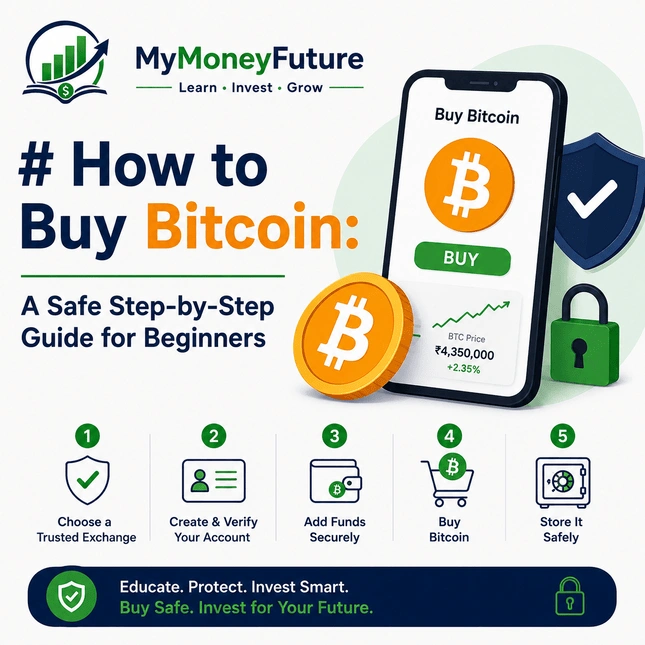
To buy Bitcoin safely, learn the risks, choose a reputable crypto exchange, secure your account with strong passwords and two-factor authentication, deposit only money you can afford to lose, place a small first order, and decide whether to keep Bitcoin on the exchange or move it to a secure wallet.
Main messages
| Main Point | Abstract |
| Bitcoin Is Risky | Prices can change fast up or down, do not invest money that you need for debts or crises. |
| Pick your platform wisely | Select a reputed exchange with clear fees, security controls and transparent policies. |
| Start small. | Your initial purchase should be small enough that a mistake won’t affect your budget. |
| Protect Your Account | Strong passwords. Two-factor authentication. Awareness of scams. |
| Storage is Key | It’s easier to leave bitcoin on an exchange, but a wallet puts you in charge and gives you more responsibility. |
What is Bitcoin and what it is not
Bitcoin is a digital currency that may be transferred across a peer-to-peer network. It is not issued by a central bank and it doesn’t act like a typical bank account.
People acquire Bitcoin for several reasons. Some consider it a speculative investment for the long run. Some for transfers. Some are interested in technology. Some buy because they fear missing out and that is not a good financial plan.
There is no promise that you will make money investing in bitcoin. It is not covered in the same way as insured bank savings. It is not without danger and can lose value quickly.
A good approach to think about Bitcoin is it is a high-risk asset and it should be treated with prudence. If you’re still working on creating an emergency fund, paying off high-interest debt, or struggling to pay the bills, Bitcoin should almost always wait.
SEC’s Investor.gov addresses key custody questions for crypto investors, such as ways to hold crypto assets and questions investors should ask before selecting a storage option. Before choosing a location for Bitcoin, have a look at the SEC Investor.gov crypto custody recommendations.
1. Find out if Bitcoin is right for your money
Before you buy Bitcoin look at your foundation of money.
Let’s not prioritize Bitcoin over rent, groceries, insurance, emergency savings or high-interest loan payments. It should not be acquired with borrowed money.
Ask yourself the following questions:
| Question: | Why it’s important |
| Emergency fund? | You don’t want to be forced to sell Bitcoin at a loss to cover some unanticipated expense. |
| Do you have high-interest debt? | Maybe it is best to pay off expensive debt first. |
| Can I afford to lose that money? | Bitcoin can go down quite fast and remain down for long durations. |
| Do I know how I’ll stash it? | Storage Errors Sometimes Result in Permanent Losses |
| Is it research or hype driving my purchase? | Hype-induced buying typically leads to bad timing. |
A rule for beginners is to start extremely tiny. Your first Bitcoin should be a learning experience, not a financial risk.
For example, a person may choose to start out with $25, $50 or $100 rather than moving a significant sum all at once. The purpose is to see how buying, fees, account security and storage function.
Step 2: Select a Trusted Crypto Exchange
Most newcomers buy bitcoin via a crypto exchange or brokerage website.
A crypto exchange is a marketplace where users can purchase, sell and sometimes store digital assets. Some platforms are easy and friendly to beginners. Others are for active traders, and might feel more involved.
When picking an exchange, go beyond app design. Investigate the platform’s reputation, fees, security restrictions, withdrawal methods, supported countries and customer support.
Utilize this checklist:
| Article | What to Check |
| Available | Is the platform legally available in your nation / state? |
| Price | What are the trading, deposit, withdrawal and spread fees? |
| Safety | Does it have withdrawal controls and 2FA? |
| Transparency | Are the costs and policies easy to understand? |
| Options for Withdrawal | If you want, may you transfer Bitcoin to your own wallet? |
| Help Desk | What if my account is locked or delayed? |
| Reputation. | Any big unsolved complaints, cyberattacks, or regulatory issues? |
Don’t choose a platform because an influencer told you to. Paid promotions may not be for you.
A good platform should include transparent fees, risk disclosures and account restrictions. If the site guarantees you profits or tells you to deposit immediately, consider that a red flag.
Step 3: Sign Up and Protect Your Account
Once you’ve selected a platform, you’ll need to make an account.
Most reputable exchangers ask you to verify your identity. This may include your name, date of birth, address, official ID and sometimes a selfie or proof of address.
It’s a frustrating process, but routine in regulated financial systems.
Once you establish your account, security is your responsibility.
This is how to do it:
| Security Step | Why It’s Important |
| Generate a new password | A repeated password can compromise your account if another site is breached. |
| Enable two-factor authentication | Provides additional security beyond your password. |
| Use an authenticator app if you can | SMS codes are not as secure as app codes. |
| Set withdrawal allowlists (if available) | Limits on where the monies can be sent. |
| Beware of fraudulent emails | Phishing can steal your login credentials. |
| – Do not send codes. | A reputable support agent will never ask for your 2fa code. |
A good password manager can help you create and save unique passwords.
Don’t save your exchange login, password, and recovery codes together. Your Bitcoin may be gone, once they get access to all of them.
Step 4: Deposit Money Wisely
Once your account is approved, you can fund your account.
Funding options commonly include bank transfer, wire transfer or other local payment methods, debit card. Processing timeframes and fees vary.
Bank transfers are usually cheaper but can take longer. Card purchases can be speedier but may be more expensive.
Shop around before you deposit:
| Method of Funding | Possible Benefit | Potential Pitfall |
| wire transfer | Often cheaper fees | Could take a bit longer |
| Credit card | Easy and quick | Charges may be higher |
| Wire transfer | Use for bigger quantities | Potential fees and delays |
| Payment apps | If supported, convenient | Additional fees or restrictions may apply. |
For your initial purchase, deposit a little amount. This way you may test the whole process without risking too much money.
Never invest money in a platform simply because someone on the internet advises you to. Scammers will set up bogus investments and encourage individuals to submit money rapidly.
Step 5: Make Your First Bitcoin Order
Once your account is funded you can purchase Bitcoin.
Most platforms provide an easy buy screen. You enter the amount you wish to spend, see the anticipated quantity of Bitcoin, evaluate the costs and confirm.
Look for before you confirm:
| Item 1 | Why it is important |
| Purchase quantity | Make sure the quantity is accurate. |
| Cost. | Trading fees and spreads might take a bite out of your buy. |
| Price quotation | Crypto prices are volatile. |
| Type of order | Market orders purchase at the current price. |
| Overall cost | Make sure you check the total before you confirm. |
Beginners frequently utilize market orders since they are easy. A market order buys at the current available price, although the ultimate price may shift a little while the order is executing.
With a limit order, you are able to determine the price you want to spend. It provides you more control but you may not fill if the market doesn’t get to your price.
For your initial buy, make it simple and small.
Step 6: Find Out Where Your Bitcoin Is Kept
When you buy Bitcoin you have to know where it is stored.
You can leave it on the exchange and the platform will manage the storage system. That’s convenient, but you’re trusting the exchange’s security and policies.
If you withdraw Bitcoin to a personal wallet, you have the private keys or recovery phrase. This allows more control but errors are irreversible.
Here’s the main difference:
| Choice of storage | Core strength | The main risk |
| Transfer of custody | Beginner Friendly | Platform risk, account risk, withdrawal limitations |
| Software Wallets | More control | Device security and accountability for the recovery phrase |
| Hardware wallets | More robust offline storage | Cost Setup mistakes Lost recovery phrase |
The recovery sentence is highly crucial. Anyone who has it can access your bitcoin. Lose it and access could be lost forever.
Never take screenshots of your recovery phrase. Don’t keep it in your email. Do not forward to any one.
For the tiny starting sums, the exchange custody could be simpler. For greater holdings, it’s more necessary to learn wallet security.
Step 7. Beware of Scams — Before and After You Buy
Scammers are drawn to Bitcoin because transactions can be difficult to reverse.
Beware of anyone promising returns , requesting you to contribute crypto in exchange for a bonus , claiming to be a government agency , or urging you to act immediately .
The FTC says crypto scammers generally take the form of surprise communications, phony investment opportunities, and requests for crypto payments. Read FTC cryptocurrency scam warnings before you reply to anyone asking you to pay or invest in crypto.
Some common symptoms of scams are:
| Warning Signal | Why It’s Dangerous |
| Profit insurance | Real investments are not always going to pay off. |
| Have to act fast | Scammers don’t want you to think. |
| Crypto payment requests | Crypto transfers are hard to reverse. |
| Fake endorsements by celebrities | Images and videos can be edited. |
| Pressure to be friends or lovers | A lot of emotional manipulation. |
| Recovery service promises. | Some scammers hit victims twice. |
If you get a random call concerning Bitcoin, take a step back.
Google the company name + words like scam, complaint, review and warning. Don’t click on links in communications; check websites yourself.
How much Bitcoin should I buy as a beginner?
There is no “right” quantity.
A newbie should start with a sum that will not impact rent, food, savings, debt payments or mental tranquility if it loses value.
For a lot of folks that means a very tiny initial investment.
Use this decision tool:
| Financial Condition | Bitcoin Methods |
| No emergency savings | First, build up a cash reserve. |
| High-interest borrowing | Pay down debt before buying crypto. |
| Balanced budget, tiny savings | If you really want to invest, start very small. |
| High savings and minimal debt | A restricted allocation, assuming it meets your risk tolerance. |
| Concerned about volatility | Keep exposure modest, or avoid it. |
There’s no room for bitcoin in a beginner’s portfolio.
If you include it, view it as a high risk satellite position, not the core of your financial plan.
Bitcoin Purchase Fees You Should Know
There are fees that can make a modest purchase cost more than you expect.
Crypto platforms may charge differently.
| Type of Fee | Meaning |
| Transaction fee | A charge for purchase or sale. |
| Distribution | Difference between the bid and ask price quoted. |
| Deposit fee | A charge for funding the account. |
| Fee for withdrawal | A fee to pay out or transfer Bitcoin. |
| Network Cost | Blockchain transaction fee |
| Card charge | Additional charge for debit or credit card purchases. |
Always review the final transaction preview.
Wide spreads are not uncommon on a platform, even with a simple UI. Low trading fee doesn’t always equal low total cost.
Taxes Matter
In many countries, selling Bitcoin, converting it into another crypto asset or using it to purchase something can trigger a taxable event.
Tax laws differ from country to country so keep records.
Save:
| Log | The reason you need it |
| Date of purchase | Required for calculation of holding period. |
| Total purchase | Helps to identify cost basis. |
| Costs | Could influence gain or loss estimates. |
| Date of sale | Required for tax reporting. |
| Selling price. | Computes the taxable gain or loss. |
| wallet to wallet transfers | Helps trace where assets went. |
Don’t wait until tax time to recreate your history.
Export reports from your exchange. Keep backups.
Beginner Mistakes (Common)
Buying motivated by rising prices
Many newcomers buy after reading headlines or hype on social media.
That can cause buying near short-term highs.
A better way is to set your risk limit beforehand and avoid emotional decisions.
Have to Invest Money Soon
Bitcoin can drop fast.
You should not use Bitcoin to pay your rent, education, taxes, medical bills or emergencies.
Deposit short term money in safer places.
Account security ignored
A weak password or no two-factor authentication can make your account easier to hack.
Crypto security is not an option.
Sending Bitcoin to the Wrong Address
Crypto transfers are irreversible.
Always check the wallet addresses. For larger transfers, try sending a tiny test amount.
Trust of Influencer
An influencer can be compensated, prejudiced or misguided.
Do your own homework. Don’t buy something just because someone on the internet sounds assured.
Forgetting Charges
Fees can eat into returns, especially on little goods.
Check entire costs before you confirm any order.
No Exit Strategy
Decide in advance why you will buy, hold or stop buying.
Without a plan, emotions can get away from you.
Buying Bitcoin – Pros and Cons
| Benefits | Cons |
| Small quantities available to buy | Very volatile |
| Accessible on various platforms | Big risk of scams |
| Can be self-custodied | Wallet Errors Can Be Permanent |
| Could add variety to a tiny portion of a portfolio | Not a safe bet |
| The world market that never sleeps | Taxes and books can be tricky |
Bitcoin could appeal to long-term investors who understand volatility. It is not for those who require stability, guarantyd income or safe savings.
Beginners Safety Check List
Here’s a list to check before you buy:
| Step | Finished? |
| I understand that Bitcoin can lose value soon. | |
| I always pay the important bills first. | |
| I don’t owe anybody anything. | |
| I checked out the exchange. | |
| I looked at fees before buying. | |
| I enabled two-factor authentication. | |
| I know where my Bitcoin will be kept. | |
| I know the basic warning flags of a fraud. | |
| I will maintain tax records . | |
| I’m starting with a little bit of it. |
If you don’t click most of these boxes, wait.
No need to jump into bitcoin right away.
FAQ Section
Q: What is the safest way to buy Bitcoin as a beginner?
A: For a newbie, the safest way to begin is to utilize a respected exchange, secure your account, start with a little amount, check the costs and avoid anyone promising guarantyd gains. Before you start decide if you are going to leave your Bitcoin on the exchange or move it to a wallet.
Q: Can I purchase a little quantity of Bitcoin?
Q: Yes. You are not required to acquire a complete bitcoin. Many sites allow for minor purchases, which can be preferable for novices who are still learning.
Q: Should I keep Bitcoin on an exchange or a wallet?
A: Bitcoin is easier to hold on an exchange, but it is contingent upon the exchange. A personal wallet offers additional control but calls for careful management of private keys or recovery phrases.
Q: Is Bitcoin secure?
A: Bitcoin is a high risk asset. There are huge price fluctuations, platform hazards and scams abound. Safety is a matter of how much you buy, where you buy it and how you store it.
Q: Can I lose all my money on Bitcoin?
A: Yes, you can lose a substantial percentage of your money if the price decreases or if you make a storage or scam related mistake. Never risk money that you cannot afford to lose.
Q: Do I need a crypto wallet before purchasing Bitcoin?
Q: All the time? Many newcomers start by buying on an exchange. But if you want to save larger sums, you must understand about wallet security.
Q: What fees should I look for when buying Bitcoin?
A: Look at trading fees, spreads, deposit and withdrawal fees, network fees and card payment fees. At the end of the transaction preview the entire cost should be shown.
Q: Is Bitcoin better than stocks?
A: Not all the time. Bitcoin and stocks are distinct risk. Stocks are shares of ownership in enterprises, while Bitcoin is a volatile digital asset. Many novices should have a solid financial basis before even exploring crypto.
Q: Should you buy Bitcoin using a credit card?
Q: You shouldn’t buy Bitcoin with borrowed money. Credit card purchases may incur excessive fees, interest, or cash advance treatment. Use existing funds and that you can afford to lose.
Q: How do I avoid Bitcoin scams?
A: Avoid guarantyd returns, unsolicited messages, bogus support agents, romance investment solicitations, celebrity promotions and anyone asking for payment in crypto. Use official websites and check all the information twice before you pay any money.
Summary
Purchase Bitcoin. In a safe way. Have patience.
Don’t lead with hype. Start with your own money, your risk tolerance and a clear grasp of how the purchase works.
Choose a trusted platform. Secure your account. Start with little amounts. Look at prices. Understand how storage works before sending greater amounts.
Bitcoin may be a part of certain long-term portfolios, but it’s not a guarantyd way to get rich. It’s volatile, it’s risky. If you hurry it, you can easily mess it up.
The safest starter strategy is simple: cover your essentials first, then buy only what you can afford to lose and don’t let excitement override judgment.
Educational Disclaimer
This page is for educational and informational purposes only. This is not financial, investing, tax, legal or crypto trading advice. Bitcoin and other crypto assets can be very volatile and dangerous. Laws, taxation, platform availability and investor safeguards differ from country to country. Before making any major investing decisions, you might want to speak with a competent financial advisor.
