Short answer
Credit card interest is typically computed using your APR, converted to a daily periodic rate, multiplied by your daily balance and added together for the billing cycle. Frequently, by paying your bill balance in whole on the due date, and avoiding cash advances and balance carrying, you can steer clear of purchase interest.
Key Messages
| Important Point | What It Means |
| APR is per year | Your card will show a yearly rate, but you can be charged interest everyday. |
| Importance of daily periodic rate | APR is then divided by days in a year to get daily interest. |
| Common is average daily balance | A lot of issuers compute interest using daily balances throughout the cycle. |
| Grace periods are useful | Pay the statement balance in full to avoid purchase interest. |
| Cash advances cost money | Often they begin earning interest right away. |
Introduction
Credit card interest can be complicated because it isn’t always obvious straight away. Today you swipe the card, you get a statement later, and you may not see interest until after the due date has passed.
That lag is why folks understate the cost of carrying a balance. A high APR credit card can make everyday purchases an expensive kind of debt if you don’t pay the balance in full.
The good news is, the basic math is accessible. Most credit card interest estimates are based on the APR, daily rates, balances, billing cycles, and grace periods.
Understanding how interest is calculated on a credit card will help you make better decisions about when and how much to pay, what balances to avoid carrying, and how to lower interest charges if you already have debt.
Understanding Credit Card APR
APR = annual percentage rate. It tells you how much it costs to borrow money on your credit card per year, as a percentage.
A card can have various APRs for different transaction types. Different rates may apply to purchases, balance transfers, cash advances and penalty balances.
For instance, a card might read:
| Type of Balance | Possible APRs |
| Purchase | 22% |
| Transfers of balance | 20% |
| Cash advances | 29% |
| Penalty interest rate | Up to a higher rate of penalty |
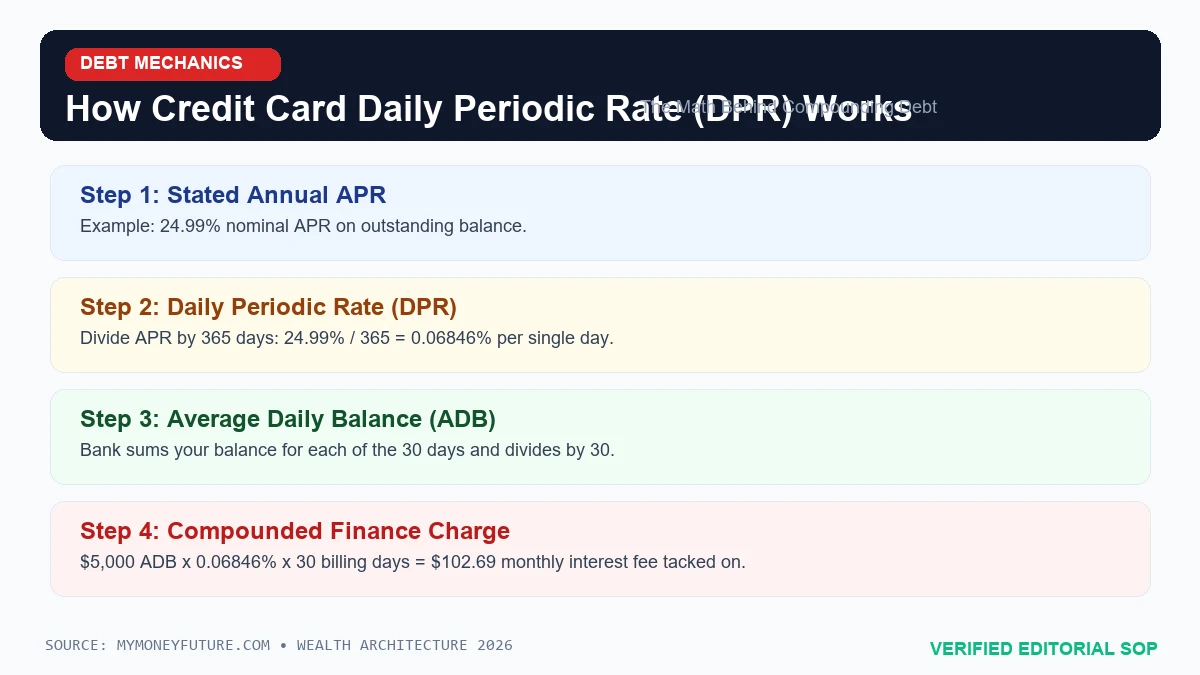
APR is annual although credit card interest is typically computed daily. That means the issuer can convert the APR into a daily rate before computing interest.
The greater the APR is and the longer you carry a load, the more expensive the debt is.
How Credit Card Interest Is Normally Calculated
The average daily balance approach is used by many issuers. It seems complicated, but the premise is very simple.
First, the issuer monitors your balance on a daily basis during the payment cycle. It then averages those amounts for the day. It then applies the daily periodic rate and the number of days in the cycle.
The Consumer Financial Protection Bureau says many card issuers compute interest on a daily basis using the average daily balance technique. The CFPB offers a consumer-friendly breakdown of how credit card interest is calculated.
One simplified formula is:
Interest charge = average daily balance x daily periodic rate x number of days in billing cycle
That’s why it’s good to pay early. If interest is charged everyday, paying down the sum sooner will reduce the amount of dollars that interest is being charged on.
Understanding Daily Periodic Rate
The daily periodic rate is the APR divided by the number of days in the year.
A basic approximation for it is
Daily Periodic Rate = APR / 365
For example, if your purchase APR is 24%, the daily rate is around .0658%.
| APR. | Estimated Daily Rate* |
| 18% | 0.0493% |
| 22% | 0.0603% |
| 24% | 0.0658% |
| 29% | 0.0795% |
The CFPB also notes that a daily periodic rate is used to compound the amount that you owe at the end of each day, which is why it is important to track daily balance fluctuations.
That percentage per day may not seem like much, but on a huge balance it adds up fast. That’s especially true when you include compound interest and additional purchases.
Average Daily Balance For Example
Let’s say you start your billing cycle with a $1,000 amount. Your billing period is 30 days and your APR is 24%.
Let’s say you keep the balance at $1,000 all month to keep it simple.
| Step | Calculation | Result Month |
| Annual rate: 24% | 24% | 24% |
| Rate per day | 24% / 365 | ~0.0658% |
| Daily average balance | Balance is $1,000 | $1,000 |
| Interest | $1,000 x 0.000658 x 30 | Approx. $19.74 |
In this simplified example, the interest charge is approximately $19.74 for the month.
Now suppose the balance was $5,000 instead of $1,000. Assuming all else is equal, the interest expense is around five times greater.
This is why it is so hard to pay off high debt. Even if you are paying, some of your money can still go to interest before the principal goes down.
Why the Minimum Payment Can Cost You
The minimum payment is to maintain the account up to date. They’re not meant to help you get out of debt fast.
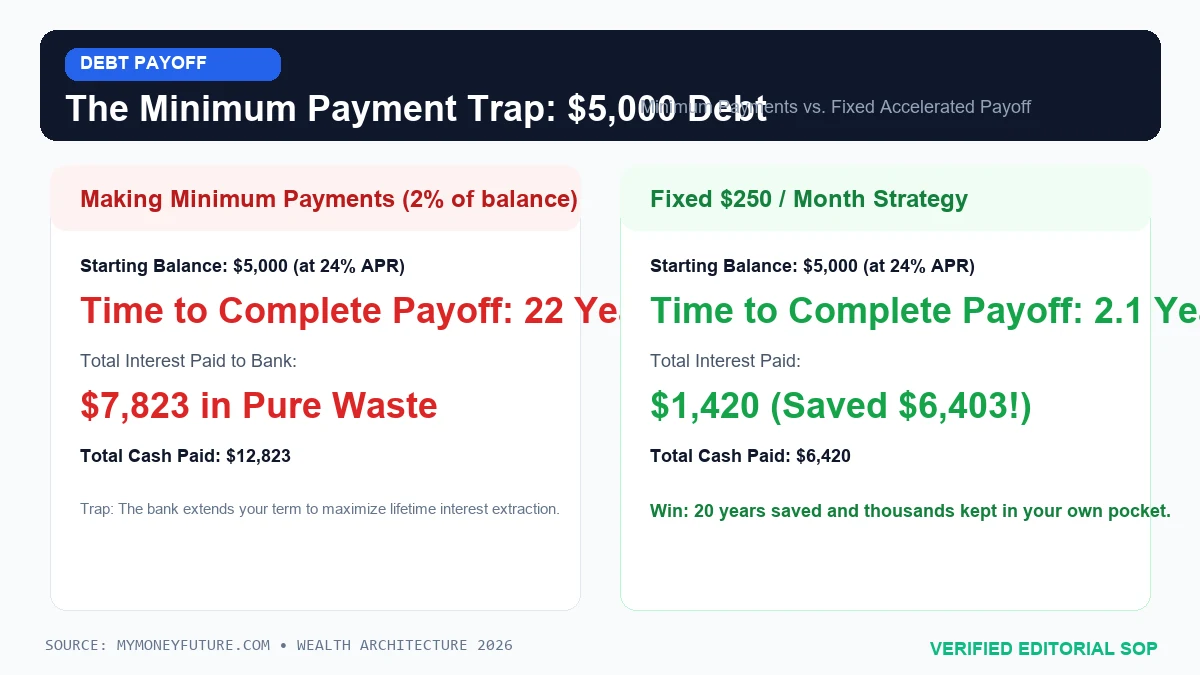
If you hold a balance at a high APR and merely make minimum payments it could take years to pay it off. A considerable portion of each payment can be applied to interest.
If your minimum payment is $ 100 and $ 70 is interest , then just $ 30 is paying down the balance . That can make development painfully slow.
One of the best strategies to cut credit card interest is to pay more than the minimum. Even little extra payments can knock time off the payback.
About the Grace Period
Grace period is the interval between the conclusion of your billing cycle and your payment due date. As long as you pay your account balance in full by the due date, you typically won’t pay interest on purchases.
The grace period is a big deal since it enables you use a credit card without paying purchase interest if you pay in whole and on time.
But grace periods can be lost if you carry a balance. And if you roll debt from month to month, fresh purchases can start accruing interest sooner, depending on your card terms.
They normally don’t have the same grace period for cash advances. Often they begin accruing interest immediately, and surcharge fees may also apply.
How to Stop Paying Credit Card Interest
The easiest approach to avoid purchase interest is to pay your entire statement balance by the due date each month.
Here are some helpful habits to develop:
- Pay only what you can afford right now.
- Pay off the entire bill balance, not just the minimum.
- Create automatic payments or reminders.
- If your balance is going up, make additional payments before the due date.
- Cash advances are to be avoided unless a serious necessity.
- Don’t treat your credit limit like it’s extra revenue!
- Keep a little emergency reserve so that any unexpected expenses don’t become card debt.
But if you already have a balance, you might not be able to avoid interest right away. But you can minimize it by making more frequent payments, avoiding new charges, and paying off the sum with the highest APR first.
Credit Card Daily Interest & True Payoff Calculator
Calculate Daily Compounding Fees & Accelerated Payoff
Understand how banks calculate the Daily Periodic Rate (DPR) and see how fixed payments destroy bank interest.
Application of Payments
Credit card payments are not always applied the way people think they are.
Generally, card issuers are required to apply payments over the minimum to accounts with higher APRs before they are applied to lower-APR balances, however the card agreement may specify a different allocation for the minimum payment.
That makes a difference when you’ve got purchases, balance transfers and cash advances on the same card.
If you have a promotional balance transfer and a high rate purchase balance, examine your statement carefully. The criteria for how the payments are allocated may impact how rapidly expensive balances fall.
Balance Transfers. Helpful, but Not Free
A balance transfer moves debt from one card to another, frequently with a brief low or 0% APR offer.
This can cut down interest if you pay the balance during the promotional period. Fees may apply to balance transfers and the APR may increase after the promotional period ends.
| Question | Why this matters |
| What is the transfer charge? | If you have a significant debt, a fee of 3% to 5% can be costly. |
| What is the duration of the promo period? | You need a payment plan before it’s over. |
| What is the APR on a regular basis? | The rate can be high following promotion. |
| Can we do without new purchases? | Payoff can be harder with new spending. |
Balance transfers are a tool, not a magic bullet. It works best if you have a monthly payout goal.
Common errors
One mistake is to make use of the card and pay the minimum. That continues the debt cycle.
Another mistake is to imagine that the bank calculates interest only once a month. In many circumstances, timing is important and it is determined from daily balances.
Some think a 0% deal means nothing costs anything. But fees, end dates and penalty rules still matter.
Another common pitfall is the cash advance. They can have higher APRs, more fees and no grace period.
The last error is to disregard the statement. Your statement displays APRs, balances, minimum payment alerts, due dates and interest costs. “If you read it, it will help you make better decisions.”
Expert Advice
If you have a balance, pay before the due date. Earlier payments will lower the daily balance used to calculate interest.
Set up automatic minimum payments to prevent late fines, then make extra manual payments on the balance.
Begin with the highest APR first. If one card charges 29% and another 18%, then the 29% balance is usually the more pressing one.
Pay down debt and stop new charges. Otherwise payments might just free up additional spending.
Try to lower interest using a personal loan or a balance transfer, but check fees and terms beforehand.
Create a tiny emergency fund. Without cash savings, one unforeseen bill might start the credit card cycle all over again.
Action Plan for Beginners
Look at your most recent credit card statement to begin. Find the APR, statement balance, minimum payment, due date and interest charge. These numbers will tell you if the card is being used as a payment instrument or as pricey debt.
Then, turn auto-minimum payments on so you don’t get charged late fees. Then make a second manual payment for whatever more you can afford. Paying earlier in the cycle can minimize the daily sum on which interest is calculated, if you carry a balance.
If you have numerous cards, rank them from the highest APR to the lowest APR. Pay minimums on all your cards, then throw additional cash at the one with the highest interest rate. That’s usually the fastest approach to cut interest costs.
Finally, cease using the card for new purchases until you get the amount under control. If you continue to use the card while paying it down, you can lose progress. If it helps break the cycle, use cash or debit for a while.
Real world situation
Nina has $3,500 on a card with a 26 percent APR. Her minimum payment is $110, but a big portion of it still goes to interest. She’s annoyed that the balance doesn’t seem to move at all.
She checks her budget and manages to find $180 a month by cutting subscriptions, eating out less and altering her phone plan. As soon as she gets paid, she makes the automated minimum payment and then adds the extra $180.
She also stops using the card to make new purchases. In a few months, interest consumes a smaller part of each payment, thus the debt begins to reduce more rapidly.
The lesson is simple: Credit card interest is the cost of speed. The sooner you start knocking down the balance and the less you add new charges, the less money goes to the card company and the more goes toward becoming debt free.
What to Do if You Already Have Interest
The initial aim is to prevent the balance from rising any further if interest has already started. So, no new charges until it’s really essential. The payoff plan gets complicated when you keep using the card and paying it down at the same time.
The second purpose is to minimize the balance as soon as possible. You don’t have to wait until the due date to make progress as interest can be calculated on daily balances. If you pay more du
ring the cycle it can help you pay off the loan sooner.The third purpose is to cut the rate if the APR you are currently paying is too high. You might want to ask your issuer for a reduced APR, compare a balance transfer or look into a fixed-rate personal loan. You might also go to a nonprofit credit counselor. Each alternative has fees and rules, so study the arithmetic before you move debt.
The end goal is to get the habit of paying in full back.” If the balance is zero, then the statement balance is the amount you need to pay each month. That habit turns the card back into a tool of convenience, not a source of debt.
FAQ Section
Q: How is credit card interest calculated?
A. The average daily balance method is used by several issuers. They transform the APR to a daily periodic rate, apply it to daily balances and add the daily interest for the billing cycle.
Q. What is APR?
A. The APR is the annual percentage rate. The yearly cost of borrowing is shown, but credit card interest can compound everyday.
Q: How do I prevent interest on my credit cards?
A: Pay your statement balance in full by the due date, and avoid transactions like cash advances that may start accruing interest immediately.
Q. Is it okay to just pay the minimum?
A: It keeps your account current, but it might make debt last a lot longer and cost more in interest.
Q: Does interest begin right after a purchase?
A: Usually not, if you pay the full statement balance by the due date and have a grace period. If you have a balance, new purchases may be treated differently.
Q. What is the periodic rate?
A. That’s your APR on a daily basis. It is normally used to Calculate Interest on the sum due each day.
Q: Why was I charged interest after making a payment?
A: It might be because you had a balance, a late payment, a lost grace period or interest from the last cycle that carried over.
Q: Are cash advances more costly?
A: Yes, often. Cash advances typically offer higher APRs, fees and no grace period.
Conclusion
Once you have a handle on the moving aspects of credit card interest — APR, daily periodic rate, average daily balance, payment cycle and grace period — you’ll find it easier to manage.
The simplest strategy to prevent purchase interest is to pay the full statement balance by the due date. If you already have debt, pay more than the minimum, stop adding to it, and pay down the highest APR sums first.
Credit cards can be handy tools, but they can also become pricey debt with interest. Understanding the process offers you greater control over what you have to pay and how fast you can get back to zero.
Note of Education
This page is for educational and informative purposes only. It does not provide financial, legal, tax, or credit advice. The terms of a credit card depend on the issuer and the account agreement. We encourage you to review your cardholder agreement. You may also want to consult with a skilled financial advisor or credit counselor before to making big debt decisions.
Debt Snowball & Avalanche Payoff Calculator
Discover how much interest you save and calculate your exact debt-free date.
Calculate Debt Payoff Savings →Frequently Asked Questions (FAQ)
Crush Debt & Save on Interest Charges
Compare the Debt Snowball vs. Avalanche strategies and see your exact debt-free date with our interactive tool: