
At first blush, house flipping sounds straightforward buy a house, fix it up, and sell it for more than you paid, pocketing the difference. In actual life it is considerably harder.
To flip successfully, acquire below market value, estimate repairs, manage contractors, control holding costs, know your local buyers and sell before costs devour the margin.
Newcomers often lose money by overpaying, underpricing repairs, skipping permits, or believing TV timelines. A house isn’t profitable because it’s nice looking. The numbers worked before you acquired it . It becomes profitable .
This tutorial covers how house flipping works, how to calculate profit, what beginners should look for, and how to avoid common blunders that can turn a promising bargain into an expensive lesson.
- Quick Overview: Can Beginners Flip Houses for Profit?
- Key Takeaways & Core Real Estate Rules
- What Does House Flipping Actually Mean?
- The 70% House Flipping Rule & Profit Formula
- 🧮 Interactive 70% House Flipping Profit & MAO Calculator
- Essential House Flipping Terminology (ARV, MAO, Comps)
- Step 1: Analyzing Your Local Real Estate Market
- Step 2: Drafting a Bulletproof Business Plan & Budget
- Step 3: Finding Off-Market and MLS Distress Deals
- Step 4: Accurately Estimating Renovation Costs
- Step 5: Establishing Your Maximum Allowable Offer (MAO)
- Step 6: Financing the Flip (Hard Money vs. Private Lending)
- Step 7: Managing Contractors & High-ROI Renovations
- Step 8: Staging, Marketing, and Closing the Sale
- Common Rookie Mistakes That Destroy Profit
- Frequently Asked Questions About House Flipping
Quick Reply
To flip properties for a profit, you must buy below market value, accurately estimate repair expenses, assess the after-repair worth, factor in financing and holding costs, manage the rehabilitation process, and sell at a price that provides a reasonable margin. The beginner should stick to cautious numbers, strong inspections, and avoid transactions that only work in the best-case situation.
Key Points
| Important Point | What It Signifies |
| Profit Begins at The Purchase | You acquire it at the correct price and usually you do a successful flip. |
| ARV problems | After repair value is the resale value estimated after repairs are made. |
| Repair estimates need to be reasonable | Underestimating the rehab cost is one of the fastest ways to lose money. |
| Profit is reduced by holding costs | That includes taxes, insurance, utilities, loan interest and delays. |
| House flipping is a business | Every project must be treated with budgets, timetables, contracts and risk controls. |
What Does House Flipping Mean?
House flipping is a real estate strategy in which an investor purchases a house with the intention of reselling it for a profit, usually after making repairs or renovations.
There are some cosmetic flips. This could include paint, flooring, fixtures, landscaping and simple renovations. Others are comprehensive rehabs including kitchens, bathrooms, roofing, electrical, plumbing, structural repairs or substantial plan changes.
The idea is to produce value. You purchase a home that is outdated, distressed, poorly advertised or mispriced. Then you upgrade it or you reposition it so a retail buyer will pay more for it.
The trouble is that every phase of this process costs money. In the end, you could be buying, financing, fixing, holding, insuring, selling and paying taxes on something that subtracts from your bottom line.
Profit Formula for House Flipping
One simple house flipping formula is:
| Item | Example sum(s) |
| Projected sales price after repairs | $300,000 |
| Purchase price | -$200,000 |
| Repair & Renovation Expenses | -$45,000 |
| Costs of financing and holding | -$15,000 |
| Selling costs and commissions | -$24,000 |
| Estimated profit before tax | $16,000 |
At first glance the spread between $200,000 and $300,000 seems huge. But after expenditures of repair, storing and selling, the profit is substantially less.
That’s why rookie flippers need conservative math. A deal that looks profitable before you factor in costs may not be viable once you factor in real costs.
Important House Flipping Terminology
| Term | significance |
| ARV | After-repair value. What the property may sell for after refurbishment. |
| Purchase price | What was paid for the property. |
| Rehab budget. | Approximate cost of repair and refurbishment. |
| Carrying costs | Expenses on property during ownership prior to selling. |
| Closing costs | Costs of buying or selling the property. |
| Hard money lending | Real estate investors use it; usually short term finance. |
| Contingency | Money laid up for unexpected expenses. |
| Work scope | Itemized list of repairs and improvements. |
Step 1: Know Your Local Market
House flipping is a local thing. What works in one city may not work in another community across town.
Before you buy something, look at similar sales.
- For Sale
- Recently Sold Homes
- Similar Size and Condition
- Location
- Lot Size
- School District
- and Layout
Don’t just take their word for it. A seller may charge what he wishes. Sold prices are what buyers actually paid.
Seek out neighborhoods where renovated homes go quickly, buyers are aggressive, and the margin between a distressed property and a rehabilitated one is broad enough to yield a decent profit.
Do NOT guess ARV based on hope. Resale price must be justified by real comparable sales.
2. Create a Practical Business Plan
Approach house flipping as a business, not a weekend pastime with pricey tools.
A business plan will guide you on what kind of properties to buy, how much risk you can afford, how you will fund deals, who will do the work and how you will assess profit.
It also helps lenders, partners and contractors take you more seriously. The one that understands their figures is less likely to be pressured into a bad agreement.
If you’re approaching house flipping like a business, the SBA business plan guide is a helpful framework to go thru costs, funding, operations and risk before throwing money at a project.
Step 3: Discover Potential Deals
“Many beginners say the hardest part is the renovation. In a lot of marketplaces, the tough aspect is finding a deal that gives you enough margin.
Some of the sources are real estate brokers, wholesalers, auctions, foreclosures, estate sales, direct mail, networking, off market leads. Every source has its benefits and cons.
Publicly traded properties are easy to study but may have more competition. Off-market agreements may have less competition, but they require more relationship-building and due diligence.
Don’t just buy a property because it’s inexpensive. A cheap home with big structural flaws, title problems, poor location or unrealistic resale potential can be pricey in disguise.
Step 4: Carefully estimate repairs
| Repair Type | What To Look For In Common Objects |
| C. Structure | Framing, roofline, water damage, foundation. |
| Roof and exterior | Age of roof, siding, gutters, windows, drainage. |
| electricity | Code problems, panel, wiring, receptacles. |
| Carpentry and plumbing | LEAKS, SEWER LINE, WATER HEATER, PLUMBING |
| HVAC | System age, heating, cooling, ducting. |
| bathroom and kitchen | Cabinets, countertops, fittings, tiling, ventillation, etc. |
| Make-up | Paint, carpet, trim, lighting, doors. |
| Licences | Required inspections and approvals. |
One area where many new flippers get burned is repair estimates. Sometimes, a home appears to be a paint-and-flooring job, until an inspection exposes problems with the roof, plumbing, mold, or electrical difficulties.
Always walk the property with someone who knows construction. If you don’t have that experience, have professional inspections and contractor estimates paid for.
Include a contingency. Even experienced investors get surprised. 10% to 20% contingency is normal based on property condition and project complexity.
Don’t assume that the cheapest contractor’s estimate is the best estimate. A low bid that misses half the job isn’t a deal.
Interactive 70% House Flipping Profit & MAO Calculator
Calculate your Maximum Allowable Offer (MAO), projected net profit, and ROI using standard real estate investor formulas.
Step 5: Determine Your Top Price
Your max bid is the most you can spend and still make the estimated profit after all charges.
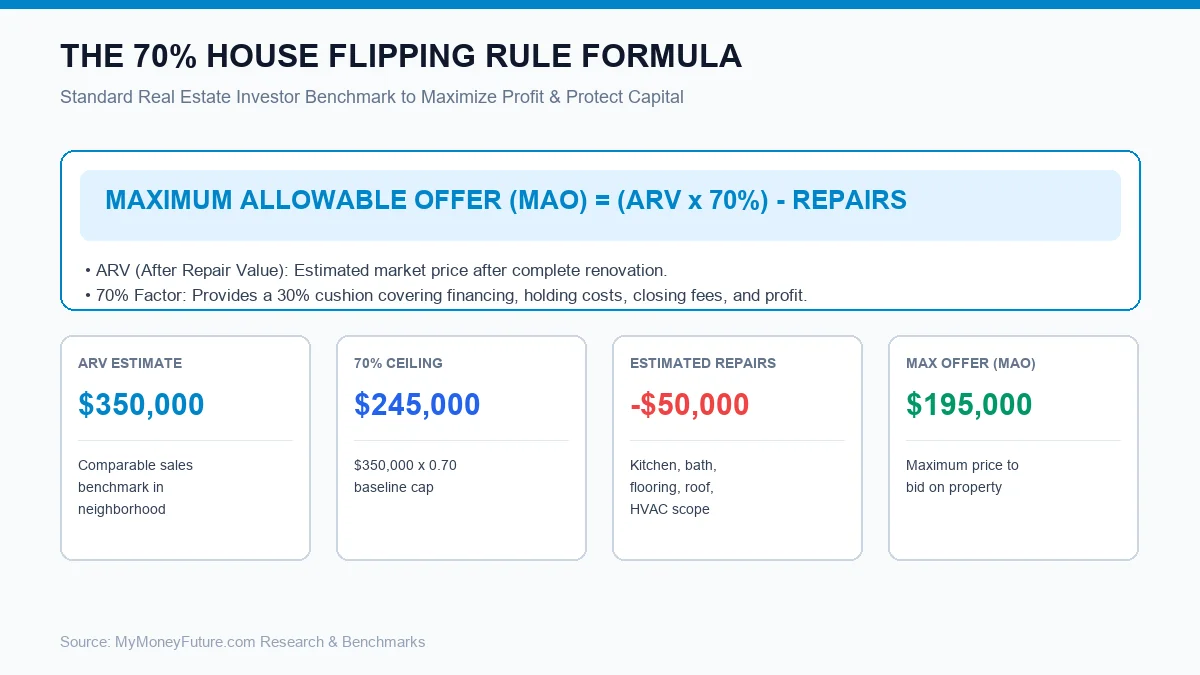
Many investors follow a variation of the 70% rule. The objective is to spend no more than around 70% of ARV minus repairs. It’s only a general shortcut, not a universal law.
Example: ARV is $300,000 and Repairs cost $45,000, 70% of ARV is $210,000. Remove repair costs and the rough maximum offer is $165,000.
In some marketplaces that figure may be too low to make a deal. In other markets, it could be too high, if the financing, holding fees and selling costs are considerable. Use it as a screening tool and then do a comprehensive calculation.
| Computer Sciences | Quantity |
| Value after repairs | $300,000 |
| 70% ARV | $210,000 |
| Estimated repairs | -$45,000 |
| Maximum rough offer | $165,000 |
Step 6: Finance it Right
Flips can be done with cash, hard money loans, private money, home equity, company credit, seller finance, or renovation loans. There are tradeoffs to each choice.
Cash offers flexibility, but also ties up capital. Hard money moves swiftly yet might have high rates and costs. Private lenders might be flexible, but it does require confidence and explicit agreements. The usage of home equity is dangerous since you could lose your home.
Your profit calculation must incorporate the cost of financing. A project that seems prosperous in cash could be thin with pricey borrowed money.
Also consider interest and the effect of delays thereto. If the flip takes 8 months instead of 4, the holding fees could quadruple.
Step 7: Think of the Renovation as a Project
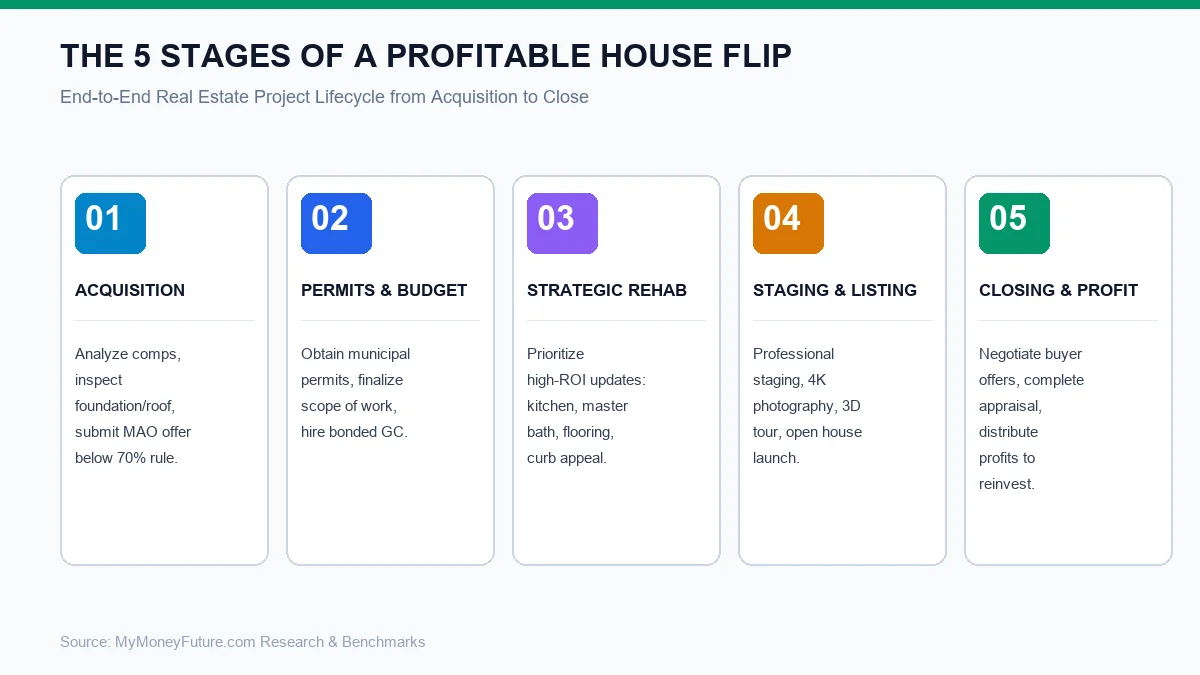
Before starting repairs, develop a written scope of work.
- Try to get bids from several contractors.
- Written agreements with payment milestones.
- Check permits before doing big construction.
- Order items early to prevent delays.
- Visit the property regularly or employ a project manager.
- Keep track of each expense against the budget.
- Note changes to the document and approvals.
Profit lost due to renovation delays. Contractors might turn up late, products might cost more than you thought, and hidden problems might show up after demolition.
A beginner should not start with a complete gut unless they have good construction support. Cosmetic or minor renovation jobs are easier to learn on.
We are not trying to make the house perfect The trick is to make the proper enhancements for the target buyer and pricing point.
Step 8: Selling with the buyer in mind
A good flip is remodeled for the buyer, not you.
Learn what sells in the neighborhood. Invest in what buyers are seeking: modern kitchens, clean bathrooms, neutral finishes, decent lighting and functional layouts. Don’t waste money on premium features that purchasers at that price won’t pay for.
Staging, great pictures, tidy landscape and accurate pricing might affect speed of sale.
A flip sitting on the market can become pricey. Each month that goes by could cost more loan interest, electricity, insurance, taxes and upkeep.
Typical House Flipping Mistakes
Paying too much for the property
Where profit begins is in the purchasing price. Even a gorgeous refurbishment will not salvage the transaction if you overpay.
Underestimating repair
Small mistakes might turn into big costs. Thorough check and always provide contingency.
Ignore Holding Costs
Interest on loans, insurance, property taxes, utilities, lawn maintenance, security and delays take nibbles out of profit.
Too much renovation
Luxury finishes don’t always mean luxury resale pricing. Match renovations to neighborhood and buyer profile.
Mistakes in Hiring Contractors
A contractor who delays the project or does poor work can cost more than a higher quality contractor, even if they are poor.
Permits Skipping
Unpermitted work might cause legal, safety, finance and resale concerns.
Seminars on How to Get Rich Quick
Flipping houses is real money, real danger and real work. Beware of anyone who says you can make money easily.
Beware of pricey coaching packages. The FTC has issued reimbursements to consumers damaged by a real estate investment training system that claimed consumers could make significant profits from flipping houses but was actually a scam.
Pros and Cons of Flipping Houses
| Benefits | Pros |
| High profit potential on each project. | High danger if figures are inaccurate. |
| Can rehabilitate for value add. | Needs capital, financial and cash reserves. |
| Develops real estate and project skills. | Contractor and permit problems caused delays. |
| Less timeline than long term rentals. | Income may not come in on a regular basis. |
| Can expand to be a business. | In downturns, the resale price may fall. |
House Flipping Strategy for the Newbie
A novice should begin with a conservative transaction, not the most dramatic restoration on the market.
Look for residences in need of cosmetic upgrades, modest repairs, cleaning, landscaping and better presentation. Avoid extensive structural repairs, fire damage, serious foundation difficulties or complicated permitting concerns until you have some experience.
Buy before you build a tiny team At the very least, you’ll need a real estate agent, inspector, contractor, lender, insurance contact, title firm and tax professional.
So keep your initial endeavor simple enough that one mistake won’t wipe away your financial existence.
How Much Profit Should You Aim for a Flip?
A flip should allow enough room to pay for the risk. There is no single profit target that is right. A $5,000 estimated benefit on a hazardous refurbishment may not be worth months of work and probable damage.
Many investors want some minimum dollar profit and some return on investment put into the business. The precise aim relies on the market, the size of the project, the financing and the amount of risk.
Generally, bigger projects should demand a bigger profit cushion. With a budget of $100,000 a small profit target and no room for mistakes.
Just because it’s predicted profit doesn’t mean it’s real profit. That final number could be lower due to unexpected repairs, appraisal concerns, buyer discussions, and market changes.
Frequently Asked Questions About House Flipping in 2026
1. How much money do you realistically need to flip your first house?
While hard money lenders typically finance 70% to 90% of purchase and 100% of rehab, beginners still need $30,000 to $60,000 in liquid capital for lender down payments, closing points, initial contractor draws, and holding cost reserves.
2. What is the 70% Rule in real estate house flipping?
The 70% rule states that an investor should pay no more than 70% of the After Repair Value (ARV) minus estimated repair costs. The remaining 30% margin cushions against holding costs, loan interest, closing fees, and your net profit margin.
3. What is After Repair Value (ARV) and how do I calculate it accurately?
ARV is the estimated market value of a home after all renovations are complete. It is calculated by finding at least 3 recently sold comparable homes (comps) within a 0.5-mile radius with identical square footage and finish levels sold within the last 90 to 180 days.
4. What are holding costs and why do they cause flips to fail?
Holding costs include loan interest (often 10%-13% on hard money), property taxes, builder risk insurance, utilities, and HOA dues incurred during renovation and marketing. Every extra month a project drags on bleeds $2,000 to $4,000+ directly from your bottom-line profit.
5. Which renovations yield the highest return on investment (ROI)?
Kitchen modernizations (quartz counters, shaker cabinets, stainless appliances), primary bathroom upgrades, durable luxury vinyl plank (LVP) flooring, fresh interior/exterior neutral paint, and basic curb appeal enhancements consistently provide the greatest ROI.
6. Can I flip houses while working a full-time job?
Yes, provided you partner with a trusted, licensed general contractor rather than trying to DIY the physical labor. Successful part-time flippers manage project budgets and milestones during evenings and conduct job site walkthroughs early mornings or weekends.
7. How are profits from house flipping taxed by the IRS?
Because flips are held for less than one year, profits are classified as active business income subject to ordinary federal income tax rates plus self-employment taxes (15.3%), rather than favorable long-term capital gains rates. Always consult a real estate CPA.
Disclaimer: The purpose of this article is to inform and educate the reader about the topic discussed herein; we attempt to provide up-to-date factual material that is accurate; however, we do not guarantee any of this information as complete or correct; you must make your own financial decisions based upon your own situation (e.g., your financial goals) and willingness to take on risk; any actions you take as a consequence of this article’s contents are at YOUR RISK.
Build True Wealth Through Real Estate & Investing
Real estate investing requires financial discipline. Explore our expert guides to establish an emergency cushion, optimize your credit score, and build investment capital.
Calculate Your Exact Mortgage & Home Payment
Estimate monthly principal, interest, taxes, and insurance (PITI) with our accurate home loan estimator: