
Short answer
Home equity can be a tool to develop wealth if it is used for productive purposes, such as making improvements to a property, purchasing an investment property, consolidating costly debt with discipline or supporting a plan that creates long-term value. It is only dangerous when you use it to fund lifestyle extravagance, investment, or debt that you cannot easily pay back.
Important Points
| Important Point | meaning |
| Real wealth, home equity | That’s the gap between what you owe and what your home is worth. |
| Equity as collateral means risk | Home equity loan or HELOC is secured by your house. |
| Use equity for value creation purposes. | Repairs, renovations, investment property or debt restructure can make sense. |
| No lifestyle borrowing | Vacations, vehicles and shopping can turn home riches into more debt |
| Run the numbers first | Size of the loan is less important than the monthly payment, rate, fees and fallback plan. |
Introduction.
The equity in a home might be one of the major assets of a family. For many homeowners, it develops slowly with mortgage payments, rising home values and time. It can be a tool for building wealth if used appropriately. But if you abuse it, it might threaten your home.
The slogan “use home equity to build wealth” is seductive, but it should be approached with caution. Home equity isn’t free money. It’s value in your real estate. When you borrow against it you are converting some of that worth into debt that has to be paid off.
That’s not to say home equity should be off limits. Thus, intent matters. Borrowing to buy an income-generating asset, pay down high-cost debt or upgrade a property is significantly different than borrowing to cover short-term lifestyle spending.
This book covers what home equity is, the primary ways to access it, smart applications, dangerous uses and what questions to answer before you put your property behind a financial plan.
What Home Equity Means in Reality
Home equity is the value of your home that you own. If your house is worth $400,000 and your mortgage balance is $260,000, you have an equity of around $140,000 before selling costs, taxes or fees.
There are two primary ways in which equity might rise. First, you pay down principal, which reduces your mortgage balance. Second, you might see your property worth increase over time. Improvements, local demand, expansion in the neighborhood, inflation and market conditions can all impact value.
According to the Consumer Financial Protection Bureau, a HELOC allows homeowners to draw on existing equity, which is the home value minus the mortgage balance. Before you think that equity borrowing is a minimal risk, see the CFPB explanation of home equity lines of credit. CFPB explanation of home equity lines of credit
One essential point: equity on paper is not the same as cash in your pocket. To get to it you generally have to sell, refinance, or borrow against it. Every route includes costs and trade-offs.
The question is not simply, “How much can I borrow?The more important issue is, “Am I going to improve my long-term net worth after costs and risks by using this equity?”
Common Ways to Tap Home Equity
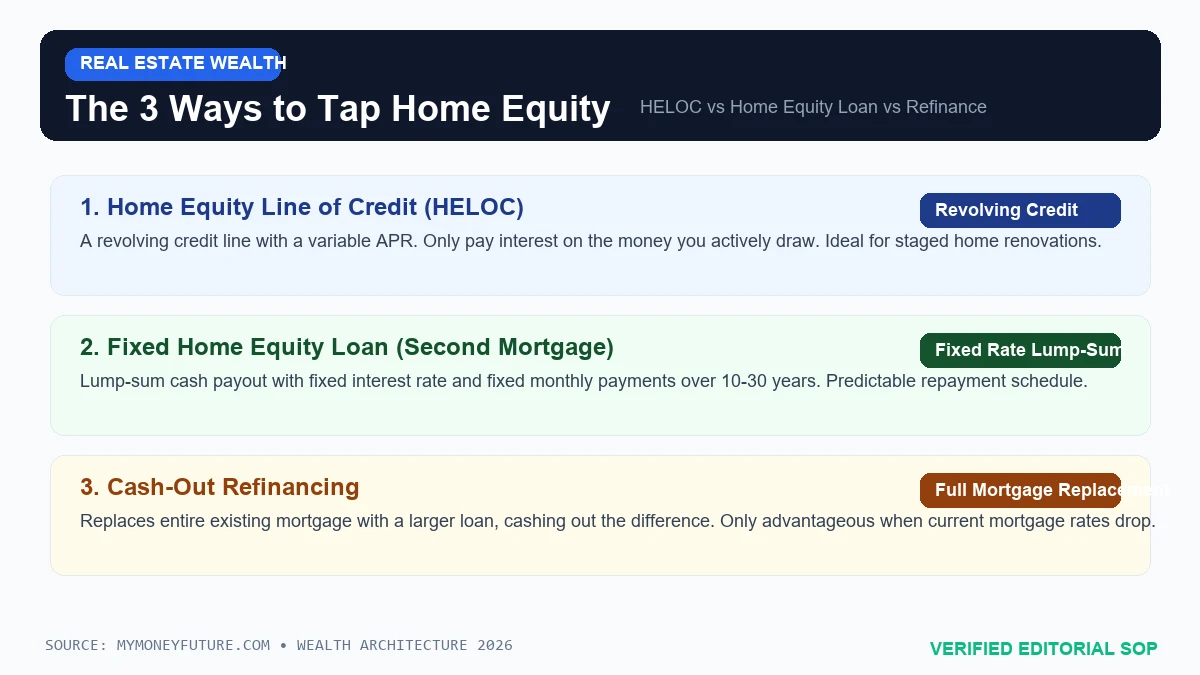
There are a few ways to tap into home equity. Each operates differently and picking the wrong structure can make a good idea pricey.
| Choice | How this works | Best Fit |
| Home equity loans | You borrow a big sum , and pay it back over time . Usually at a fixed rate . | Big, one-off project with a predictable cost. |
| HELOC | You have a line of credit that you can use as needed during the draw period. | Artificial costs or flexible initiatives. |
| Cash-out refinancing | You take out a new mortgage for more than you owe on your home and keep the difference. | If the new mortgage terms still work for you. |
| Home equity investment / shared equity | Company offers cash now in return for future share of house value. | Terms might be difficult and should only be reviewed carefully. |
| Selling and reducing size | You sell the house and go somewhere cheaper. | Tap equity without incurring new debt. |
Home equity loans are straightforward because the money is provided in a flat sum. It can help with a kitchen remodel, roof replacement or a debt payoff plan where the sum is known ahead of time.
A HELOC is more versatile. During the draw period you can borrow, pay back and borrow again like a credit card. The danger is that flexibility can lead to overspending unless you set limits.
A cash-out refi can look appealing when mortgage rates are low, but it can cost you when rates are higher than your current mortgage. It also, in many instances, re-starts or extends mortgage debt.
A common mistake is selling and downsizing. Selling may be safer than borrowing against the same home if the purpose is to decrease pressure and raise investable assets.
Clever Ways to Use Home Equity to Grow Wealth
The finest uses of home equity usually have one thing in common: They produce value, ease pricey financial burden, or boost long-term cash flow.
It doesn’t assure success, but it gives the money a productive purpose.
1. Strategically enhance the property
If the modifications are to safeguard the property or to increase its resale value, then tapping home equity can be a smart move. Examples include a roof, HVAC system, plumbing, energy efficiency, accessibility enhancements or a well-planned kitchen or bathroom makeover.
The mistake is believing that every enhancement is worth the money spent. Luxury finishes, creative designs and overbuilding for the neighborhood may not return what they cost.
Get documented quotations before borrowing, examine local resale data and separate necessary repairs and wish-list enhancements. A repair that stops further harm may be more useful than a cosmetic endeavor.
2. Carefully Buy An Investment Property
Some homeowners pull equity out to use as a down payment on a rental property. This can provide wealth if the rental is positively geared, appreciates over time and is maintained well.
“The risk is leverage. You could be owing money on both your home and the investment property at the same time. Cash flow might easily turn negative if the rental is empty or in need of costly maintenance.
Perform a cautious rent analysis. Mortgage Payment, taxes, insurance, repairs, vacancies, property management, utilities, legal costs, reserves. If the agreement only works in a perfect world, it may not be a wealth-building venture.
3. Swap out expensive debt for a cheaper plan
Consolidating credit card debt using house equity will save you interest, but it’s one of the most dangerous techniques because unsecured debt becomes debt secured by your property.
This only works if the interest savings are evident and the behavior that caused the debt has changed. If home equity is used to pay off credit cards, and the cards are used again, the homeowner could end up with a home equity balance and new debt on the cards.
A better way: Start by plugging the spending leak. Then construct a small emergency savings. Stop new credit card borrowing. And finally, compare repayment options.
4. Fund Education or Career Growth Prudently
Sometimes home equity can be used to pay for education, certifications or training that improves your earning ability. But the predicted income improvement should be reasonable and not on the basis of hope.
Explore safer finance choices before you borrow. Scholarships, employer tuition help, payment plans and federal student loans may offer better safeguards than borrowing against your house.
If you are unsure, or it is expensive to train, do not put your house up as collateral without a clear strategy for income.
Home Equity Borrowing Power & LTV Calculator
Calculate Usable Equity Under 80% LTV Guidelines
Estimate how much capital you can safely access via a HELOC or Home Equity Loan without triggering private mortgage insurance.
5. Build a Business With a Good Backup Plan
Some entrepreneurs tap home equity to finance a firm. This can work but should be considered high risk. Many companies take longer than planned to become successful, others never do.
If you are leveraging home equity for a business, keep the borrowing minimal, keep business and personal accounts separate and don’t use your home as the first source of cash. Safer are customer revenue, savings, grants, small business loans, or a gradual side-business method.
“Don’t borrow against your home for a business model you haven’t tested with real customers.”
When home equity is not a good idea
The problem with home equity is that it may be exploited to put off tough financial decisions. If you are already living beyond your means month to month, taking out a home equity loan may just be covering the problem for a while.
The Federal Trade Commission advises that home equity loans and HELOCs are secured by your property, so if you don’t make the payments, there might be serious consequences. Before you sign any loan agreements, check out the FTC guide to home equity loans and HELOCs. FTC guide to home equity loans and HELOCs
Other things not to use home equity for include vacations, luxury goods, weddings you can’t afford, speculative investments and routine payments. These uses drain wealth, with no reliable asset or permanent financial improvement.
And watch out for HELOCs with fluctuating rates too. What looks reasonable today can become less so if rates increase or if the repayment period kicks in.
Home Equity Math: An Easy Example
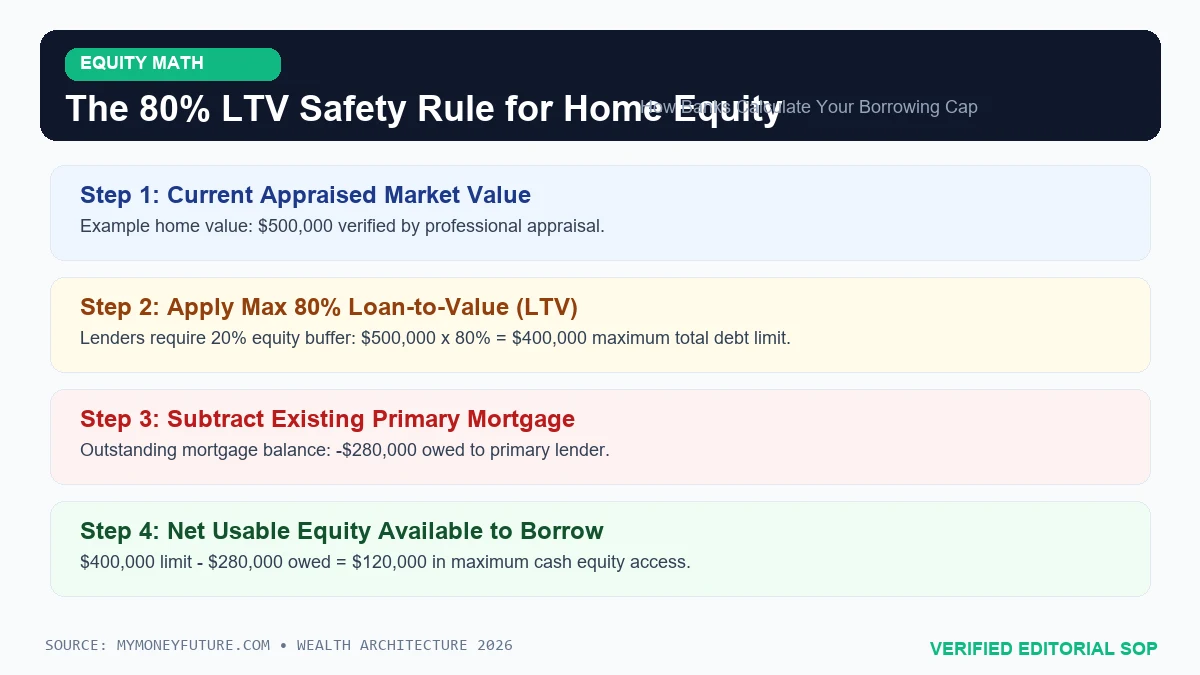
Say your house is worth $500,000 and you still owe $300,000 on your mortgage. You have $200,000 in paper equity.
That doesn’t imply you go out and borrow 200,000 dollars. Borrowers are often limited by loan-to-value rules, credit profile, income and debt levels. additionally, you have to maintain a safety margin.
| Item. | Quantity |
| Home value estimate | $500,000 |
| Balance of mortgage | $300,000 |
| Equity estimate | $200,000 |
| Up to 80% combined loan to value maximum borrowing | $100,000 |
| Recommended personal safety margin | Don’t touch meaningful equity. |
If you are borrowing $75,000 for a remodel, ask whether the project maintains value, increases resale appeal or minimizes future maintenance expenses. Next, check your budget against the monthly payment.
If income drops, expenses increase or the home value doesn’t improve as predicted, the contract should still function.
Questions to Ask Before You Borrow
- What is the money actually going to be used for?
- Does this use boost my net worth, income, long term stability?
- Can I afford the payment if interest rates go up?
- What are the fees, closing costs, or appraisal fees?
- How many years to payoff the balance?
- What if my income decreases?
- Am I trading unsecured debt for home-secured debt?
- Do you have an emergency fund, not counting your home equity?
- Have I thot about other options?
- If property prices plummeted would I still make this choice?
Expert Advice
Tap home equity for assets, not for looks. Wealth is supported by necessary repairs, income-producing property, or a lower-cost financing plan. A luxury buy typically doesn’t.
Borrow less than you are approved for. Your safe limit is not the maximum of the lender.
Maintain cash reserves. Don’t use home equity in place of an emergency fund as it may take longer to get to, cost more, or not be available while you are under financial difficulty.
Review the loan terms carefully. Be aware of variable rates, draw periods, payback durations, balloon payments, surcharges and prepayment requirements.
‘If you are taking the money, go for a signed repayment plan. If you can’t explain how the debt will be paid back, you’re probably not ready to borrow.
Action Plan for Beginners
Begin by assessing your equity, but don’t stop there. Note the current valuation of your property, the mortgage balance, the potential borrowing limit, payment estimate and the specific purpose of the funds. A nebulous objective is a red flag.
Then, compare the home equity choice to at least two other options. If you want to do renovations, for example, consider saving cash, taking a smaller personal loan, postponing the project or doing the work in stages. If debt consolidation is your aim, try a debt avalanche plan or nonprofit credit counseling before you put your home on the line.
Then, test the payment for strain. Ask yourself if you could afford the loan if you had a 20% hit to your salary, taxes go up, insurance goes up and the HELOC rate goes up. Plans to develop wealth need to be flexible enough to allow for life.
Finally, establish a repayment rule before borrowing. Decide whether to apply extra income, cash flow from rent or monthly budget savings straight to the home equity balance. Without a system for repayment, flexible borrowing can turn into permanent debt.
Practical Situation
Maria has a home valued at $420,000, with a $270,000 mortgage on it. She wants to borrow $40,000 for a down payment on a rental property. On paper, the concept sounds exciting with potential for income and appreciation in the rental.
She crunches the rental statistics carefully before going to equity. She includes management fees, insurance, property taxes, repairs, a reserve account and vacancies. She then assesses whether she could meet both the HELOC payment and the rental mortgage for three months if the renter moves out.
Maria looks at the numbers and decides to borro
w less and save more money first. That slower pace decreases the risk. She still uses home equity as part of the plan, but she doesn’t gamble on perfect conditions.This is the attitude homeowners need. Home equity can help you develop wealth, but the plan has to weather stress, delays and the normal obstacles of life.
FAQ Section
Q: How can home equity build wealth?
A: Home equity can develop wealth if used for constructive objectives such as home upgrades, investment property, lowering expensive debt with discipline, or funding a strategy that raises income.
Q: Is a heloc a good investment?
A: It can be dangerous. A HELOC is backed by your home and generally has a variable rate. Don’t use it for speculative investing if you don’t comprehend the hazards and can’t afford to repay.
Q: Is home equity equal to cash?
A: No. Home equity is the portion of your home that you own. To access it, you normally have to borrow, refinance or sell. All of which can come with prices and hazards.
Q: Can I use my home equity to pay off credit cards?
A. You can do this but it is risky since you could be converting unsecured debt to debt secured by your home. It only works if you avoid running up new credit card debt and the lower rate saves you real money.
Q: What is the safest way to use home equity?
A: The safest uses are usually those that repair or safeguard the property itself, pay down expensive debt with a known plan, or are part of a prudent investing strategy. Don’t borrow for lifestyle expenditures.
Q: Am I risking my home if I get a home equity loan?
A: Yes. Home equity loans and HELOCs are secured by your home, thus falling behind can threaten the property.
Q: Should I use home equity for a business?
A: Only with reservation. The firm may go down but the debt remains. Test the business model first and look for safer financing solutions.
A: This is contingent upon the business model.
A: There’s no one answer, but a meaningful equity cushion protects you if house values fall, you need to sell or costs rise.
Summary.
Home equity can be a way to generate wealth, but only if handled wisely. This is not free money and this is not risk free cash.
The best uses are for long-term value: to secure the property, improve cash flow, buy income-generating assets or pay off costly debt with a defined repayment schedule.
The weakest uses are mainly lifestyle expenditures, speculation and short-term spending that leaves you with a bigger loan and no firmer financial footing.
Do the math, analyze the options and before you borrow, ask yourself one honest question: Will this decision make my household wealthy and safer in five years? If you’re not sure of the answer, don’t rush into using your home as collateral.
Educational Disclaimer
This page is for educational and informative purposes only. This should not be taken as financial, legal, tax, mortgage or investment advice. A loan against your home equity could put your home at jeopardy. If you’re considering accessing your home equity, you might want to see a certified financial advisor, housing counselor, tax professional or mortgage specialist.
Mortgage & Home Loan Calculator
Estimate your monthly principal, interest, taxes, and amortization breakdown.
Calculate Monthly Mortgage Payment →Frequently Asked Questions (FAQ)
Calculate Your Exact Mortgage & Home Payment
Estimate monthly principal, interest, taxes, and insurance (PITI) with our accurate home loan estimator: