
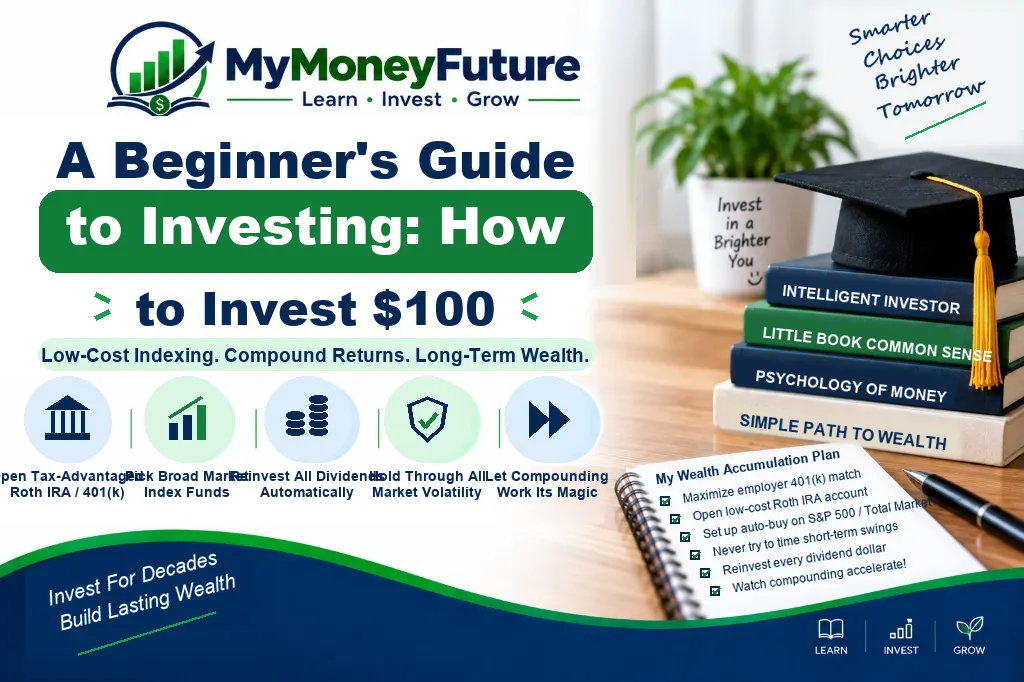
A lot of people assume investing is for the rich. The truth is, with today’s investment platforms and fractional shares, you may begin generating wealth with $100 or less.
The biggest problem most starters face is taking the initial step, not money. If you know where to invest, how much risk to accept, and what mistakes to avoid, it can make a huge difference to your long-term financial success.
This easy-to-understand book will tell you how investing works, where to put your first $100, and how to come up with a plan that will help your money grow over time.
- Key Takeaways & $100 Starter Rules
- The Power of Compound Growth Over Decades
- Can You Really Build Wealth Starting With Just $100?
- How Micro-Investing and Fractional Shares Work
- The Best Investment Assets for Beginners in 2026
- 🧮 Interactive $100 Starter Compound Interest Calculator
- Step-by-Step Execution Plan: How to Invest Your First $100
- Sample Portfolio Allocations for $100
- Understanding Stock Market Volatility and Risk Management
- Common Rookie Mistakes to Avoid
- Pros & Cons of Starting Small
- Certified Financial Planner Tips for Long-Term Success
- Frequently Asked Questions About Investing $100
Key Points
Even $100 a month turns into serious wealth over time. Test your numbers with our Compound Interest & SIP Calculator.
- You Can Begin Small
A lot of investment sites allow you to begin investing with $100 or less. - Time is More Important than Quantity
In general, it’s better to keep investing than try to time the market. - Diversification of Risk
ETFs and index funds can distribute risk across numerous companies. - Long Term Focus Wins
Investing works best when you allow it time to compound. - Begin Now
It’s often more expensive to wait than start out with a little now.
The Importance of Investing
It’s crucial to save, but investing makes your money work for you.
With your money in a conventional savings account, often there is minimal growth. Investing might give the opportunity for larger profits over time, but it comes with risk.
The Strength of Compound Growth
Compound growth is when your investment earnings earn additional earnings as time goes on.
| Year | Investment Value |
|---|---|
| Initial investment | $100 |
| After 10 Years (7% Return Per Year) | $197 |
| After 20 Years (7% Return Per Year) | $387 |
| After 30 Years (7% Annual Return) | $761 |
Here’s an illustration of how time could be your biggest ally in investing.
Learn more about compound interest from the SEC.
Can You Actually Invest With $100?
Yes.
Today several investment platforms offer:
- Partial shares
- No minimum investment thresholds
- Trading without commission
- Automated investing tools
This means you don’t need thousands of dollars to start investing.
Real World Example
Let’s say you wish to buy equity of a corporation whose stock is trading at 100 instead of buying a whole share.
How It Works: Invest
Investing is the act of placing money into something that has the potential to increase in value over time.
| Type of Asset | Risk Grade | Growth Opportunities |
|---|---|---|
| Savings Accounts | Low | Low |
| Bonds | Low-Medium | Medium |
| ETFs | Medium | Medium to High |
| Index Funds | Moderate | Moderate to High |
| Individual stocks | High | High |
| Cryptocurrency | Very high | Very high |
Diversified investments are frequently regarded as safer for beginners than selecting individual stocks.
Best Investments for New Investors
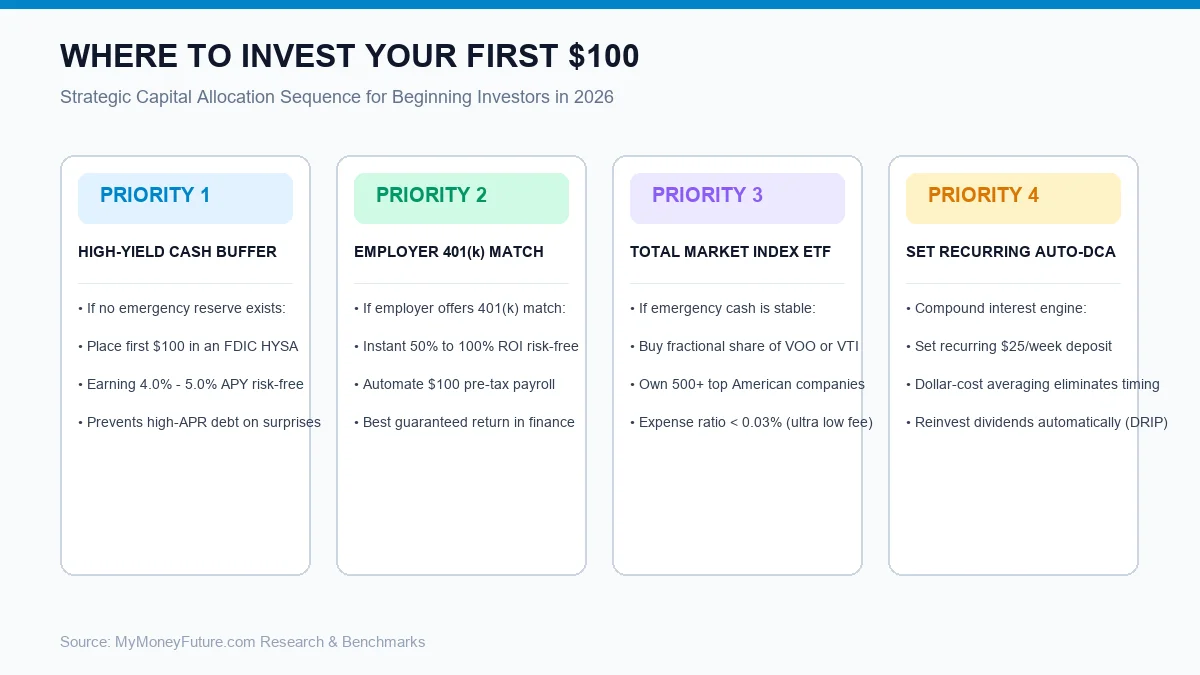
- Index Funds
Index funds follow a market index, such as the S&P 500.- Wide diversification
- Lesser charges
- Easy for beginners
- Historically strong long-term performance
An S&P 500 index fund means you own a piece of hundreds of large companies, not just one. - ETFs (Exchange Traded Funds)
ETFs are comparable to index funds, except they are traded like stocks.- Spread of risk
- Versatility
- Inexpensive
- Easily reachable
- Partial Shares
Fractional investing lets you buy chunks of expensive stocks.- Lower initial expenses
- Simple diversification
- Greater access
- Pension accounts
Tax-advantaged retirement accounts might be a huge benefit, depending on your country.- IRA (U.S.)
- RRSP (Canada)
- ISA (UK)
- Superannuation (Australia)
Interactive $100 Starter Compound Interest Calculator
Witness how starting with $100 and compounding regular monthly deposits transforms into substantial wealth.
How to Start Investing with $100: A Step-by-Step Guide
Step 1: Establish your financial objectives
Think about it:
- Are you saving for retirement?
- Buying a house?
- Long-term wealth building?
Your strategy depends on your goal.
Step 2: Establish an emergency fund First
Consider building up emergency funds before you invest for the unplanned expenses.
Most experts suggest having three to six months of necessary expenses.
Step 3: Select an Investment Account
Common choices are:
- Brokerage Account (General investment)
- Retirement Savings Account (Long-term retirement savings)
- Robo-advisor (Hands-off investment)
Step 4: Pick Your Investments
A lot of newbies might just start out easy, with a diversified ETF or index fund.
Step 5: Invest on a Regular Basis
It isn’t always about how much you invest, but how consistently you invest.
| Monthly Investment | Annual Contribution |
|---|---|
| $25 | $300 |
| $50 | $600 |
| $100 | $1,200 |
Little investments might add up to a lot over time.
Sample Investment Plans for $100
The Conservative Approach
- Bond ETF: $60
- General Market ETF: $40
Balanced Strategy
- S&P 500 ETF: $70
- International ETF: $30
Growth Mindset Attitude
- Broad Market ETF: $80
- 20 Individual Stocks: $20
These are sample investments for educational purposes and are not personalized investment recommendations.
Understanding the Risks of Investment
With every investment there is risk.
Typical dangers are:
- Market Risk: Investments could drop in value owing to economic conditions.
- Inflation risk: Inflation can wear away at your purchasing power over time.
- Company risk: Problems relating to the business of a company can affect the individual shares.
- Emotional Risk: Investors are prone to making bad choices out of fear and panic while the market is crashing.
Common Investing Mistakes Made by Newbies
- The Get Rich Quick Scheme: Investing is usually a long-term endeavor, not a shortcut to wealth.
- Timing the Market: It is quite difficult to consistently predict market highs and lows.
- Investing Without Research: Know what you are investing in before you put your money.
- Ignoring Diversification: Putting all eggs in one basket increases risk.
- Selling in a Down Market: Short-term volatility is a common component of investing.
Pros and Cons of Investing $100
Benefits
- Easy to get in
- Develops investing behaviors
- Diversified fund access
- Learning opportunity
Cons
- Little growth in the short term
- Returns might be affected by market volatility.
- It takes time
- There is no assurance of a return
New Investor Tips from the Experts
- Focus on Time in the Market: Long-term investing is usually better than short-term speculation.
- Automate Contributions: Automatic investing takes emotion out of the equation and helps you stay consistent.
- Keep Costs Low: High fees might erode your gains over time.
- Diversify Early: Don’t put all your eggs in one basket.
- Continue to Learn: One of the best investments you can make is financial literacy.
In the Real World
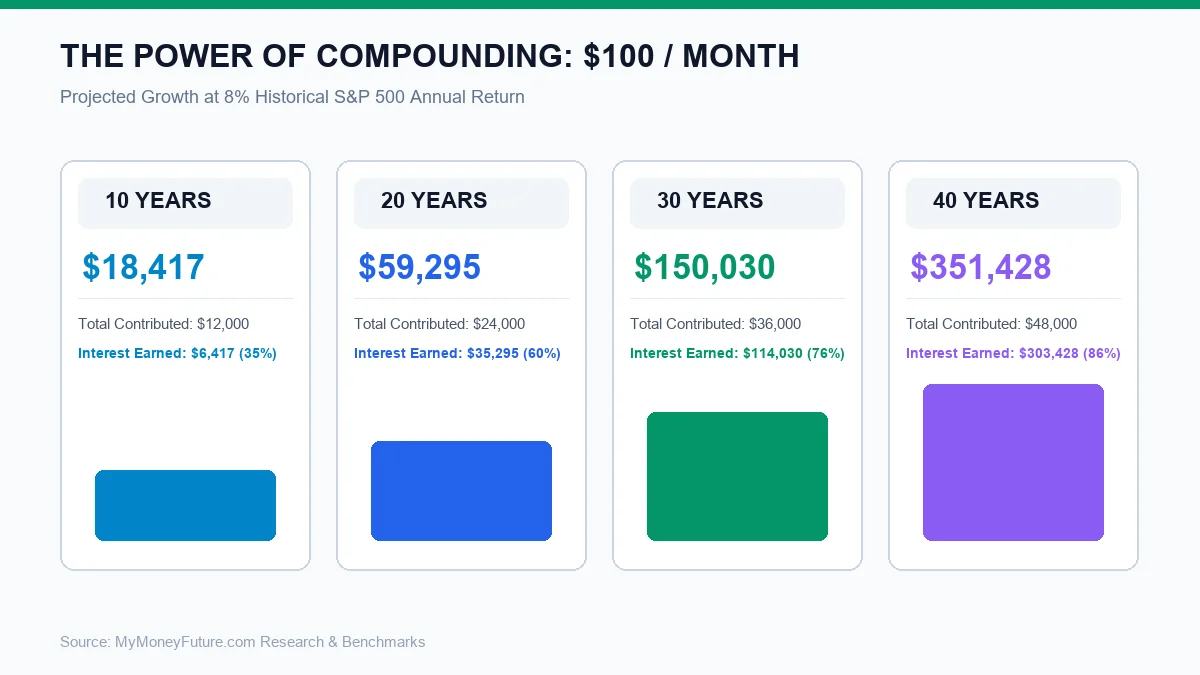
Alex is 25 years old and begins investing 100 every month. He would have more than $120,000 in 30 years by investing regularly and compounding his returns, using a hypothetical 7% average yearly return.
The exact return will vary, but this is to show how little deposits may really add up over time.
Summary
You don’t need to have thousands of dollars or be a financial whiz to start investing. Start developing a diverse portfolio with just $100, learn how the markets function, and form habits that will lead to long-term wealth accumulation.
The most crucial stage is not identifying the right investment but taking action. For those just starting out, focusing on diversification, stability, and long-term thinking can help to develop a solid basis for long-term financial success.
Remember that effective investing is usually a marathon, not a sprint.
Frequently Asked Questions About Investing $100 in 2026
1. Is $100 really enough to start investing?
Absolutely. Thanks to commission-free trading and fractional shares available on platforms like Fidelity, Schwab, and Robinhood, $100 can purchase exact fractional slices of broad-market index ETFs like VOO (S&P 500) or VTI (Total Stock Market).
2. What is the single best investment for a beginner with $100?
A low-cost S&P 500 Index ETF (such as VOO or SPY) or Total US Stock Market ETF (VTI). With an ultra-low expense ratio of 0.03%, you instantly own diversified equity in America’s 500 largest, most profitable corporations.
3. Should I save an emergency fund before investing $100?
Yes. Financial planners advise maintaining at least a starter $1,000 emergency cash reserve in an FDIC-insured High-Yield Savings Account (HYSA) before investing in the stock market to avoid forced stock sales during unexpected emergencies.
4. What are fractional shares and how do they work?
Fractional shares allow you to invest by dollar amount rather than whole share price. If a stock trades at $500, a $100 investment buys precisely 0.20 shares, earning identical proportional percentage gains and dividend distributions.
5. What returns can I realistically expect from investing $100?
Historically, the US S&P 500 has averaged an annual return of approximately 10% (around 7% to 8% after inflation). If you continue adding $100 each month at an 8% return, your portfolio grows to over $59,000 in 20 years and $150,000+ in 30 years.
6. What is the biggest rookie investing mistake to avoid?
Trying to day-trade or pick speculative individual meme stocks/options. Studies prove 90%+ of active retail day traders lose money. Long-term wealth is built through automated Dollar-Cost Averaging (DCA) into diversified index funds.
7. Should I open a Roth IRA or a regular brokerage account?
If investing for long-term retirement, a Roth IRA is superior because all capital gains and dividends compound 100% tax-free forever. If you need liquidity before age 59½, a standard taxable brokerage account offers maximum flexibility.
Disclaimer: The purpose of this article is to inform and educate the reader about the topic discussed herein; we attempt to provide up-to-date factual material that is accurate; however, we do not guarantee any of this information as complete or correct; you must make your own financial decisions based upon your own situation (e.g., your financial goals) and willingness to take on risk; any actions you take as a consequence of this article’s contents are at YOUR RISK.
Accelerate Your Wealth Building Journey
Investing $100 is your first step. Discover our step-by-step master guides to optimize your budget, eliminate high-APR debt, and plan for lifelong financial freedom.
Calculate Your Long-Term Wealth Growth
See how compounding interest accelerates your net worth and calculate your exact FIRE retirement freedom number: