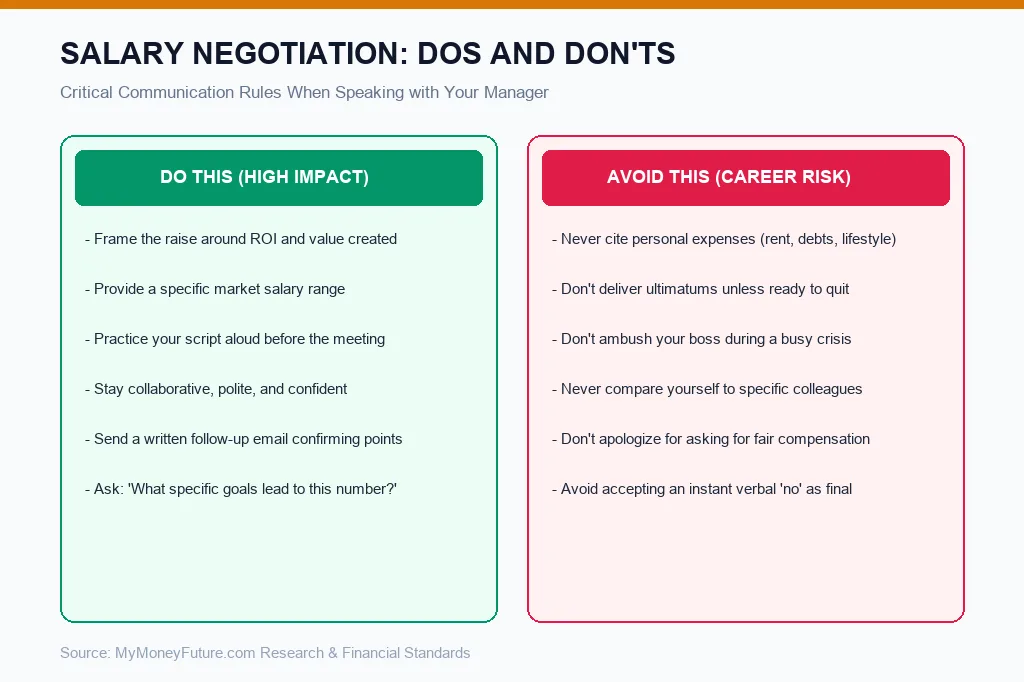
Figure 2: Salary Negotiation Rules: High-Impact Dos and Career-Risk Don’ts When Speaking with Management.
💼
Senior Financial Editor’s Action Plan: Monetizing Your Career
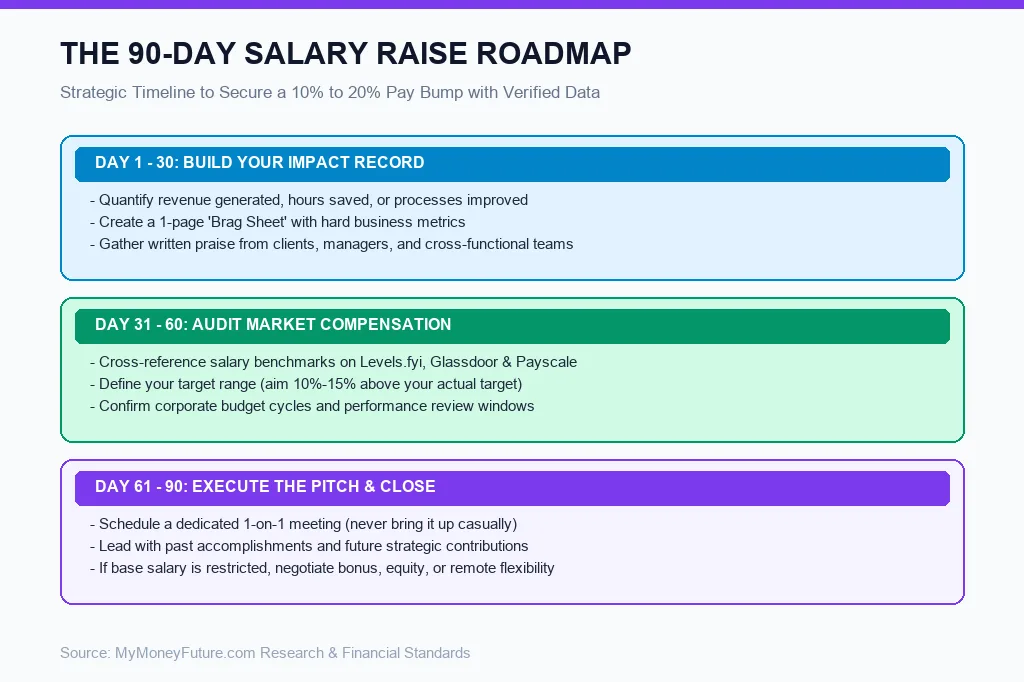
A successful pay raise is rarely won in the 30-minute meeting—it is won in the 90 days prior through meticulous documentation of business impact. Treat negotiation not as a conflict, but as a mutual business alignment where you solve high-value problems for your organization.
How to Direct Your New Income:
Avoid Lifestyle Inflation: Auto-route 75% of your net pay bump straight to high-growth investments.
Strengthen Your Base: Top up your High-Yield Savings Account to match your higher monthly cost of living.
Optimize Savings Habits: Explore our curated list of 100 Ways To Save Money to maximize your savings velocity.
Salary negotiating is not about being aggressive. It’s about establishing a clear, professional case for the value you bring to a company.
Written by Kavita Thakur • Reviewed & Edited by Gourav Shandil
Senior Personal Finance Editorial Team • Fact-Checked & Verified Math
📅 Last Updated:October 17, 2026
“It’s an uncomfortable conversation for a lot of people, so they avoid it, but it can cost thousands of dollars over the course of a career,” she said.
Figure 1: The 90-Day Salary Raise Roadmap: Building the Value Record, Market Audit, and Formal Pitch.
A bigger paycheck means more than just your next paycheck. It can increase your retirement contributions, bonuses, future rises, loan eligibility and long-term savings rate. An early career negotiation can pay dividends for years to come.
Preparation is king: market data, proof of impact, a reasonable aim and a calm script. When you know your value and convey it properly, the conversation is less emotional and more business-like.
This article will provide you with practical salary negotiation advice, examples, scripts and a step-by-step approach that you can use for a new job offer or a raise in your present business.
Calculate your exact take-home pay raise and discover what investing that increase produces over a 10 and 20-year horizon.
New Annual Salary
$84,000
Net Monthly Pay Bump
+$570 / mo
10-Yr Wealth Growth (8% APY)
$104,288
Research market compensation, document your conclusions, establish a realistic salary range, make the request gently and support it with proof. Ask about good performance during a job offer, or before to a remuneration review. Write a clear script. Stay cool. Negotiate complete comp if base pay can’t move.
Main Takeaways
Main Idea
What it Signifies
Research first
Use more than one salary data source to give a number.
Number of Results
Tie your ask to quantifiable commercial value
Timing is helpful
Negotiate after wins, after job offers, after review cycles.
A selection
Provide a reasonable target price range, not a random number.
Total pay counts.
Add bonus, equity, PTO, remote employment, and benefits.
The Importance of Negotiating Salary
Your income is one of the major financial levers you have in your arsenal. Cutting little expenses helps but boosting your income can make a far bigger difference to your ability to save, invest and pay off debt.
For example, a $5,000 raise isn’t $5,000 this year. From then on, any raises based on your new pay means you’ll make more money each year after that. If a portion of your compensation is going into a 401(k), pension or investment account, the boost can help you generate long-term wealth, too.
Negotiation also sends a message. It shows employers you know your market value, and you take your career seriously. Good employers expect to negotiate professionally, particularly at hiring and review times.
Many workers make the mistake of waiting until they are frustrated. At that point, the debate could become emotional. The better way is to prepare before the pressure builds. Learn the market, get the timing perfect, and plan the conversation for the right moment.
Step 1: Know Your Market Value
Before you begin asking for a raise, you need to know what people in similar jobs are making. Guessing can undermine your position. If your figure is really too low, you’re leaving money on the table. If it’s too high, you may look unprepared.
Start with your work title, location, years of experience, industry and primary tasks. The wage for a marketing manager in a big metropolis may be different than that of a marketing coordinator in a small town. If you are a software engineer working on infrastructure you may not pay the same fee as someone providing basic web support.
Use more than one source. Government wage statistics, employer salary ranges, recruiter chats, job posts, professional communities and compensation reports can all help you put together a realistic picture.
The CareerOneStop Salary Finder is a good place to start to investigate salary information by occupation and location. You also might want to look at wage statistics from the Bureau of Labor Statistics, which provides official occupational wage estimates for various jobs. The BLS says the wage statistics can help workers prepare for salary negotiations by understanding how compensation varies by vocation, industry and geography.
Step 2: Develop Your Value Case
It’s best to negotiate salary from results, not necessity. Your rent, your expenses, your objectives matter to you, but your employer is generally paying for performance, skill, reliability and commercial effect.
List the 3-5 most important contributions you’ve made. Where feasible, focus on precise and measurable results. For example: revenue earned, costs avoided, clients maintained, projects delivered, errors avoided, processes improved, team members trained.
If your labor is hard to measure, use proof of responsibility. Perhaps you’ve taken on a heavier workload, supported a new team, managed delicate clientele, increased response times, or been the person everyone turns to when they need help with a problem.
Responsibility: the committee Action: investigate the committee Result: investigate the committee
For example: ‘I took over weekly client reporting, updated the dashboard and decreased manual reporting time by six hours a week.’ That sounds a lot stronger than ‘I work incredibly hard.’
Step 3: Decide on Your Target Number
Decide on a target range once you’ve established your market and your worth. A range opens the door for conversation and shows you have thot it thru.
You need three digits in your range. The first is your desired number. The second is the number you are allowed. Third is your walk-away number for a job offer or your next-step number for a current job.
For example, if the market range is $75,000 to $90,000 and your experience fits the top middle, you might target $88,000, accept $83,000 with great benefits, and rethink offers below $78,000. The numbers will depend on your market, leverage and options.
Don’t pick a number just because it sounds good. Link it to data. If you can say, “Considering the market range for this role and the scope of responsibility, I was expecting something closer to $88,000,” you sound prepared, not demanding.
Step 4: Choose the Right Time
Timing doesn’t guaranty a yes, but it can smooth the conversation. The optimum time to negotiate a job offer is after the employer has explicitly stated they want you, but before you accept.
Good times to ask for a raise include after a big win, before yearly review choices are made, after you’ve taken on new duties, after completing a challenging project, or when your function has expanded beyond the original job description.
Bad timing is when it’s right after a company setback, a crisis, when you don’t have evidence queued up, or when you’re just reacting to displeasure. If the organization is under pressure, you can still ask, but you may have to frame the conversation around a timeframe, a title change, a bonus or a future review date.
If your firm has a formal review cycle, start the conversation before the budgets are finalized. Many employes sit during the review meeting and find out judgments were made weeks before.
Utilize These Salary Negotiation Scripts
Case
Script
New Job Offer Message
Thanks but no thanks. I’m looking forward to the role and the team. Given the responsibilities we mentioned, and the market range for similar occupations, I was hoping to see remuneration in the range of [goal amount]. Can we get the base salary closer to that?
Raise ask script
I’d want to address my salary in light of the expansion of my role and the outcomes that I have delivered over the past [time period]. [Particular example] I have assumed [responsibility] and contributed to [outcome]. Due to the impact and market pay today, I’d like to explore adjusting my salary to [goal amount or range].
If they tell you the budget is fixed
I understand there are fiscal limitations. Is there any room to negotiate other areas of the remuneration package, including a signing bonus, performance bonus, additional PTO, remote employment flexibility, a professional development budget, or salary review in three to six months?
If they ask your wage expectations early on
I want to grasp the whole extent of the role first, but based on my experience and the market I am looking in the range of [range]. Once we know there is a strong fit, I am willing to discussing the whole compensation package.
If you need time to think
Thanks for sharing the offer. I appreciate everything and would like to go thru the details carefully. Would you be able to give me till [date] to get back to you once I have had a chance to assess the complete package?
How to Negotiate More Than Just Base Salary
Sometimes base compensation just isn’t negotiable, but that doesn’t mean the debate is finished. Total compensation can be made up of multiple pieces. A corporation could have fixed salary bands but be more flexible on bonus, title, start date, remote days, relocation support, training budget or paid time off.
Consider what matters most to you. There’s a $3,000 signing incentive to help right away. Remote employment might cut commuting costs. More PTO can mean an improved quality of life. A budget for professional certifications could lead to a greater rise eventually.
If you can’t hit your wage goal, ask what you can negotiate. Maintain the tone collaborative. You’re not attempting to win every point. You’re trying to construct an offer that feels fair and sustainable.
You can also ask for a documented road map to the next level for a present position. If the response is no today, ask what specific results would support the increase and when the compensation talk can be addressed.
10 Salary Negotiation Mistakes to Avoid
The first mistake is to negotiate without data. Saying ‘I feel underpaid’ is less powerful than demonstrating market range, increased responsibility and specific results.
The second mistake is to accept the first number at face value. You don’t have to be pushy, but asking the question about flexibility is appropriate. There are many of deals to be negotiated.
The third mistake is to personalize the interaction. Don’t suggest you need more because your costs are high. It should be about the role’s scope, market worth and measurable influence.
Mistake number four: Giving a number too early before you comprehend the work. If you put a low amount out there before you know the entire scope, it can be challenging to move it higher later.
The fifth mistake is confusing quiet with rejection. Wait after you make your request. Let the other guy do the answering. Talking nervously will harm your stance.
If They Say No, What To Do
Not every no is forever. It may be the incorrect time, the budget is set, the manager requires approval, the corporation needs more proof before raising compensation.
Ask a calm follow-up question: ‘What would have to be true for this wage adjustment to be possible?’ This moves the debate from rejection to criteria.
Then ask for a time line. Vague promises won’t cut it. Try to agree a review date, desired results and measurable expectations. After the discussion, send a short email summarizing the talk.
If the corporation has no path, no deadline, no interest in discussing remuneration, that is information. You might want to keep developing your talents while you seek higher-paying employment elsewhere.
Expert Tips for a More Powerful Conversation
Practice it aloud before the meeting. The words may sound easy on paper, but saying them gently is an art that demands preparation.
Keep your request brief. A short, concise two-minute case is better than a protracted explanation that is full of tense details.
Include numbers and results. Managers respond more to income, savings, speed, quality, retention, and responsibility than to generalities.
Even if the response is disappointing to you, be professional. Your reputation is important. What you say now can affect a rise you get in the future.
Know your plan B. If you have another offer, significant savings or skills in great demand, you’re in a better position to negotiate. Otherwise, negotiate politely and focus on a way ahead.
Example: Developing a Business Case from a Raise Request
Let’s say Maya is an operations analyst making $68,000. In the past year, she has automated a weekly report, decreased manual tracking errors, educated two new team members and taken management of vendor reporting after a coworker left.
She doesn’t declare, “I think I deserve more.” She builds a little case. She cites the projects she has finished, the hours she has saved, the duties she has added to her job and the going rate for similar employment in her area.
Her script says: ‘My role has moved on from the original analyst responsibilities over the last year. Currently I conduct vendor reporting, maintain the automated dashboard, and assist in onboarding new analysts. These modifications have cut down the team’s manual reporting time and increased accuracy. Considering the increased scope and market data for comparable roles, I’d want to talk about a wage adjustment to the $75,000 to $78,000 range.”
That request is professional because it’s explicit, quantified and associated with commercial value. She may not get all the money right away, but she has started a real discourse about compensation.
FAQ Section
Q: What are some good pay bargaining tips?
Q: What’s the best tip for asking for help?
A: The best tip is to prepare before you ask. Find out what the market is paying, write it down, pick a realistic range, and practice a script.
Q: When should I negotiate salary?
A: You should negotiate salary when you get a job offer.
A: Negotiate after you have an offer but before you take it. At that moment the employer has demonstrated they want you, so you have greater leverage.
Q: How much more should I be charging?
A: This depends on the market pay and your experience and the offer. Most candidates will ask for a realistic range above the offer, supported by data and scope of the work.
Q: If I negotiate salary, can an employer take back an offer?
A: Professional bargaining itself is seldom a problem. The risk is higher if the request is unpleasant or unrealistic, or handled badly.
Q: What if my supervisor says there is no budget?
A: Inquire about a future review date, bonus, title change, professional development, remote flexibility, or other benefits.
Q: Should I tell them about another employment offer?
A: If it’s legitimate, relevant and you do it respectfully, you can disclose another offer. No bluffing.
Q: Is it better to negotiate over email or in person?
A: For a lot of big negotiations, it’s usually best to talk live. Email can be a good way to memorialize the request and follow thru.
Q: If I am underpaid but don’t have any strong outcomes yet?
A: Track your results today and ask your manager what goals might warrant a raise. Then collect evidence for the next few months.
Q: Is it OK to negotiate benefits instead of salary?
A: Yes. If compensation is fixed, bonus, PTO, remote employment, training, title, and review date might all matter.
Q: How to seem confident without sounding aggressive?
A: Speak calmly, data-driven, and appreciative. Strength in bargaining may be both firm and respectful.
Discussion
A skill is negotiating a better compensation. The more you prepare, the less terrifying it is.
Begin with market research. Create a value case. Pick a realistic range. Rehearse your script. Then ask plainly and professionally.
Not every deal is going to be a quick yes. But even a no can lead to a future review, higher perks, a stronger title or a clearer path to your next raise.
Your salary is a big aspect of your financial life. Learn to negotiate it successfully and you may save more, invest more, pay down debt faster and build a stronger future.
Education Notice
This page is for educational and informative purposes only. It is not intended as legal, tax or career or financial advice. Salaries are determined by role, firm, region, performance, labor market conditions and employer rules. Get a career coach for your situation.
⚖️ Editorial & Financial Advice DisclaimerThe information provided on My Money Future is strictly for educational and informational purposes only and does not constitute professional investment, tax, legal, or financial advice. Past performance is no guarantee of future returns. Please consult a licensed financial advisor, CPA, or certified planner (CFP) before making major financial commitments. See our full Editorial Standards and Terms.
📈
Calculate Your Long-Term Wealth Growth
See how compounding interest accelerates your net worth and calculate your exact FIRE retirement freedom number:
Kavita Thakur is a senior financial journalist and content writer specializing in personal finance, investing, budgeting, retirement planning, and macroeconomic news. She delivers clear, data-driven, and actionable guidance to help readers make confident financial decisions.
About Editorial Team | LinkedIn | Quora