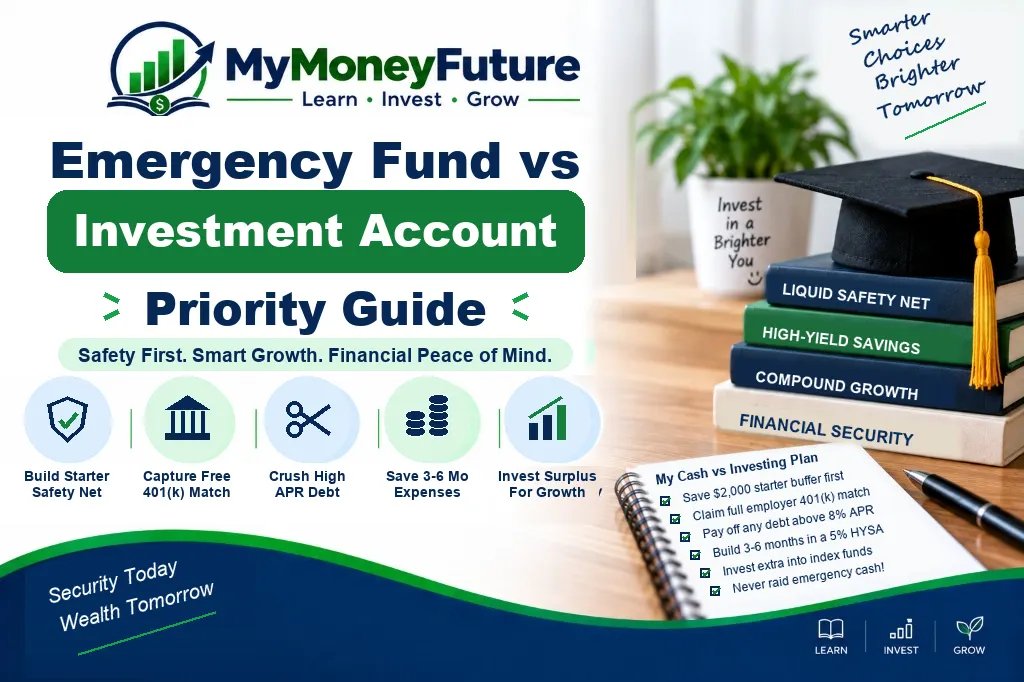
Should You Build an Emergency Fund or Start Investing First is one of the common money questions. Both are vital but they are dealing with different issues.


- Short Answer: Which Should You Fund First?
- Key Financial Takeaways
- What an Emergency Fund Is Used For
- What an Investment Account Is Designed For
- Why Emergency Savings Must Precede Volatile Assets
- The 5-Step Financial Priority List for Beginners
- Interactive Savings vs Investing Priority Calculator
- Understanding Investment Time Horizons (5+ Year Rule)
- When It Pays to Hold Pure Cash Over Stocks
- When Long-Term Investing Trumps Extra Cash Reserves
- The 80/20 Rule: How to Fund Both Simultaneously
- Costly Errors That Derail Wealth Building
- Real World Case Study: Variable Incomes vs Corporate Stability
- Sample Priority Action Plan
- Frequently Asked Questions
- Final Verdict: Strategic Harmony
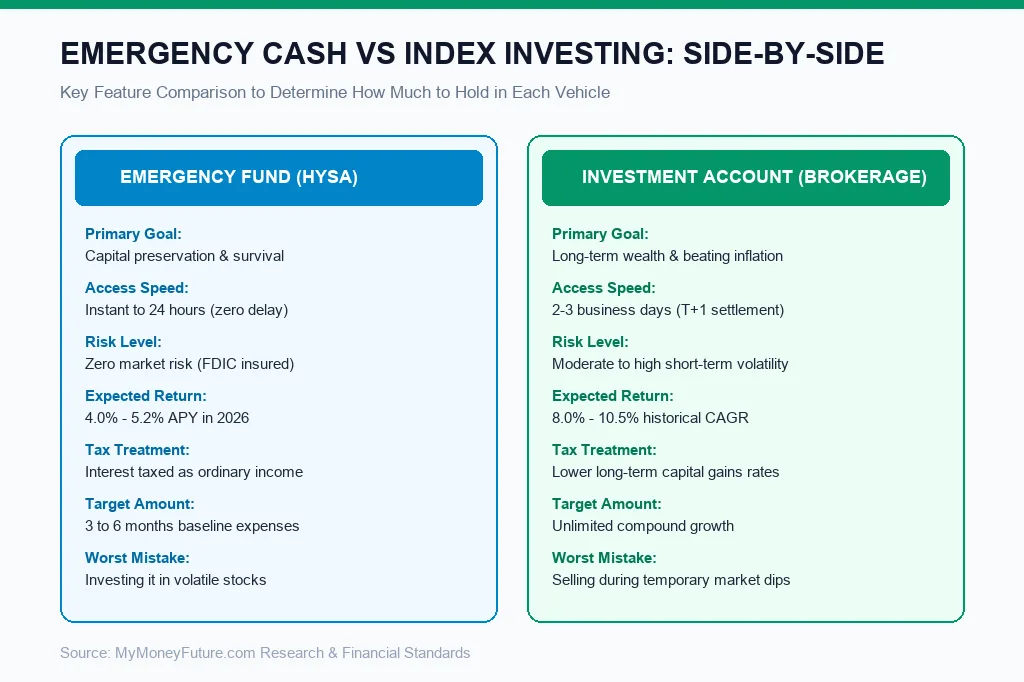
An emergency fund helps you protect yourself from short-term financial shocks. A good way to accumulate wealth over the long run is using an investment account. The issue is that the money spent on one goal can’t always be spent on the other goal at the same time.
Keeping too much cash can cause inflation to progressively erode your purchasing power. If you buy too quickly, a layoff or auto repair could compel you to sell investments at the worst possible time.
The appropriate response is generally not all cash or all investing. Most people need a step-by-step priority structure that first guaranties safety and then begins to generate riches.
Short Answer
Most newbies need to establish a basic emergency fund before they become active investors. Start with enough cash to cover a few brief crises. Then build that fund to cover three to six months of critical needs while you invest. If you have high-interest debt, balance emergency funds with debt payoff before investing too significantly.
Key Takeaways
| Importance | Meaning |
| First the emergency. | Cash safeguards you from surprises with debts and lack of work. |
| Investing creates riches | Investments are preferable for long term goals, not acute emergencies. |
| Take incremental steps if needed | Start-up fund can stop additional debt. |
| High interest debt is key | You might want to pay off expensive debt before you start investing big. |
| Balance is achievable. | Once you have basic stability you can invest and save simultaneously. |
What an emergency fund is used for
An emergency fund is money saved for unexpected expenses. This isn’t money for holidays, or shopping or for an investing fund for the future. It’s your financial shock absorber.
Common emergencies include the loss of a job, medical bills, car repairs, house repairs, urgent travel or a sudden decline in income. Without cash, these things tend to be credit card debt or personal loans.
Emergency reserves should be low risk and easily accessible. Usually, this is a savings account, money market account or other safe cash account. The objective is not a high return. It’s availability, full stop.
The Consumer Financial Protection Bureau advocates establishing an emergency savings goal and developing a structure for regular contributions. Their important guide to building an emergency fund emphasizes how regular recurring transfers can make saving easier.
What an Investment Account is Used For
An investing account is meant to increase over time. Stocks, bonds, mutual funds, ETFs, retirement accounts and brokerage accounts can grow your money faster than cash over lengthy periods of time.
But investments go up and down. The stocks that perform well this year may perform poorly next year. This is typical, but it makes investing a bad location to put money you might need next month.
Time is the power of investment. The longer you invest thru the cycles, the better compounding works. Compound interest is interest on the interest as well as the principal. Investor.gov explains it and has tools that let you see how regular donations might grow.
That’s why an investment account is better for goals like retirement, long-term wealth, education savings or financial independence. Not so good for emergency repairs, or for income replacement next week.
Why First Emergency Savings
An emergency fund is normally first since it covers the rest of your strategy. If you invest all of your money, and have no cash buffer, one emergency can put you in debt.
Say you spend $1,000 and two weeks later your car needs a $900 repair, for example. If you don’t have money, you can charge the repair to a credit card. If the card has a high interest rate, the expense of the debt could offset the benefit of getting into investing early.
Money is power to decide. It helps you steer clear of payday loans, late penalties, overdrafts, missed payments and panic selling of investments.
That doesn’t mean you need a full six months of emergency savings before you start investing anything. That means don’t disregard cash protection in the pursuit of returns.
Simple Priority List for Beginners
A sensible order can cut down on confusion. First, pay your essential bills and ensure you are current on required payments. Second, prepare a tiny emergency beginning fund. Third, fight excessive interest debt. Fourth, begin or continue investing for long-term goals. Fifth, increase the emergency fund to a more substantial amount.
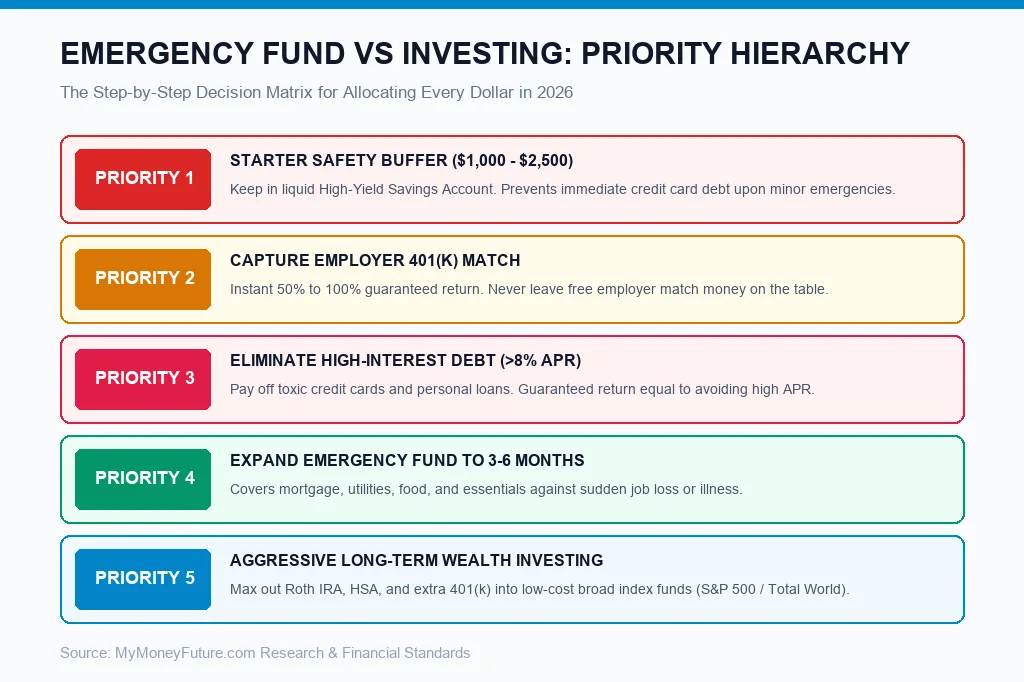
This sequencing is good, since each stage builds on the one before. A beginning emergency fund stops new debt. Less debt means more cash flow each month. Then investing becomes easier with fewer emergencies and payments disrupting the plan.
The exact order can vary if your business has a retirement match. If there is an employer match, donating enough to get the entire match can be very helpful, if your basic emergency cash is not zero.
Imagine it like building a house. Cash is the base. The frame is debt control. Growth is driven by investment. The rest of the construction is more susceptible to harm because of a weak foundation.
What Size Emergency Fund Do You Need?
Emergency Fund vs Investing Priority Calculator
Input your financial numbers to determine your exact emergency cash cushion and recommended next-dollar allocation.
There is no perfect number that fits everyone. Three to six months of necessary spending is a frequent goal. But the novices might start smaller.
A basic emergency fund of $500-$1,000 can take care of a lot of modest difficulties. It won't cure a job loss, but it can avoid small setbacks from becoming debt.
How much you should have depends on work security, family size, health, insurance, debt, property ownership, and income predictability. A person with a steady salary may need less than a single parent with dependents and a sporadic income.
Use needed expenses, not all lifestyle spending. The basics usually include shelter, utilities, food, insurance, transportation, minimum debt payments, child care and minimal medical expenses.
| Position | Proposed Cash Target |
| Single steady employment, low debt | You might be able to begin by setting aside three months of necessary costs. |
| Family w/ kids | Maybe four to six months sounds better. |
| Income from commission or self employment | Six to twelve months might be more realistic. |
| Home owner | Add for repairs and insurance deductibles. |
| Debt at high interest | Keep the startup cash and then attack the debt payoff. |
Investing Timeframe
You want to start investing when your financial situation is simple enough that you probably won’t need to access the money you’re investing for a while. It doesn't have to be perfect.
Start modest with retirement contributions and still accumulate cash. The habit is key. Investing $ 50 a month won’t make you rich overnight but it teaches consistency and starts compounding.
Once you have some emergency cash, consider contributing enough to your workplace retirement match to get it. You get a match as part of your compensation and to lose that for years can be very pricey.
Be more conservative for non-retirement investment. Money you'll need in one to three years shouldn't really be in equities, it should be in cash or very low-risk options. Market volatility can hurt when the time horizon is short.
When it’s time to cash in, not invest
If your income is inconsistent, you’re behind on bills, you have no emergency savings, or you foresee a large expense to come along soon, you should have cash on hand before you invest.
If you have high insurance deductibles, an ancient car, a property that requires repairs or family members who rely on your salary, cash should be a priority, too.
Another danger flag is dependency on credit cards. If you tend to use a card because cash vanishes before payday, investment is not the first answer. The first fix is cash flow and emergency savings.
High-interest emergency borrowing won’t help much if you have a great investment return. The return on investment can be protecting yourself against debt itself.
When Spending Trumps Extra Cash
When you get your emergency fund well established, holding too much cash might be a drag on you. Cash is safe, but usually it doesn’t grow enough to meet long-term goals, such as retirement.
If you’ve already saved six months’ worth of expenses and have no high-interest debt, for example, investing for retirement or long-term prosperity may be more effective than stuffing every extra dollar into cash.
The aim of cash is to safeguard you. The aim of investment is growth. When protection is sufficient, the focus should move more to growth.
That’s where a lot of folks stall out. They keep saving because investing seems dangerous. But you need some exposure to growth assets to achieve long-term goals. It's not only that you lose money in a market slump. It is also not growing fast enough to meet future needs.
How to Balance Both at the Same Time
You don't have to pick one and stick with it. A lot of folks may put some extra dollars into emergency savings and investment.
For example, if you had $400 extra a month and no emergency fund, you may put $300 into savings and $100 into retirement. Once you have built up your initial capital, you might go to $200 savings and $200 investing. Once you build up the full emergency fund, most of the $400 can be used for investing or other purposes.
The right split is a function of urgency. If you’re one emergency away from debt, prioritize savings. If you have a solid cash reserve and lagging retirement savings, favor investment.
Make the divide automatic Manual transfers demand will power. The choice is made a system with automatic transfers.
Frequent Errors
The first mistake is investing without a cash buffer. This can lead to credit card debt or forced selling in a downturn.
The second mistake is holding emergency reserves in hazardous investments. A stock portfolio may be great for retirement, but it can drop when you need money the most.
Mistake number three is waiting to invest for years until you have a great emergency fund. If you are employed and have some money to begin with, you can make tiny contributions and grow your retirement savings over time.
The fourth mistake is thinking that your emergency money is extra spending money. If you touch the fund for anything other than emergencies, it will not be there when life gets pricey.
• Mistake #5 – Ignoring high-interest debt Generally, trying to earn 7% in the market and pay 20% interest is not a good approach.
Expert Tips
Keep emergency savings separate from your everyday checking account. If the money is too easy to spend it will be gone on ordinary goods.
What's the account name? Label it a ‘Emergency Fund’ or ‘Safety Fund’ and it removes the temptation to dip into it on a whim.
If you’re a newbie, start investing with broad, straightforward choices. You don’t need a complex portfolio to start learning.
Reassess your cash goal following major life events. A new baby, mortgage, career shift, move, illness emergency or business launch can all modify how much safety net you require.
Take windfalls with care. You may build up emergency savings fast without impacting your typical monthly budget by using tax refunds, bonuses and gifts.
Real World Example: Two People, Different Priorities
Then take two persons who make the same amount. Priya has no emergency savings, no credit card debt and a solid work. She can quickly develop a basic emergency fund, then divide money between savings and retirement contributions. Her biggest worry isn’t debt, it’s not having a cash buffer.
Now think about Daniel. He has $800 in savings, but he also has a high-interest charge on his credit card. He’s probably better off just keeping the initial cash, stopping new charges, and sending most of the extra money to the credit card before investing further.
They are both making intelligent choices, even if their priorities seem different. Personal finance isn’t a one size fits all checklist: Depends on the issue that may be hurting you the most right now.
The point is not to make drastic decisions. “Not carrying cash is dangerous. But not investing for 10 years can be risky too. A reasonable plan preserves the short term and builds the long term gradually.
Sample Priority Plan
| Stage | Action | Why That Matters |
| Stage One | Save the first $500-$1000 | Takes care of little crises without borrowing. |
| • Level 2 | Attack high interest debt. | Lowers costly interest charges. |
| Step 3 | If offered, contribute to employer match | Offers good compensation perks. |
| Stage Four | Emergency fund for 3-6 months | Prevents higher costs or loss of jobs. |
| Step 5 | Improve long term investing | Builds wealth and retirement over time. |
Frequently Asked Questions
Q: Should I invest first or save an emergency fund?
A: Most newcomers should first construct a basic emergency fund, then invest while expanding financial reserves over time.
Q: How much money do I need to save before I invest?
A: $500-$1,000 to start can be helpful, but many people eventually sock away enough to cover three to six months of necessary costs.
Q: Can I invest while I’m building my emergency fund?
A: Yes, particularly if you have a stable income and employer match. Just don't put in any money you may need soon.
Q: How do I save my emergency savings?
A: Store it in a safe, easily accessible account, such as a savings or money market account. Don’t put your emergency cash in hazardous places.
Q: What if I owe on credit cards?
A: First build a little cushion and then attack high-interest debt aggressively and don't take on additional debt!
Q: Is having too much emergency savings bad?
A: Having too much cash can hurt long-term wealth growth. Once your safety fund is solid, extra money can be better spent on investment or other priorities.
Q: Should rent and groceries be included in my emergency fund?
A: Yeah. Use basic expenses such as housing, utilities, food, insurance, transportation and needed debt payments
Q: What are the risks of investing without an emergency fund?
A: Yes. If you don’t have emergency funds, you may need to borrow or sell investments in a market downturn.
Q: How often should I review my emergency fund?
A: Review it at least once a year, or after any major life changes such as a new job, child, mortgage or change in income.
Q: What’s the right mix of saving and investing?
A: This is contingent upon your stability. The best balance is… If the danger is large, go cash. When your safety net is strong, go investment.
Senior Financial Editor's Action Plan: Cash vs Growth
Never treat an emergency fund and an investment account as competitors—they are defensive and offensive teammates. Your emergency fund defends your investment portfolio so you never sell stocks at a 30% loss to fix a transmission or pay a doctor's bill.
Your Optimal Step-by-Step Capital Allocation:
- Step 1: Deposit $1,500 - $2,500 into a high-yielding High-Yield Savings Account earning 4.5% - 5.2% APY.
- Step 2: Capture 100% of employer 401(k) matching dollars (instant 100% risk-free return).
- Step 3: Pay off toxic credit card and personal debt balances compounding above 8% APR.
- Step 4: Expand liquid reserves to 3-6 months, then route surplus into broad market index funds.
Preparing for early retirement? Check out our in-depth numbers guide on How To Retire At 40.
Final Verdict: Balancing Safety and Growth
Having an emergency fund or investing is not a one-time decision. It’s a prioritization system.
Emergency funds defend your present. Invest to Build Your Future. Both are needed. But most beginners need to build up basic cash protection before investing actively.
You can build a small emergency fund and keep current on your expenses, work on expensive debt, and begin investing as your foundation grows .
The best plan is not the one that appears most spectacular. It’s the one that stops you from losing your mind, stops you from taking on additional debt and helps your money grow over the years.
Education Disclaimer
This post is for educational and informational purposes only and should not be construed as financial, investing, tax or legal advice. Your income, debt, risk tolerance, employment stability, family needs, and ambitions all affect your savings and investing selections. Before you make any big financial decisions, talk to a certified financial professional.
Explore Free Interactive Financial Calculators
Put these insights into practice with our 7 free financial planning and net-worth growth calculators: