
The 25x rule is a popular starting rule. This means you take your annual expenses and multiply them by 25. It is associated with a 4% initial withdrawal rate although early retirees tend to take a more conservative strategy given their longer retirement horizon.
For example, if you spend $40,000 a year, then 25x costs is $1 million. If you spend $80,000 each year, 25x is $2M.
But retiring at 40 is different than retiring at 65. The plan can be made safer by a reduced withdrawal rate, extra cash reserve, part-time income or a bigger portfolio.
Simple Calculator for Retiring at 40
Retire at 40: FIRE Portfolio Nest Egg Calculator
Calculate your required liquid nest egg and annual withdrawal buffer based on realistic living expenses.
Here’s a trivial example. For example, you spend $50,000 a year. Your goal is to get to $1,250,000 at 25x. The goal is to get to $1,500,000 at 30x.” At 33x, your aim is around $1,650,000.
The more conservative figure provides you with greater cushion for market downturns, inflation, healthcare bills and life events.
If you want to retire at 40, don’t just ask yourself if the math works in a spreadsheet. “You should ask if it still works after a bad market year, a medical bill, higher rent, or a family change.”
It’s not so much about finding that perfect number to retire early, but more about creating a plan that can withstand unexpected.
| Annual Spending | 25x Target | 30x Target | 33x Target |
| $30,000 | $750,000 | $900,000 | $990,000 |
| $40,000 | $1,000,000 | $1,200,000 | $1,320,000 |
| $50,000 | $1,250,000 | $1,500,000 | $1,650,000 |
| $75,000 | $1,875,000 | $2,250,000 | $2,475,000 |
| $100,000 | $2,500,000 | $3,000,000 | $3,300,000 |
How Much You Need Based on Annual Spending
Step 3: Know Your Savings Rate
Your savings rate is the percentage of your income you save and invest. It’s one of the top reasons for retiring early.
It’s normal to save 10%, but that will usually not get someone to retirement at 40 years old unless they start very young, achieve very high returns or have a big windfall.
Most early retirement programs entail saving 40%, 50% or even 60% of take-home income. That sounds excessive, but retiring decades early is an extreme desire.
There are only three ways to make math better: make more money, spend less money, or invest consistently over time. Nearly every single one of the most successful early retirees uses all three.
Step 4: Pick a realistic investment plan
Retiring at 40 typically cannot be funded by cash alone. Safe accounts may not grow enough and inflation might eat into cash value over decades.
Diversification
Most early retirement plans rely on a diverse investment portfolio. These could be stock index funds, bond funds, cash, real estate, retirement accounts, taxable brokerage accounts, or company revenue.
Asset Allocation Matters
Your portfolio has to find a balance between growth and stability. Investor.gov’s guide to asset allocation and diversification says asset allocation is dividing your investments amongst asset categories including equities, bonds and cash, and the proper mix relies on your time horizon and your risk tolerance.
Often a young early retiree still requires growth, because retirement might last a very long time. But too much exposure to equities can cause emotional and practical hardship when the market plunges.
Step 5: Prepare For Health Care Before Medicare
One of the most difficult aspects of early retirement is health care. In the US, Medicare typically starts at 65, so someone retiring at 40 has plenty of time to plan for coverage.
Options can include a spouse’s employer plan, marketplace insurance, private insurance, health sharing arrangements, international living, part-time work with benefits, or a greater healthcare reserve.
Don’t regard health care as a small line item. Premiums, deductibles, medicines, dental care, vision care and unforeseen medical requirements can all change the retirement calculations quickly.
Outside the United States the healthcare system may be different but the fundamental is the same, know what coverage costs before you stop work.
Step 6: Know Your Taxes and How to Access Your Account
Retiring at 40 is an account access concern. You may have money in retirement accounts that you can’t access without taxes or penalties until you reach certain ages.
For this reason, many early retirees construct a mix of accounts. Taxable brokerage account provides flexible access. Retirement accounts can still increase for future years. Cash will handle short term needs. Roth contributions, conversion ladders, and other measures can aid in some instances, but they need to be carefully planned.
According to the IRS, if you are under age 59½, you may be subject to an additional 10% tax on early distributions from some retirement plans unless an exception applies. That regulation makes tax planning essential for anyone who wants to retire decades before the typical retirement age. IRS guidance on early retirement distributions
Don’t design a plan that appears good on paper but is impossible to get at without consequences. The location of your money is important.
Step 7: Add Social Security Carefully
If you live in the United States, Social Security may be a part of your later retirement income, but it shouldn’t be the bedrock of a retire-at-40 plan.
Your Social Security payments are based on your lifetime earnings and when you claim. You can apply for retirement benefits from the Social Security Administration at any age from 62 to 70, and the amount is bigger the longer you wait up to age 70.
For example, if you retire at age 40, you may have less years of high-earning income than someone who works until they are 65 years old. This could impact on future advantages.
If you’re planned for early retirement, count on Social Security as a later layer of support, not an excuse to under-save in your 30s and 40s.”
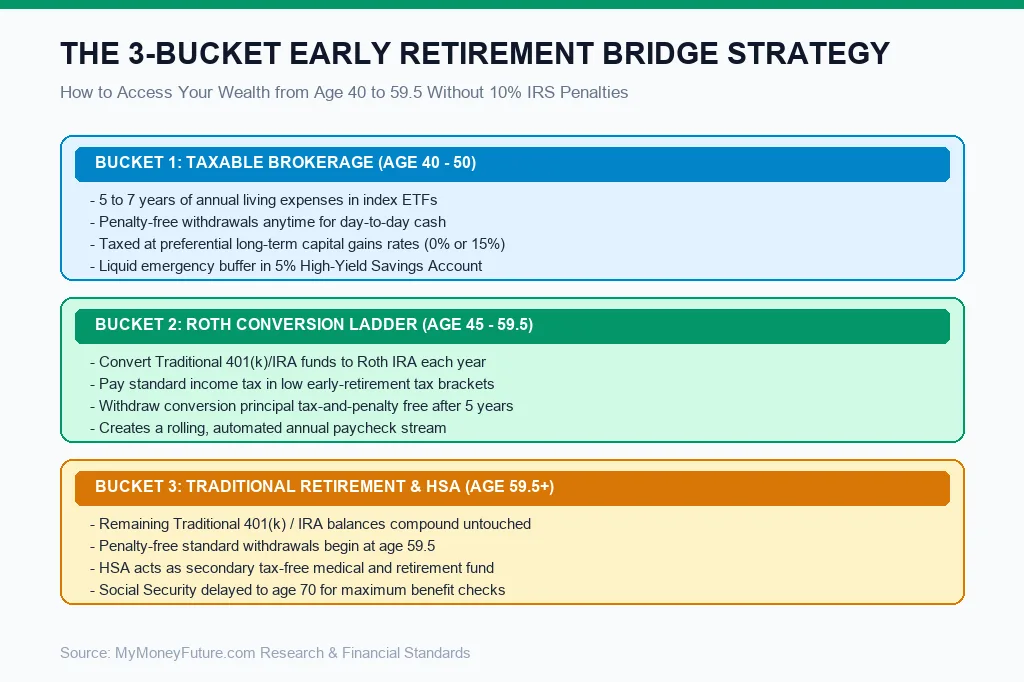
Step 8: Create a Bridge Strategy
A bridge strategy is a method of bridging the period between leaving full-time work and accessing sources of later life income.
Retiring at 40 is doable, it’s not casual math tho. You need to know your expenses, savings rate, investment plan, tax exposure, health care costs and backup plans.
A simple 25x target might be a starting place, but a 40-year-old retiree usually needs a bigger cushion than a traditional retiree. Longer timelines mean more uncertainty.
It’s not really about just stopping work. The aim is to have enough freedom that employment is optional without compromising your future.
Just because the numbers aren’t there now doesn’t mean the goal isn’t achievable. Increase income, cut costs, invest regularly, and increase flexibility. Retirement early is often constructed one decision at a time.
Educational Note
This post is for educational and informational purposes only and should not be considered advise regarding financial matters, taxes, law, or investments. When planning for an early retirement, income, expenses, taxes, healthcare, investment returns, risk tolerance, location, and personal goals all matter. If you are leaving work or thinking of a change in retirement methods, consider speaking with a skilled financial planner or tax specialist.
Retiring at 40 sounds like a fun idea, but the math is serious. You are not saving for a typical 20 year retirement. You may need your money to last 45, 50 or even 60 years.


- Fast Response: How Much You Need
- Key Financial Reality Check Points
- Step 1: Calculate Your Real Annual Spending
- Step 2: Determine Your FIRE Number
- Interactive FIRE Calculator
- Step 3: Required Savings Rate (50%+ Rule)
- Step 4: Resilient Asset Allocation Portfolio
- Step 5: Pre-Medicare Health Insurance Plan
It means early retirement is about more than just a hefty financial account. You need modest costs, a high savings rate, a realistic withdrawal plan, healthcare planning, tax strategy, and flexibility when markets or life don’t behave properly.
The true question is not only, ‘Can I leave work at 40?’ The better question is “Can my assets support my life reliably without pushing me back to work under duress?”
This guide covers the facts behind retiring at 40, including how to calculate your target portfolio, savings rate, investment needs and hazards that many early retirement plans overlook.
Fast Response
If you want to retire at 40, estimate your annual expenses, multiply them by 25 to 33 or more, and amass enough invested assets to fund decades of withdrawals. Someone spending $50,000 a year may need $1.25 million to $1.65 million or more depending on taxes, healthcare, inflation and risk tolerance.
Key points
| Important Point | What It Means |
| It’s an expense driven number. | Your spending is more important than your salary. |
| 25x is the beginning point. | You may need a bigger cushion for long retirements. |
| Health care is a huge gamble | If you’re retiring before you’re eligible for Medicare, you’ll need a plan. |
| Taxes are Important | The kind of account and order of withdrawals impact your net income. |
| Adaptability is key | Working part-time or less can also help protect the plan. |
Step 1: Know Your Yearly Expenses
The first number you need is not your salary. This is your yearly expenditure. Track your outflows by following a structured monthly budget plan to eliminate waste without sacrificing quality of life.
Imagine someone making $200,000 and spending $180,000 vs someone earning $90,000 and spending $40,000. The latter is more likely to hit early retirement. Early retirement is based on the difference between income and expenses.
Track your actual spending for at least six to twelve months. Include accommodation, food, insurance, transportation, travel, subscriptions, presents, taxes, healthcare, repairs, and other irregular expenses.
Don’t use your best month for the estimate. Use a realistic average. Early retirement plans fail because people underestimate the costs of normal living.
Step 2: Determine Your FIRE Number
Your FIRE number is the amount of invested assets you need to cover your living expenditures without a traditional job. FIRE is Financial Independence, Retire Early.
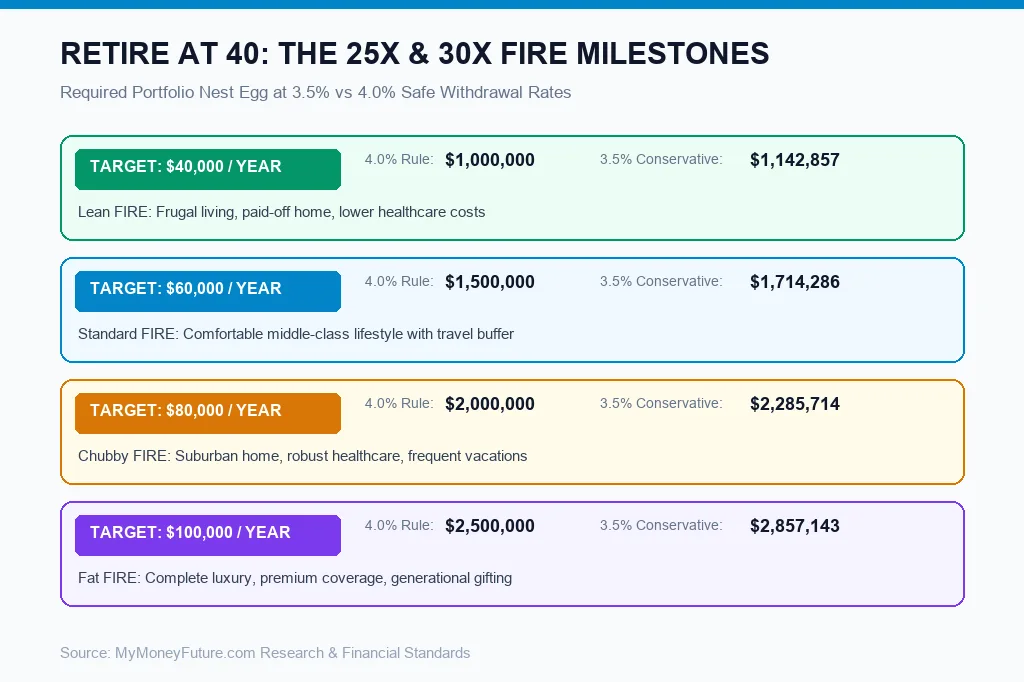
The 25x rule is a popular starting rule. This means you take your annual expenses and multiply them by 25. It is associated with a 4% initial withdrawal rate although early retirees tend to take a more conservative strategy given their longer retirement horizon.
For example, if you spend $40,000 a year, then 25x costs is $1 million. If you spend $80,000 each year, 25x is $2M.
But retiring at 40 is different than retiring at 65. The plan can be made safer by a reduced withdrawal rate, extra cash reserve, part-time income or a bigger portfolio.
Simple Calculator for Retiring at 40
Retire at 40: FIRE Portfolio Nest Egg Calculator
Calculate your required liquid nest egg and annual withdrawal buffer based on realistic living expenses.
Here’s a trivial example. For example, you spend $50,000 a year. Your goal is to get to $1,250,000 at 25x. The goal is to get to $1,500,000 at 30x.” At 33x, your aim is around $1,650,000.
The more conservative figure provides you with greater cushion for market downturns, inflation, healthcare bills and life events.
If you want to retire at 40, don’t just ask yourself if the math works in a spreadsheet. “You should ask if it still works after a bad market year, a medical bill, higher rent, or a family change.”
It’s not so much about finding that perfect number to retire early, but more about creating a plan that can withstand unexpected.
| Annual Spending | 25x Target | 30x Target | 33x Target |
| $30,000 | $750,000 | $900,000 | $990,000 |
| $40,000 | $1,000,000 | $1,200,000 | $1,320,000 |
| $50,000 | $1,250,000 | $1,500,000 | $1,650,000 |
| $75,000 | $1,875,000 | $2,250,000 | $2,475,000 |
| $100,000 | $2,500,000 | $3,000,000 | $3,300,000 |
How Much You Need Based on Annual Spending
Step 3: Know Your Savings Rate
Your savings rate is the percentage of your income you save and invest. It’s one of the top reasons for retiring early.
It’s normal to save 10%, but that will usually not get someone to retirement at 40 years old unless they start very young, achieve very high returns or have a big windfall.
Most early retirement programs entail saving 40%, 50% or even 60% of take-home income. That sounds excessive, but retiring decades early is an extreme desire.
There are only three ways to make math better: make more money, spend less money, or invest consistently over time. Nearly every single one of the most successful early retirees uses all three.
Step 4: Pick a realistic investment plan
Retiring at 40 typically cannot be funded by cash alone. Safe accounts may not grow enough and inflation might eat into cash value over decades.
Diversification
Most early retirement plans rely on a diverse investment portfolio. These could be stock index funds, bond funds, cash, real estate, retirement accounts, taxable brokerage accounts, or company revenue.
Asset Allocation Matters
Your portfolio has to find a balance between growth and stability. Investor.gov’s guide to asset allocation and diversification says asset allocation is dividing your investments amongst asset categories including equities, bonds and cash, and the proper mix relies on your time horizon and your risk tolerance.
Often a young early retiree still requires growth, because retirement might last a very long time. But too much exposure to equities can cause emotional and practical hardship when the market plunges.
Step 5: Prepare For Health Care Before Medicare
One of the most difficult aspects of early retirement is health care. In the US, Medicare typically starts at 65, so someone retiring at 40 has plenty of time to plan for coverage.
Options can include a spouse’s employer plan, marketplace insurance, private insurance, health sharing arrangements, international living, part-time work with benefits, or a greater healthcare reserve.
Don’t regard health care as a small line item. Premiums, deductibles, medicines, dental care, vision care and unforeseen medical requirements can all change the retirement calculations quickly.
Outside the United States the healthcare system may be different but the fundamental is the same, know what coverage costs before you stop work.
Step 6: Know Your Taxes and How to Access Your Account
Retiring at 40 is an account access concern. You may have money in retirement accounts that you can’t access without taxes or penalties until you reach certain ages.
For this reason, many early retirees construct a mix of accounts. Taxable brokerage account provides flexible access. Retirement accounts can still increase for future years. Cash will handle short term needs. Roth contributions, conversion ladders, and other measures can aid in some instances, but they need to be carefully planned.
According to the IRS, if you are under age 59½, you may be subject to an additional 10% tax on early distributions from some retirement plans unless an exception applies. That regulation makes tax planning essential for anyone who wants to retire decades before the typical retirement age. IRS guidance on early retirement distributions
Don’t design a plan that appears good on paper but is impossible to get at without consequences. The location of your money is important.
Step 7: Add Social Security Carefully
If you live in the United States, Social Security may be a part of your later retirement income, but it shouldn’t be the bedrock of a retire-at-40 plan.
Your Social Security payments are based on your lifetime earnings and when you claim. You can apply for retirement benefits from the Social Security Administration at any age from 62 to 70, and the amount is bigger the longer you wait up to age 70.
For example, if you retire at age 40, you may have less years of high-earning income than someone who works until they are 65 years old. This could impact on future advantages.
If you’re planned for early retirement, count on Social Security as a later layer of support, not an excuse to under-save in your 30s and 40s.”
Step 8: Create a Bridge Strategy
A bridge strategy is a method of bridging the period between leaving full-time work and accessing sources of later life income.
The bridge may be cash reserves, taxable investments, part-time consultancy, rental income, dividends, a spouse’s income, business income, or planned Roth conversions.
For example, maybe someone retires at 40 and uses taxable investments and cash from 40 to 55, then begins to use some of the retirement options later on, and eventually relies partially on Social Security or pension income after traditional retirement age.
Why does the bridge matter? Because early retirement has stages. The money you need at 42 might not come from the same location as the money you need at 72.
Step 9: Stress Test the Plan
Retirement with a spreadsheet looks easy. A stress test addresses the question: what happens when life doesn’t follow the spreadsheet?
Test your strategy against poorer investment returns, increased inflation, a market crash in the first five years, higher healthcare expenditures, a home repair, family support needs or a transition back into paid job.
First 10 years of early retirement are a big deal. If markets tumble early and you keep pulling out large sums, you can hurt the portfolio long-term. This is known as sequence-of-returns risk.
A safer plan incorporates flexibility. That could involve spending less in weak markets, holding two years of savings, working part-time or deferring significant purchases.
Typical Mistakes
The first mistake is picking a retirement number that ignores taxes. You don’t spend gross portfolio value You pay with cash after tax.
The second mistake is to underestimate the value of healthcare. Cheap plan with big deductible can still give you big bills.
The third fallacy is to assume that investment returns would be smooth. Markets don’t give average returns in a straight line.
The fourth mistake is retiring without flexibility. A plan that succeeds only under the best of circumstances is not strong enough.
The fifth mistake is thinking that financial freedom means you’ll never earn an income again. Early retirees many times still perform paid projects, consulting, writing, teaching, or commercial work because it offers purpose and safety.
“Expert Advice”
- Before you decide, monitor real spending. Cost estimates are often too low.
- Fund a taxable investing account if you desire flexibility before age 59 ½.
- The traditional retiree may need a bigger cash reserve. If you retire early, you have a longer runway.
- Lifestyle modifications. Marriage, kids, aged parents, changes in housing, health needs…all can affect the calculations.
- Think about the option of phased retirement. Or you can lower your strain and have more freedom by going from full-time work to part-time consultancy.
Retire at 40 with $60,000 Expenses Per Year
Say someone wishes to spend $60,000 per year after they leave full-time job. 25x expenditures thus the aim is $1.5 million. 30x $1.8 million goal. Target is around $1.98 million using 33x.
If this person has no pension and healthcare is paid for, the conservative objective could be somewhat higher. If they also earn $15,000 per year from part-time consulting, the required portfolio could be less because the portfolio just has to cover part of their expenses.
Now, add taxes. If they need $60,000 of spendable money after tax, the withdrawals may need to be higher depending on account type and tax restrictions. If they are in a taxable account, there could be capital gains taxes. If they tap retirement accounts early, penalties may apply unless they have a valid strategy or exception in place.
That’s why budgeting for early retirement is much more than just multiplying spending by a number. The withdrawal source, tax treatment, healthcare plan and flexibility all matter.
FAQ Section
Q: How much money should I have to retire at 40?
A: Depends on annual spend. A common starting point is 25 to 33 times your annual expenses. For someone spending $50,000, they might need $1.25 million to $1.65 million or more.
Q: Can I retire at 40 with the 4% rule?
A: It can be a bit too aggressive for some early retirees as the retirement period can be much longer than a typical retirement. Many folks choose a lower withdrawal rate or have more flexibility built in.
Q: Can you retire at 40 with $1 million?
A: Perhaps, if you have minimal spending, reasonable taxes, covered healthcare and flexibility. May not be adequate for more expensive lifestyles.
Q: How much do I need to save to retire at 40?
A: Many people need to save at a high rate, sometimes 40% to 60% or more, depending on income, age, spending and investment returns.
A: The biggest risk of retiring at 40 is running out of money.
A: Top risks are market declines, health care costs, inflation, taxes, early withdrawal penalties and underestimating expenses.
Q: Should I use retirement accounts if I want to retire early?
A: Yes, but you could also require taxable accounts or other liquid assets to bridge the years until you can access traditional retirement savings.
Q: Does part time employment help you retire at 40?
A: Yeah. Even a tiny income stream can reduce portfolio withdrawals and increase the plan’s longevity.
A: Several key considerations in planning for healthcare if you retire at 40 are:
A: Compare marketplace plans, private insurance, coverage thru a spouse, perks of part-time work and other possibilities. Remember about your premiums and out-of-pocket payments in your plan.
Q: Is it realistic to retire at 40?
A: It is realistic for some high savers, high earners, business owners or very thrifty households. It takes good planning and adaptability.
A: Before you quit your job, do the following:
A: Check on your budget, verify healthcare, understand taxes, get cash reserves, check investments, and have a backup income plan.
Senior Financial Editor’s Action Plan: Retiring at 40
Retiring at 40 is a marathon of aggressive savings discipline and meticulous asset structuring. You cannot rely solely on tax-deferred 401(k) accounts due to the pre-59.5 early withdrawal penalty. Ensure your taxable brokerage account holds at least 5 to 7 years of liquid living expenses before leaving the workforce.
Checklist Before Handing in Your Resignation:
- Bridge Fund: Verify 5+ years of expenses in taxable brokerage accounts or Roth contribution principal.
- Cash Reserve: Keep 12-18 months of expenses in a High-Yield Savings Account to prevent sequence-of-returns risk.
- Healthcare Budget: Line-item ACA marketplace premiums and out-of-pocket maximums ($12k-$18k/yr).
- Emergency Liquidity: Prioritize an intact Emergency Fund separate from your volatile growth portfolio.
Bookmark this guide and explore our Core Investing Principles to optimize your compounding curve.
Summary
Retiring at 40 is doable, it’s not casual math tho. You need to know your expenses, savings rate, investment plan, tax exposure, health care costs and backup plans.
A simple 25x target might be a starting place, but a 40-year-old retiree usually needs a bigger cushion than a traditional retiree. Longer timelines mean more uncertainty.
It’s not really about just stopping work. The aim is to have enough freedom that employment is optional without compromising your future.
Just because the numbers aren’t there now doesn’t mean the goal isn’t achievable. Increase income, cut costs, invest regularly, and increase flexibility. Retirement early is often constructed one decision at a time.
Educational Note
This post is for educational and informational purposes only and should not be considered advise regarding financial matters, taxes, law, or investments. When planning for an early retirement, income, expenses, taxes, healthcare, investment returns, risk tolerance, location, and personal goals all matter. If you are leaving work or thinking of a change in retirement methods, consider speaking with a skilled financial planner or tax specialist.
Explore Free Interactive Financial Calculators
Put these insights into practice with our 7 free financial planning and net-worth growth calculators: