

Introduction
Staking crypto is one of the most popular ways for investors to make passive income from digital currencies. Instead of merely storing coins in a wallet, staking allows you to lock or delegate specific crypto assets to maintain a blockchain network and earn rewards.
The idea is simple: hold crypto, stake it and earn rewards. In the actual world, the decision is more complex. There are no guaranties on staking rewards, crypto prices can crash, systems can be compromised, and some staking products have regulations that newbies might not comprehend at first.
That doesn’t imply we should disregard stake. So that means it must be done with caution and with clearly defined expectations. A high advertized return is not equivalent to safe income. The incentive only matters if the underlying asset, platform, validator and custodial configuration is sound.
This post will show you how to stake bitcoin and earn passive income in 2026 without treating it like free money. You’ll find out how staking works, which options are available to novices, what hazards to look out for, how taxes could come into play, and how to create a safer staking plan.
The quick answer
Crypto staking allows you to earn rewards by locking or delegating specific proof-of-stake crypto assets to help support a blockchain network. Beginners can stake thru exchanges, wallets, staking pools or liquid staking platforms, but should compare lockups, fees, custody risk, validator quality, tax restrictions and the risk of losing money if crypto values fall.
Key Points
| Important Point | significance |
| Staking Is Not Free Money | Rewards are subject to market risk, platform risk, validator risk and tax issues. |
| Not all crypto is stakeable | Staking is usually for proof-of-stake networks, not every coin. |
| Custody Issues | Who owns the private keys is what determines your risk and flexibility. |
| Yield is not the only factor | Price decreases, surcharges, lockups or slashing can counterbalance high reward rate. |
| Potentially Taxable | In many jurisdictions, staking awards might give rise to taxable income or capital gains difficulties. |
What is staking crypto?
Staking is related to proof-of-stake blockchains. The validators in these networks verify transactions, Add blocks and help keep the network running. In this process, validators are typically required to lock up a specific amount of the network token.
When you stake, you are generally doing one of two things. Or you can run your own validator which is more technical and may demand a higher quantity of coin. Or otherwise, you might delegate your tokens to another person who operates the validator for you.
And the network can, in turn, pay rewards. These incentives are typically given out in the same crypto asset that was staked. For instance, staking a proof-of-stake token may produce more of that token over time.
The word passive is confusing. Staking doesn’t take everyday trading, but it does take research. You need to know where the assets are, whether they’re locked, how rewards are paid out, who has the keys, and what can go wrong.
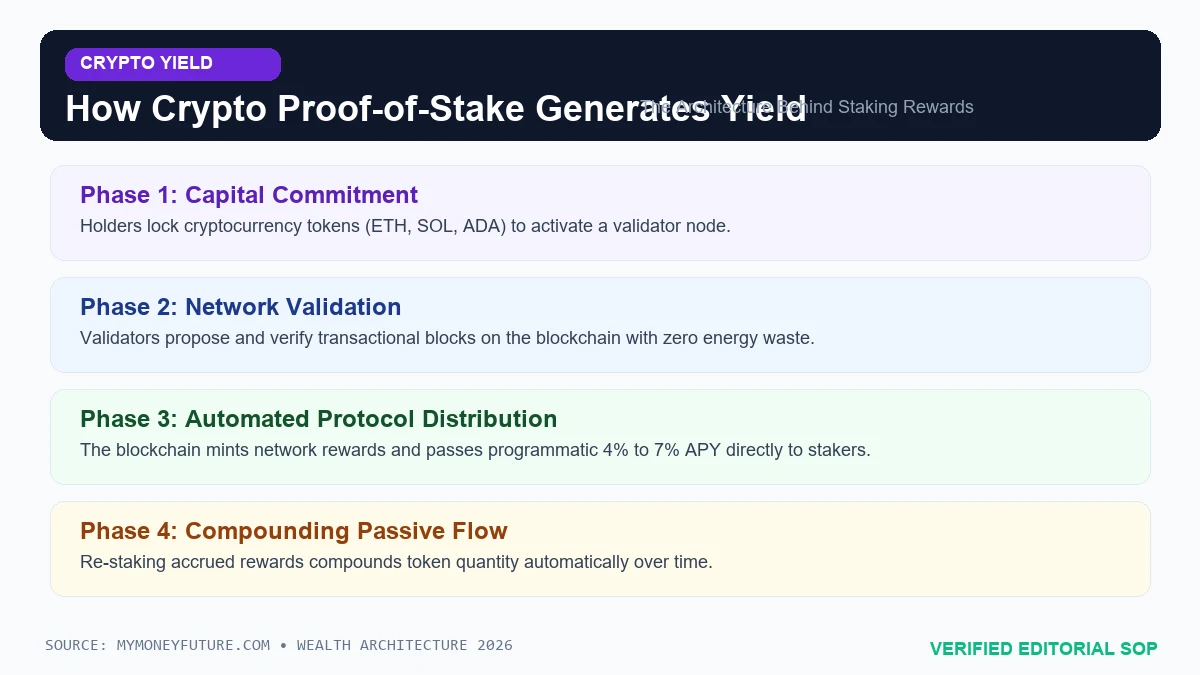
How Staking Rewards Are Created
Staking rewards often come from the blockchain system. Validators help to process transactions and keep the network safe. The rewards can be either newly minted tokens, transaction fees, or a combination of the two.
Rewards rate may differ. It is contingent upon network activity, the amount of staked tokens, validator performance, inflation laws and protocol upgrades. The advertized 6% staking yield today may not be 6% permanently.
Rewards may be lowered for platform costs. When a staking provider tells you about a projected annual reward, check if that value is before or after costs. Also, see if incentives are auto-restaked or paid to your account.
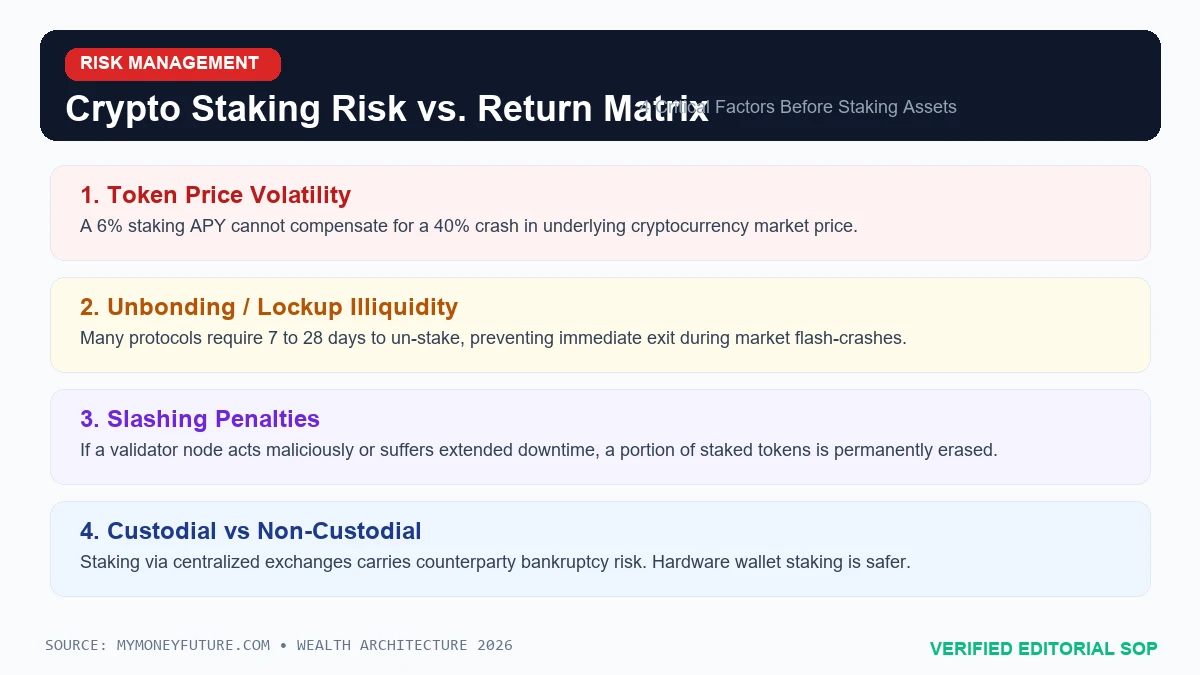
The biggest thing to note is that staking income is typically paid in crypto. If the price of the token drops 40% a 5% reward isn’t going to save your dollar worth. As your total investment value lowers, staking might help you raise the quantity of tokens you hold.
Popular Crypto Staking Methods
| Staking Process | How It Works | Ideal For | Primary Risk |
| Staking on centralized exchange | You trade using an exchange account and the platform does the technical work. | Great for beginners | Fees, little control Platform failure |
| Delegation of wallets | Supported wallets hold your assets and delegate them to a validator. | Users looking for more control | Choosing a weak validator or loss of wallet access |
| Validator activities | You run validator software and satisfy network requirements. | Technical Abilities of Expert User | Downtime, slashings, hardware and operational risk |
| Pool de Staking | Many users pool assets to fulfill staking thresholds. | Small investors not able to run a validator | Rules, fees and trust assumptions of the pools |
| Liquid staking | Rewards pile up. You receive a token that represents the staked assets. | Users that need liquidity | Smart Contract Risk, Protocol Risk, Depeg Risk |
1. Staking Via a Centralized Exchange
The most common place to begin by staking is frequently exchanges. You hold eligible crypto on a platform, pick a staking option, and the exchange manages validator activities behind the scenes.
This is useful as you don’t have to master the technical tools. You may also view estimated rewards, lockup periods, and withdrawal alternatives all from a one dashboard.
The tradeoff: control. You might not control the private keys. The platform can define withdrawal regulations, take fees, define maximum assets, adjust staking conditions. In case of legal, operational or liquidity issues with the platform, it could impact your ability to access your funds.
Newbies should learn about custody before they start utilizing a platform. The SEC Investor.gov advisory on crypto asset custody basics offers essential questions investors should ask about how crypto assets are maintained and accessed.
2. Staking With a Crypto Wallet
Wallet staking provides you more power than most exchange staking allows. In many circumstances you will hold your tokens in a non-custodial wallet and delegate them to a validator.
This can lower the danger of platform custody but raises personal responsibility. You want to keep your seed phrase safe, choose your validators wisely, watch out for unstaking periods, and avoid bogus wallet links or phishing sites.
Delegating does not always mean that the validator can take your tokens. On many networks the validator receives the voting/validation authority but the assets are still in your wallet. But the specific restrictions rely on the blockchain itself.
For folks who already understand wallets, private keys, and fundamental crypto security, wallet staking is frequently a good second step.
3. How to run your own validator
The most straightforward way to stake is to run a validator, however it’s not really beginner friendly for most users.
To become a validator, you need at least some crypto, technical setup, reliable internet, safe infrastructure, software maintenance, and knowledge of network rules.
Rewards can be decreased if a validator is down too often or behaves inappropriately. Some networks additionally use slashing (part of the staked amount can be fined for specific failures or misconduct).
If you are a sophisticated user, institution or have good technical skills, it makes sense to run a validator. For newbies, it’s generally easier to delegate.
4. Liquid Staking is one answer
Liquid staking allows users to stake assets and instead receive another token that symbolizes the staked position. This token can be used in other sections of the crypto ecosystem.
The upside is flexibility. Instead of waiting for an unstaking period, you may be able to trade or employ the liquid staking token. The drawback is more risk.
Staking liquidity may incorporate smart contract, protocol, market liquidity and pricing risk for the tokens. Liquid staking token may not always trade at the exact value that people want it to.
Crypto Staking Compound Yield & APY Calculator
Calculate Token Accumulation & Estimated USD Yield
Simulate Proof-of-Stake validator rewards, auto-compounding frequencies, and fiat currency cash value.
Liquid staking is something to be wary of as a newbie. It may seem like a straightforward upgrade, but it adds layers that are easy to underestimate.
Step by Step Instructions: Staking Crypto
- Pick a crypto asset that has staking functionality and learn the workings of its network.
- Choose wallet delegation, exchange staking, a pool, liquid staking or validator operation.
- Get to know the platform, wallet, validator, lock-up time, fees, reward estimation, and withdrawal procedures.
- Don’t risk your entire position all at once. Begin with a tiny amount.
- “Record the transaction, reward schedule and any tax information from Day 1.
- Watch your incentives and validator performance, but don’t chase yield every week.
- Have a separate emergency fund apart from crypto so you don’t need to unstake in a terrible market.
How much can you earn with staking?
Staking rewards might vary greatly. Some networks may give a low single digit reward rate, while others may offer a significantly higher rate. More yield doesn’t necessarily guarantee better opportunities.
The true return depends on the reward rate, token price change, fees, lockup regulations, inflation, and taxes. A token paying 12% but having dropped 50% can still result in a big loss.
Think in terms of total return. Ask yourself: Am I being paid enough to take the risk of this asset, this platform and this lockup?
The safest setup and a stronger asset with a lower return might appeal more to novices than the most advertized reward.
| Factoring | Why This Matters |
| Reward rate | It shows estimated token rewards, not total return. |
| Token price | A price fall can eliminate staking profits. |
| Fees | A slice may be taken by platforms and validators. |
| Lock in period | You may not be able to sell it straight away. |
| chopping up | Some networks penalize validator failures. |
| Taxes | Awards may give rise to liabilities to income or capital gains. |
Staking Risks Newbies Should Know
The first risk is the market risk. The price of the crypto asset can decrease. Staking gains do not negate that risk.
The second danger is the custody risk. When staking thru an exchange or custodian, you rely on that platform to secure funds and manage withdrawals.
The third risk is the validator one. Lower payouts can be the result of bad validator performance. Validator faults might lead to penalties in some networks.
The fourth risk is the risk of illiquidity. Some staking programs have a lockup/unstaking time. If the market falls in that period, you may not be able to sell.
The fifth risk is tax complexity. You may have to produce records of rewards, sales, swaps and liquid staking tokens at a later date. Poor record keeping might cost you a bundle at tax time.
Sixth risk is scam risk. Crypto is rife with fake staking sites, wallet-draining links, and promises of impossible rewards. A red flag would be if the platform offers you a lot of money with no risk.
Taxes on Crypto Staking
Tax restrictions differ from nation to country but generally staking rewards have tax implications. According to the IRS’s digital property page, digital property are treated as property for U.S. tax purposes, and income from digital property is taxable.
This means that staking payouts may need to be closely monitored. You may require records of when you received awards, what they were worth when you received them and what happened when you later sold or swapped them.
If you live outside of the United States, check with your local tax office. In some countries staking rewards are treated as income, in others they might be treated differently, rules might alter.
Don’t wait until tax time to collect the records. Start keeping a spreadsheet or utilize reputable crypto tax software right away.
Who benefits most from crypto staking?
Staking crypto can be a good option for persons that understand the asset they possess, plan to hold it long term and can handle volatility.
Might also be good for folks who wish to earn extra tokens on their long term crypto holdings while they wait. If so, staking offers a technique to put a dormant holding to work.
This isn’t for folks who need quick cash, can’t endure swings, don’t comprehend wallets, or are buying a crypto asset solely because the staking yield sounds attractive.
The safest way to think about this is simple: First decide if the asset belongs in your portfolio. Then determine if staking makes sense.
Common Errors
A common mistake is to go toward the highest yield. High rewards may mean high risk, low demand, inflationary token model, or platform incentives that are not sustainable.
Another mistake is to overlook lockup periods. If the market dips and your assets are locked in, you may not be able to react soon enough.
The third mistake is going for all-in. Beginners should test the procedure with a little sum before transferring larger sums.
The fourth problem is employing unfamiliar platforms. A shiny website is not a guaranty of safety. Look for reputation, transparency, audits, withdrawal history and terms.
- Not accounting for taxes. The advantages from staking may seem tiny at first, but regular payouts can become a recording strain.
And the last mistake is thinking of staking as a savings account. It’s not. Staking crypto is a legitimate investment activity with actual risk.
Tips from the Pros
- Don’t just acquire a coin for yield, start with assets you already understand.
- Start with a modest test transaction before staking bigger amounts.
- Check for locked prizes, automatically restaked, or paid separately.
- Compare costs and validator commission before selecting your platform.
- Never enter your seed phrase into unexpected websites Keep your seed phrase offline
- Don’t risk money you may need for rent, emergencies or short-term needs.
- Track taxes from the first reward payout, not after months of engagement.
FAQ Section
Q: What’s crypto staking?
A: Crypto staking is the practice of locking or delegating certain proof-of-stake crypto assets to help support a blockchain network and collect incentives.
Q: Does staking crypto mean passive income?
A. It may seem passive as the rewards can be automatic, but it still entails risk, research, taxes and continual monitoring.
Q: Is it possible to lose money staking crypto?
Q: Did you? A: Yes. You can lose money if the token price drops, the platform fails, a validator gets penalized, or you utilize an unsecure wallet or fraudulent site.
Q: Is staking more secure than trading?
A: Staking doesn’t require you to make decisions as often as trading, but it’s not necessarily safer. The asset can be volatile still.
Q: Which is the best crypto to stake?
A: There is no best crypto for everyone. And more importantly, does the asset, network, custody arrangement and risk profile match your goals.
Q: Do staking rewards count as taxable income?
A: Staking rewards are subject to taxes in several countries. Please see your local guidelines and maintain a record of awards and sales.
Q: Should new users use exchange staking?
A: Exchange staking can be easy but it comes with the danger of platform custody. For beginners think ease against control and safety.
Q: What is liquid staking?
A: Liquid staking offers you a token that is a representation of a staked position. It can boost flexibility but introduces smart contract and token pricing risk.
Q: How much shall I bet?
A: Beginners should normally start small and never bet money that’s needed to cover short-term needs or emergency savings.
Q: Will staking rewards be changed?
A: Yes. The distribution of rewards may vary according to the network’s rules, the validator’s performance, the fees they charge, and the total amount of crypto staked on the network.
Summary
Staking crypto might be a handy way to earn rewards on assets you already plan to hold. But it should never be assumed to be an income you can count on.
The finest staking strategy begins with risk management. Get to know the asset, pick a staking technique with caution, evaluate fees and lockups, secure your wallet and retain tax documents.
“For beginners you are not looking for the highest yield.” The idea is to learn the procedure, avoid expensive mistakes, and see if staking fits into a bigger financial plan.
Responsible staking can provide an additional income stream to a crypto portfolio. “Carelessly used, it can turn a risky asset into a riskier error.”
Educational Statement
This article is for informative and educational purposes only. This is not financial, tax, legal, investment or crypto advice. Crypto assets are quite volatile and can lose a lot of value. Staking benefits, rules, tax treatment and risk of the platform differ by country, network and provider. Before making any important decisions with crypto, consult a certified financial, tax or legal professional.
Frequently Asked Questions (FAQ)
Calculate Your Long-Term Wealth Growth
See how compounding interest accelerates your net worth and calculate your exact FIRE retirement freedom number: