
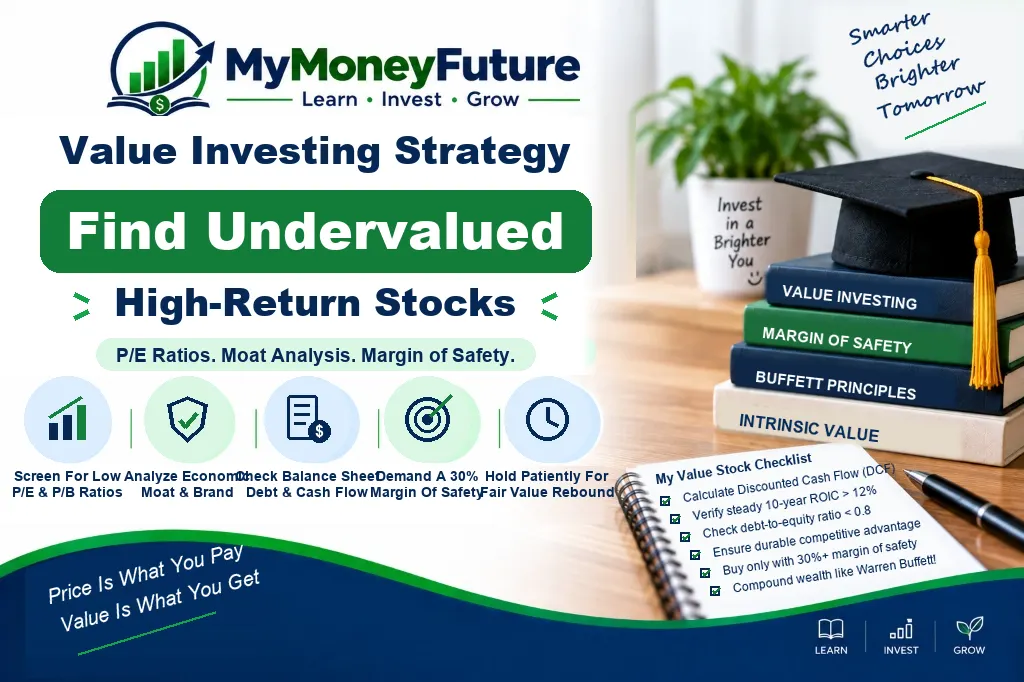
Preface
Value investing is the process of buying stocks that look as if they are trading at a discount to what the firm is worth.
Easy to say, hard to perform successfully demands patience, research, discipline and humility. Cheap stock is not necessarily a bargain. Sometimes it’s cheap for a reason, since the business is poor or deteriorating or has major problems.
Value investors attempt to uncover the difference between price and value. Price is what the market charges you to pay today. Value is what the business is worth based on profit, assets, cash flow, growth, debt, and risk.
This tutorial will teach you how to locate discounted stocks, what financial criteria to look at, how to avoid value traps and how beginners may develop a rigorous value investing approach.
Brief Answer
worth investing is seeking for stocks that are priced below a reasonable estimate of their real company worth. Investors look at price relative to earnings, cash flow, assets, debt, competitive position and future prospects. The aim is to buy with a margin of safety but value investing is still risky and demands patience.
Essential Takeaways
| Main Point | Summary |
| Price Isn’t Value | A low stock price doesn’t always mean a stock is inexpensive. |
| Why Fundamentals Matter | Value investors look at earnings, cash flow, assets, debt and quality of firm. |
| Margin of Safety Helps | Buying below projected value leaves space for error. |
| Value Traps Exist | Some stocks look inexpensive because business is getting worse. |
| Patience is Needed | Undervalued stocks take years to be noticed by the market. |
What Is Value Investing?
Value investing is an investment technique based on the idea that markets occasionally misprice stocks.
A corporation may be ignored, misunderstood, temporarily out of favor, or over penalized after unfavorable news. If the business continues healthy, the stock will likely rebound as the market realizes its worth.
Value investing is not about buying any stock that has plummeted. It is not bargain hunting based on a low price chart.
According to Investor.gov, value stocks are frequently companies with a low price-to-earnings ratio that have fallen out of favor with investors. Their stock guide is a good beginner’s guide to comprehending common stock classes. Investor.gov
The primary concerns for the value investor are market value vis-à-vis financial strength and earning capability.
Value vs. Price
The price is in view. Value has to be estimated.
If a corporation is losing money and drowning in debt, a $20 stock can be pricey. A $200 stock can be cheap if the company generates significant cash flow, grows steadily and has a lasting competitive edge.
Newbies are more likely to get caught up in the share price. Better question: What do I receive for what I pay?
| Question #1 | Why Is It Important |
| What is the company’s earnings? | Provides earning power. |
| What cash does it generate? | Cash flow supports operations, debt repayments and dividends. |
| What is the debt load? | Cheap stocks can be problematic if they have a lot of debt. |
| Revenue steady or increasing? | Falling sales might be a symptom of deeper crisis. |
| Does the business have an edge? | Strong companies can defend earnings. |
| Trust in management ? | Capital allocation impacts returns to shareholders . |
Step 1: Start With What You Know
Newbies should start with companies they can explain in simple terms.
It is challenging to determine value if you cannot grasp how the firm produces money, who its consumers are, why they buy and what dangers could affect the organization.
Simple doesn’t mean boring. Some industries are easy to get: banks, merchants, insurers, software corporations, consumer products companies, utilities, payment networks, industrial companies.
The aim is not to know everything. The aim is to avoid buying into companies you can’t analyze.
Step 2: Look for Steady Profits
A company’s earnings are what’s left over after expenses.
Many value investors want a company with a history of consistent or rising earnings. It is easier to value a business that makes money regularly than one with crazy gains and losses.
| Earnings Pattern | What this could mean |
| Strong Earnings | Business can be so predictable. |
| Earnings growth | The company is profitable. |
| Reduced profits | need more inquiry. |
| Unpredictable incomes | Valuations could be more difficult. |
| Losses | Risk may be greater if turnaround is unclear. |
One bad year doesn’t always equal a bad company. But you have to know if the problem is transitory or structural.
Step 3: Know Your Cash Flow
Earnings can be altered by accounting decisions. Cash flow is the real amount of cash the business makes.
What really matters is free cash flow. It is the cash remaining after a corporation has paid for the capital expenditures necessary to sustain or expand its business.
Companies with solid free cash flow may be more flexible to pay down debt, pay dividends, buy back shares, reinvest or weather downturns.
A profitable corporation that still burns cash needs further scrutiny.
Step 4: Check out the valuation ratios
Valuation ratios are used to compare the price of the company with its financial results.
No one ratio will show you that a stock is undervalued. Ratios are a beginning point for inquiry, not a final answer.
| Metric | What It Reveals | Beginner’s Note |
| Price/Earnings ratio | Price relative to earnings | Lower may be cheaper, but quality is important. |
| Price to Book Ratio (P/B) | Price to book value | Good for banks, asset heavy companies. |
| P/S ratio | Price versus sales | Useful when income is suddenly low. |
| Ebitda EV/EBITDA | Enterprise value relative to operating earnings | It is helpful for comparing enterprises with high debt. |
| Dividend rate | Price vs Dividend | High yield might be an opportunity or a warning sign. |
| Free cash flow yield | Market value and cash flow | Good for cash analysis. |
If earnings are consistent, a low P/E ratio may be attractive. It can be risky if earnings are about to fall.
Step 5: Compare the Company to Its Competitors
A stock may look cheap in itself yet pricey against related companies.
Compare firms within the same industry. There should be a comparison with banks. » You should be comparing a retailer with retailers. You want to compare a software company against other software companies.
Peer comparison can tell if low valuation is abnormal or normal for that industry.
| Comparison Area | What to Watch For |
| Profits | Is the corporation more or less profitable than its peers? |
| The Debt Numbers | More debt than competitors? |
| Rate of growth | Growth better than peers? |
| Return on equity ( | Is management deploying the capital well? |
| Ratios of valuation | Is the discount reasonable? |
| Market standing | Does the corporation have an advantage? |
Step 6: Review Balance Sheet
A company could look cheap until you look at the debt.
The balance sheet illustrates a company’s assets, liabilities and shareholders’ equity. This can enable you to know if the company is financially strong or under pressure.
Look at debt . Cash . Short term commitments . Long term liabilities . Can the corporation pay interest .
High debt is not always bad but it constrains flexibility. Debt can turn a temporary corporate crisis into a lasting shareholder loss in a downturn.
Step 7: Search for a Margin of Safety
A margin of safety is buying under your estimate of worth.
If you think a company is worth $100 a share, you may only want to acquire it at $70 or $75. That discount allows you some leeway if you guess wrong.
The more uncertain the business the greater the margin of safety.
Value investing is not being absolutely right. It’s about doing it right-ish, but shielding oneself from very major blunders.
Step 8: Beware of Value Traps
A value trap is a stock that appears cheap but keeps plunging as the firm goes downhill.
Typical symptoms are falling sales, bad cash flow, large debt, poor management, obsolete products, eroding industry demand, or a dividend that might be slashed.
| Possible Value Trap Signal | Why It’s Important |
| Revenue continues to fall | The company could be losing customers. |
| Debt is mounting | The risk of financial stress going up. |
| Poor cash flow | Earnings reported may not be accurate. |
| Dividend yield is exceptionally high | The dividend might be in danger. |
| The industry is on the wane | It may be justified by the low valuation. |
| Management dodges the hard questions | Transparency counts. |
The question is, is the stock cheap because people are overreacting or low because the business is growing worse?
9. Review Company Filings
“Value investing is not only about headlines.”
Annual reports, quarterly reports, investor presentations, earnings call transcripts, risk disclosures.
Look at the business strategy, risk, debt, cash flow, management conversation and what is different from last year.
Be wary of a company’s report that is full of misleading terminology and insufficient explanations. Businesses that are straightforward can typically express themselves clearly.
Step 10. Understand the Risks
Undervaluation is not safety.
“Risk is the chance an investor will lose money or not make money,” Investor.gov tells investors. Before you buy any given stock, understand why higher predicted return usually comes with increased uncertainty by looking at its explanation of investment risk.
The biggest risks in value investing are being mistaken about the firm, buying too early, underestimating the debt, ignoring disruption or falling in love with a lost idea.
Diversification can be a help. Even good investors can make blunders on specific stocks.
A Sample Value Investing Process
Imagine a profitable corporation that has dropped 35% after a bad year.
A newbie value investor should not buy only because the price is down. The research process may look like this:
| Act | Question: |
| Business cheque | Does the company have a great product or service? |
| Income verification | Was the bad year an anomaly or the beginning of a trend? |
| Cash flow check | Is the firm still cash producing? |
| Debt check up | Will the corporation be able to meet its obligations? |
| Valuation evaluation | Is the stock inexpensive relative to normalized earnings? |
| Risk Assessment | What could go wrong with the investment? |
| Decision | Is the safety margin sufficient? |
If the responses are good, the stock may be worth a closer look. If the responses are poor, a low price may be a caution, not a bargain.
The Beginner’s Mistakes
Buying Because the Price Dropped
“The falling price can bring opportunity, but it can mean real trouble. Always look at the basics of the business.
Using Ratio One
A low P/E ratio is not enough. Look at earnings quality, cash flow, debt, growth and industry conditions.
Debt Overlooked
Debt can turn a cheap stock into a risky bet. A corporation with a weak cash flow and a lot of debt may not be able to survive a downturn.
Mixing up Dividend Yield and Safety
A high dividend yield may be appealing, but if the dividend is not backed by cash flow, the dividend may be reduced.
Too Much Patience with a Bad Business
Patience is a virtue when the biz is good. It becomes bad when it is used as an excuse to dismiss new evidence.
Value Investing: Pros and Cons
| Pros | Pros |
| Promotes discipline and research | requires patience and emotional restraint |
| Concentrates on basic business | Can underperform for long periods of time |
| May lessen the risk of overpaying | Valuation estimations might be incorrect |
| Good for people who ponder long-term | Errors in individual stocks can be costly |
| Margin of safety taught | Value traps are everyplace |
Expert Advice
- Before you buy, write down your investment thesis.
- Don’t simply use one valuation metric, use more than one.
- Compare the company to its peers in the same industry.
- Look at cash flow and debt prior to distributions.
- Have a watchlist so you can be ready when pricing are good.
- Demand a greater margin of safety for companies with unknowns.
- Don’t invest in company you don’t understand well enough to value.
FAQ Section
Q: What is value investing?
A: Value investing is a way of buying stocks that seem to be selling for less than what their underlying business value is.
A: You really only know by conducting a lot of research and making an educated guess.
A: Earnings, cash flow, debt, assets, growth, competitive position, valuation ratios. A stock is possibly undervalued when its price is low relative to a credible estimate of its value.
Q: Is a low P/E ratio always good?
A: No. A low P/E can indicate value, but it could also indicate diminishing earnings, low growth, high debt or business risk.
Q: What is a value trap?
A. A value trap is a stock that appears cheap but continues to underperform because the business is deteriorating.
Q: Is value investing for beginners?
Yes, but beginners should take it gently, research industries they understand, diversify and avoid making significant bets on single equities.
Q: What is the duration of value investing?
A: It can take years. The market may be over or under-valuing things and some investments may not work out.
Q: Which it safer to invest in value stocks or growth stocks?
A: Not by default. Value investing may lessen the danger of buying too much, but you might still lose money on discounted stocks.
Conclusion
Value investing is buying a business for less than it is worth.
The technique rewards patience, research and discipline. It penalizes shortcuts.
Search for inexpensive stocks by examining profits, cash flow, debt, valuation ratios, peer comparisons, industry patterns, and management quality. Then inquire if the price affords you a meaningful margin of safety.
A low price is just the start of the research. The fundamental question is if the firm is robust enough to deserve your faith.
A Research Checklist for the Beginner
A checklist prevents value investing from becoming a guessing game. Before buying a stock, write down why you think the market price is less than the worth of the company.
| Research Area | question to solve |
| Business model | How does the company generate revenue? |
| Revenue pattern | Are sales growing, steady, or declining? |
| Quality of earnings | Are profits sustainable and backed by cash flow? |
| Debt | Can the corporation service the interest and repayments? |
| Valuation | Is the stock selling at a bargain relative to realistic profits or assets? |
| race | Is the company sustainably competitive? |
| Risking | What would cause the investment to go bad? |
If you cannot answer these questions in clear words, then the stock is probably too complex for your existing procedure.
Building a Watchlist
Value investors usually wait for the price and value to diverge. A watchlist gives you a chance to prepare in advance for a buying opportunity.
Start with companies that you know, and want to own, at the proper price. Follow their profits, debt, value and key news. Write out a price range where the stock might look appealing, but modify that range when business results change.
A watchlist can help stop emotional purchases. You don’t chase headlines. You have your study ready to go when a good company goes out of favor temporarily.
Signs a Stock is Worth Further Study
- The company is making money and generating cash.
- The balance sheet is solid enough to weather a downturn.
- Valuation is below the peer group for reasons that may be transient.
- Management is open about the challenges and takes ownership.
- The business still has consumers, price or competitive advantage.
- The adverse risks are understandable and no hidden.
When not to buy:
Sometimes doing nothing is the best value investing move. If the company is too difficult for you to grasp, debt is too large, cash flow is weak or management is not transparent, passing is a valid choice. Permanent losses are more harmful than lost chances.
A decent rule of thumb for novices is to have a clear reason to buy and a clear reason to sell. If the sole reason to buy is because the stock is down, you have not done your research.
Educational Disclaimer
This essay is for educational purposes only and does not constitute financial, investing, tax, or legal advice. Investing in individual stocks is risky and you can lose principle. Conduct your own research and due diligence before investing and, if needed, get advice from a certified financial professional.
Calculate Your Long-Term Wealth Growth
See how compounding interest accelerates your net worth and calculate your exact FIRE retirement freedom number: