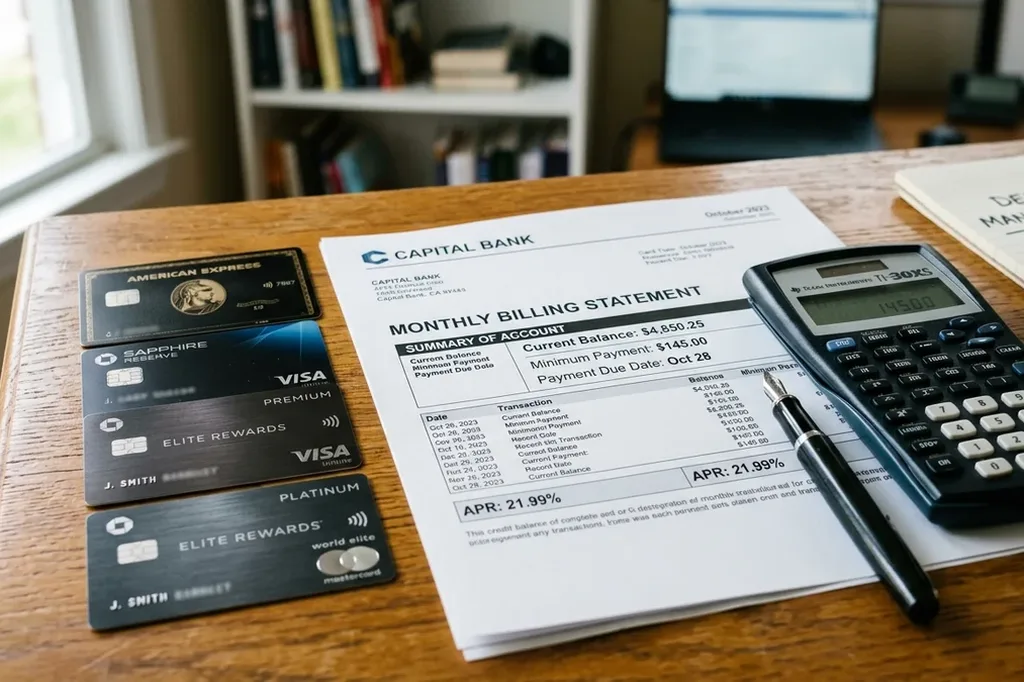
NEW YORK — Cumulative credit card balances across American households have surpassed a record $1.3 trillion, according to data from the Federal Reserve Board’s G.19 Consumer Credit release and the Federal Reserve Bank of New York’s Center for Microeconomic Data. Persistent cumulative inflation across essential expenses—including groceries, motor vehicle insurance, and housing utilities—has caused consumer reliance on revolving lines of credit to reach historic highs.
| Credit Metric | Benchmark Level | Long-Term Baseline | Risk Level |
|---|---|---|---|
| Total U.S. Revolving Debt | ~$1.31 Trillion | $1.05 Trillion (2022) | Historic High |
| Average Balance per Cardholder | $6,580 | $5,470 (2021) | Elevated |
| Average Commercial APR (Assessed) | 22.8% – 23.9% | 15.1% (Historic avg) | Severe Margin Drag |
| 30+ Day Delinquency Rate | 2.85% | 1.90% (2021 lows) | Plateauing |
The Dangerous Mathematics of Minimum Payments at 23% APR
Because credit card APRs are calculated daily using an Average Daily Balance methodology, maintaining carrying balances at 23% interest functions as a severe wealth-eroding mechanism. On an average $6,580 card balance with a standard minimum payment requirement (typically 2% to 3% of the outstanding balance), a cardholder making only minimum monthly payments will require over 17 years to reach zero debt.
Over that repayment trajectory, the borrower will pay more than $8,200 in compounding interest fees alone—far exceeding the original principal value of the purchases made on the card. Delinquency transitions (accounts moving past 30 and 90 days overdue) remain especially concentrated among younger demographic cohorts and households lacking home equity cushions.
Current Legal Status of the CFPB $8 Late Fee Regulation
Compounding cardholder difficulty, the Consumer Financial Protection Bureau’s (CFPB) landmark administrative rule aiming to slash standard penalty fees from $32–$41 down to an $8 ceiling remains stalled in federal appeals courts. Financial trade associations and banking lobbies filed preliminary injunctions challenging the agency’s rulemaking authority, keeping legacy penalty fee policies in active enforcement for the vast majority of consumer accounts.
The CFPB maintains that excessive penalty fees generate upwards of $14 billion annually for card issuers while disproportionately penalizing consumers living paycheck to paycheck.
Strategic Playbook to Eliminate High-Interest Balances
Proven 3-Step Debt Elimination Action Plan:
1. Utilize 0% Intro APR Balance Transfers: Transfer existing high-APR balances to a dedicated balance transfer card offering 0% APR for 15 to 21 months. Divide your balance evenly across the promotional months to achieve debt freedom with zero interest drag.
2. Apply the Debt Avalanche Methodology: Order your credit cards by interest rate from highest to lowest. Direct all surplus monthly cash toward paying down the card with the highest APR while paying minimums on lower-interest balances to mathematically minimize interest expenses.
3. Request a Direct APR Concession: Call your card issuer’s retention department and cite lower interest offers received from competitors. Credit bureaus report that over 65% of cardholders in good standing who explicitly request an APR reduction receive a 2% to 5% reduction on their account.
Frequently Asked Questions About Credit Card Debt
How does credit card utilization impact your credit score? Credit utilization—the percentage of your total available credit limit you are currently borrowing—accounts for 30% of your FICO® credit score calculation. Financial advisors recommend keeping total utilization below 10% across all individual cards to maintain an optimal credit rating.
Does a 0% balance transfer hurt your credit history? Applying for a new balance transfer card causes a minor temporary dip of 3 to 5 points due to the hard inquiry. However, the new card expands your total available credit line, reducing your overall utilization ratio and significantly lifting your score within 60 to 90 days as you pay down the debt.
Explore Free Interactive Financial Calculators
Put these insights into practice with our 7 free financial planning and net-worth growth calculators: