
1. Introduction
You don’t have to make a drastic shift in your lifestyle to save money. Sometimes it starts with finding out where the money is leaking out each month and changing one habit at a time.


It doesn’t seem thrilling at first, saving a few dollars on groceries, subscriptions, banking fees, insurance, and utilities. But month after month, little savings grow into significant breathing space.
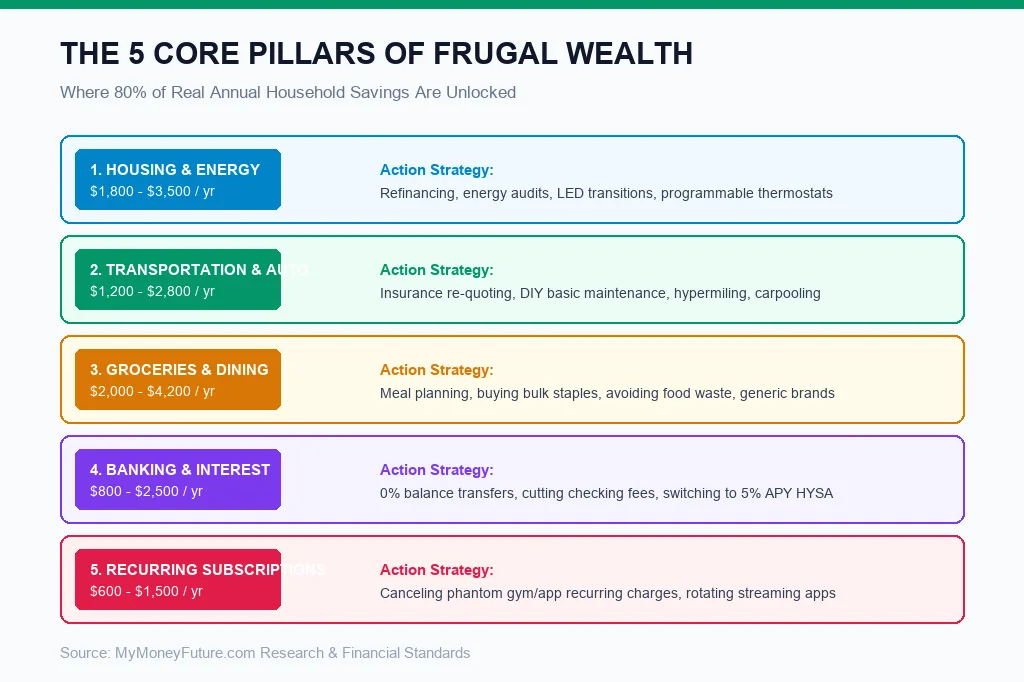
This guide shows you 100 practical methods to save money in 2027. Some ideas are low hanging fruit. Some require planning. You don’t have to utilize them all. Begin with what works for you, then build from there.
The idea is not to make life miserable. The goal is to spend less on things that don’t matter so you can have more money for the things that do matter.
Fast Answer
Annual Household Savings Potential Calculator
Select the areas you plan to optimize this year to calculate your total estimated annual cash savings.
Here are the top tips to save money: Automate your savings, Track your spending, Cut unnecessary subscriptions, Plan your meals, Compare insurance, Reduce your energy use, Avoid high-interest debt, Buy used when practicable, Negotiate your bills, and Create a budget that assigns every dollar a task before the month starts.
Top Takeaways
| Argument | The meaning |
| Little saves pile up | A $25 monthly cut for 12 months is $300. |
| Automation assists | Saving before you spend makes you less dependent on willpower. |
| Big bills count most | The highest savings are in housing, travel, food, insurance and debt. |
| Say no to fake thrift | Don’t save $5 to create a $500 problem. |
| Consistency trumps intensity | It’s more about repeatable habits than one rigid month. |
Start With a Simplified Savings System
Build a simple system . List 100 ideas . There’s a system. Savings aren’t random.
“Automatic saving is one of the easiest ways to make saving a regular habit,” says the Consumer Financial Protection Bureau. You are able to set up automatic transfers thru a bank or credit union, as detailed in the CFPB guidance on building an emergency fund.
Begin with one automatic transfer, no matter how tiny. A weekly $25 transfer amounts to $1,300 a year. A weekly transfer of $50 is $2,600.
You can always add more later. The first win is to create the habit.
100 Ways to Save Money in 2027
Think of this list as a menu, not a punishment. First pick five to ten concepts . Then add more after those feel natural .
Banking and Budgeting
- Keep track of every expense for 30 days to see where your money is going.
- At the beginning of each month, draw up a modest monthly budget.
- Separate bill, spending, and savings accounts.
- Set up automatic savings on payday before you spend.
- Name your savings account goals (emergency fund, vacation fund, etc.).
- Shop around for bank account fees. Change accounts if you can avoid monthly expenses.
- Set up low-balance notifications to avoid overdraft penalties.
- In places where you tend to overpay with a credit card, pay cash or a debit card.
- Schedule a 15 minute money review once a week.
- Have a sinking fund for annual bills, rather than be startled.
Groceries/Food
- Meal plan before supermarket shopping.
- Shop with a list and don’t shop hungry.
- Go for store brands for the basics – rice, pasta, oats, spices, cleaning stuff.
- Look at per-unit prices, not just price per box.
- Make double batches and freeze extras.
- Use what’s in your pantry before buying more.
- Limit food delivery to a single scheduled order each week.
- I make coffee at home most days.
- Pack your lunch a couple of times a week.
- Buy seasonal produce while prices are low
- Use loyalty programs exclusively for things you would buy anyhow.
- Avoid buying perishable goods in bulk if you can’t complete them.
- Have a once-a-week throw-away nite.
- Check out grocery pickup pricing against in-store prices.
- Keep easy emergency meals in the house to avoid last-minute takeout.
Monthly bills
- Cancel memberships you haven’t used in 60 days.
- Switch out streaming services instead of running them all.
- Call your internet provider and see if they have a cheaper package or a current promotion.
- Compare mobile phone plans annually.
- Only use autopay reductions if your account can afford them.
- In winter, turn your thermostat down a little, and up a little in summer.
- Switch out lamps for LEDs.
- Unplug devices that consume energy when idle.
- Use cold water whenever possible in the laundry.
- Air dry some laundry instead than running the dryer every time.
- Water leaks around toilets and faucets?
- Only bundle services if the package is really cheaper.
- Cancel paid app trials ahead of their renewal date.
- Check if utility companies have budget billing or help programs.
- Check your card statement for any reoccurring charges.
Credit & debt
- Pay more than the minimum payment on high-interest debt.
- Avalanche approach – attack the highest interest rate first.
- Use the snowball strategy if fast wins keep you motivated.
- Avoid buying now and paying later on non-essential items.
- Don’t carry a credit card balance for the perks.
- Ask credit card companies to cut your APR if you have a solid payment history.
- Only do a balance transfer if the costs and payment timing make sense.
- Use payment reminders to prevent late fees.
- Don’t use the card until you pay it off.
- Build a tiny emergency reserve to prevent new debt.
Retail Therapy
- Don’t buy anything you don’t need for 24 hours.
- Use a 30-day rule for big wants.
- Shop around for electronics and appliances before to purchase.
- Buy used furniture, tools, and kids’ stuff if it makes sense.
- Fix clothes, shoes and appliances when it is cheaper than throwing them out.
- If you are an impulse buyer when browsing, avoid shopping apps.
- Unsubscribe from emails from retailers that entice you to spend.
- Just use coupons on things you were going to buy anyhow.
- Buy quality on things that are used everyday, but don’t be a brand snob.
- Rent instead of buying things you don’t use often.
Transportation & Housing
- Re-shop insurance for renter’s or homeowner’s coverage annually.
- Increase deductibles only if you have enough savings to cover them.
- If housing is too expensive, consider a roommate.
- Refinance if it makes sense in terms of fees and rate savings.
- Keep your home in good condition to avoid pricey repairs.
- Plan your errands on one route to conserve fuel.
- Check tire pressure monthly
- Compare car insurance prices every 12 months.
- Whenever possible, take public transit or carpool.
- If you have a good car, don’t do a car upgrade.
Entertainment & Lifestyle
- Go to the library for books, audiobooks and digital materials.
- Take in free local activities instead of paid entertainment.
- Have a monthly limit for pleasure money.
- Have dinner parties at home instead of always eating out.
- Parks, trails and community spaces are inexpensive fun.
- Share memberships only as permitted by the terms.
- Plan inexpensive dating nights.
- Don’t upgrade your lifestyle on every raise.
- Collect used gear to make activities affordable.
- Limit convenience expenditures that does not really save time.
Travel
- Travel in the shoulder seasons for better pricing.
- Compare with adjacent airports.
- Use fare alerts when purchasing flights.
- Book options that are refundable if plans are unsure.
- Bring snacks and refillable water bottles.
- Use the right payment card to avoid overseas transaction fees.
- Before you decide where to go, check hotel, rental and public transit prices.
- Don’t run after rewards with debt, use points instead.
- Read luggage rules when buying inexpensive airfares.
- Spend big on one thing and save on the others.
Annual income and spending habits
- Sell off anything you don’t need.
- Save any tax refund, bonus or gift before you spend it.
- Ask for a raise when you’re worth it.
- Acquire a marketable skill that can boost your income.
- Use cash windfalls to create an emergency reserve.
- Track your net worth monthly to see your growth.
- Don’t measure your spending to social media habits.
- Have a monthly no-spend weekend.
- Review of quarterly goals.
- Make your savings plan realistically repeatable.
How to Choose Which Money Saving Tips to Start Off With
The simplest category is not always the best place to start. Start where the savings count, and the difference is real.
Start with meal planning, if your major issue is food delivery. Recurring costs are a good place to start if subscriptions are your biggest worry. If debt interest is costing you income, focus on paying off debt.
| If Your Problem Is | Begin With |
| No saving | Emergency fund and automatic transfers |
| Food prices high | Meal Planning and Shopping List |
| Subscriptions – Too many. | Review of Standing Charges |
| Debt distress | Minimum payments + additional goal payment |
| Expensive insurance | Yearly quote comparison |
| Impulsive shopping | 24 hour and 30 day rule |
Don’t attempt to do all 100 ideas in a month. That frequently leads to burnout. Select a few, monitor the savings, and stick with what works.
Big Categories Usually Get the Biggest Savings
Small habits matter, but often the biggest savings will be in the biggest budget categories: housing, transportation, food, insurance, debt, and taxes.
If it works for your life, saving $5 on coffee is useful. But $150 in insurance savings or $200 in groceries or $300 in housing savings has a significant impact.”
The FDIC’s Money Smart program teaches people how to build better banking relationships and financial abilities. It has more extensive financial literacy content that can help with fundamental budgeting and saving decisions . If you are interested in more formal financial literacy resources, look at FDIC Money Smart.
A good savings plan has modest victories and huge wins. Small victories build momentum. Big wins impact the monthly figures.
Common Errors
The first mistake is cutting too much, too quickly. Budgets that suck the fun out usually don’t work.
The second mistake is to cut costs in one area and spend in another. Put savings directly into a savings account, debt payment, or other purpose.
The third mistake is to forget fixed costs. But housing, transportation and insurance typically get more attention than subscriptions.
The fourth pitfall is buying cheap things that break soon. Saving money is not the same as wasting money.
The fifth mistake is utilizing discounts as a justification to spend. If you were planning to buy the thing, then a sale is a sale.
How NOT to Save Money in the Wrong Places
Some money-saving ideas aren’t worth the trouble. Some approaches save a little money but cost too much in time, health, safety or stress.
Don’t forego medical treatment to save money. If one mishap could take out your finances, don’t underinsure your automobile or home only to lower premiums. If you have a dependable product that lasts significantly longer, do not buy the cheapest one.
Frugality is good when it is deliberate. Bad frugality is reactionary. The aim is to eliminate waste, not create additional risk.
| Poor Saving Move | Better Option |
| No insurance – skip it | Compare policies and select coverage wisely |
| Continually buying low quality things | Buy durable things if cost per usage is cheaper |
| Neglecting maintenance | Solve tiny problems before they cost you a lot |
| Major reduction to food | Make cheap meals that yet encourage health |
| No Fun Allowed | Set a fair limit to recreational money |
A solid savings plan should make your life less vulnerable, not more fragile.
Sample 30-Day Savings Plan
A large list is good, but it is not as good as action. For a simple way to begin, use this 30-day plan.
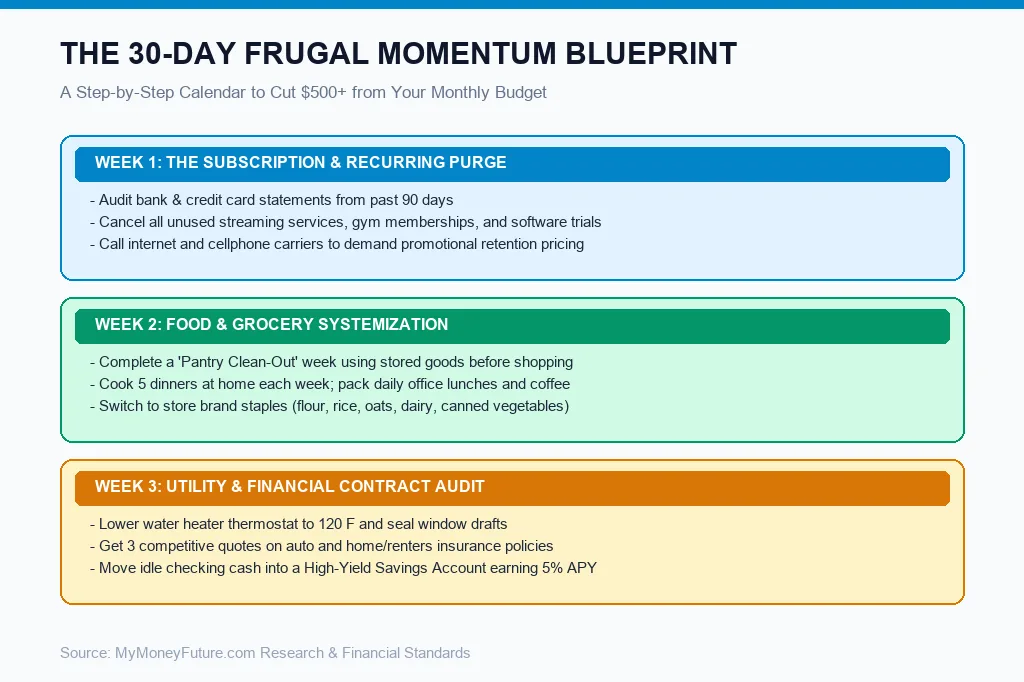
Week one, track your spending and cancel anything evident. Week 2: Food & Groceries Compare reoccurring bills on the third week. Week 4: Automate your savings.
| Week | Focus | Action |
| Week 1 | Locate Leaks | Review statements and cancel memberships you don’t need |
| Week 2. | Food prices | Meal plan, shop with a list, cut back on delivery |
| Round 3 | Repeat billing | Compare insurance, phone, internet, utilities |
| Week Four | Make it work | Set automatic transfer for amount saved |
For instance, you might cancel $40 in memberships, spend $120 less on takeout, downgrade your phone plan by $25, and save $35 with a meal plan. That’s $220 a month. If you automated that amount, it would be $2,640 a year.
Doesn’t have to be a perfect number. The concept is to convert one-off cuts into monthly progress.
How to continue saving beyond the first month
The first month of saving is usually the simplest because you are really motivated. The second and third month are the test of the habit.
should continue to make savings transparent. Balance your watch, name the account and attach the money to a meaningful objective. It is more motivating to label things like emergency fund, auto repair fund, debt free fund and home deposit fund than just using an account number.
prepare for setbacks also. A car repair, school fee, medical cost or a family function may put your finances on hold for a month. That doesn’t imply the plan failed. Begin a new with the next paycheck, not the perfect month.
The best savers aren’t flawless. They can be depended on. When things become nasty in life, they resort to the habit.
Senior Financial Editor’s Takeaway: Make Savings Permanent
The secret to saving money isn’t cutting out everything that brings you joy—it’s ruthlessly eliminating expenses that don’t matter to you so you can fund the goals that do. Automate your savings directly into high-yield accounts the morning your paycheck clears.
Immediate 3-Step Action Plan:
- Park Cash Wisely: Move your emergency buffer into a High-Yield Savings Account to earn over 4.5% APY.
- Structure Inflows: Align your cash flow with our Step-by-Step Monthly Budgeting Guide.
- Defend Your Wealth: Balance your liquid cash versus index funds using the Emergency Fund vs Investing Priority model.
Ready to take control of career earnings? Read our scripts on How To Ask For A Pay Rise.
FAQ Section
Q: How do you start saving money easily?
A: Get an auto transfer on pay day. Even a little creates the habit and prevents savings from being purely willpower-based.
Q: How do I save money fast?
Cancel unwanted subscriptions, cut back on food delivery, stop non-essential buying, compare insurance and channel the savings right away.
Q: How much should I save each month?
A: This is contingent upon your income and your expenses. Begin with a percentage or a set sum that you may repeat, then raise it over time.
Q: What do I cut first?
A: Begin by tackling large, flexible expenses such as subscriptions, eating out, food waste, insurance fees and high-interest debt.
Q: Can I save money and not feel deprived?
A: Yep. Continue to spend on items that you value. Reduce spending that has little benefit. The optimal savings plan should be practical enough to follow thru on.
Q: Is frugal living worth it?
A: Frugal living is worth it if it lets you spend with purpose. If it causes tension, guilt or unsafe decisions, it is not healthy.
A: What should I do with the money that I save?
A: Put it to work. Depending on your situation, either build an emergency fund, pay off high-interest debt, save for a goal, or invest for the future.
Final Thoughts: Building Sustainable Frugal Wealth
There are numerous strategies to save costs, but the best are the ones you can do again and again.
Begin with automation, then consider grocery, bills, loans, insurance, shopping and lifestyle spending. You don’t need to have a flawless budget to achieve progress. You need a few habits from real life.
Today, choose five of the ideas on this list. Use them for a month. Watch the savings pile up. Then add some more. Small improvements, over time, can lead to a much brighter financial future.
Learning Disclaimer
This post is for educational and informational reasons only and is not intended to be financial, legal, tax or investment advice. Savings solutions depend on your income, debt, region, household size and personal demands. Talk to a certified specialist before making any important financial decisions.
Take Control of Your Budget Instantly
Don't just read about money management—calculate your exact monthly breakdown right now using our free financial tools: