
Interest charges month after month can make credit card debt pricey. If your card has a high APR, then paying on time can seem like slow progress, as some of your money is going toward interest rather than paying down the debt.
A balance transfer credit card might help by shifting debt from one card to another card with a reduced rate, frequently a promotional 0% APR for a limited time. When used properly it can give you some breathing room and help you pay off debt faster.
But a balance transfer isn’t free cash. Most deals contain transfer fees, deadlines, credit criteria and limitations that can cut down the reward if you ignore them.
This tutorial covers how balance transfer cards work, how to determine the savings, when they are worth it, and how to prevent turning a 0% APR deal into another debt trap.
Fast Answer
Calculate how much monthly payment you need to wipe out your balance before the promo APR ends using our Debt Payoff Calculator.
A balance transfer credit card allows you to move existing debt to a new card, usually with a brief 0% APR. If the transfer cost is less than the interest you would pay, it can save you money and you can pay off the debt before the promotional period ends. That’s not helpful if you continually adding fresh debt.
Key Points
| Important Point | What it means is |
| A balance transfer is moving debt | You move an old balance to a different card, typically at a discounted APR. |
| 0% APR is promotional | The promo rate is for a limited time, such as 12, 15, 18, or 21 months. |
| Fees count | It can still be worth a 3% to 5% fee, but you have to do the math. |
| It’s good to have good credit | The finest deals usually go to people with decent to exceptional credit. |
| New spending is hazardous | You could end up with greater debt and interest troubles by using the new card for purchases. |
What Is a Balance Transfer Credit Card?
A balance transfer credit card is a credit card that allows you to move debt from another card or loan to the new card. People do this mainly to acquire a lower interest rate for a brief period of time.
Many balance transfer cards have an introductory 0% APR. As long as you obey the card regulations, you won’t pay interest on your transferred balance during that time. This allows you to directly assault the equilibrium.
There is normally a cost for the transfer. The cost is included in your amount as part of what you owe. That fee’s likely still considerably lower than hefty credit card interest for another year.
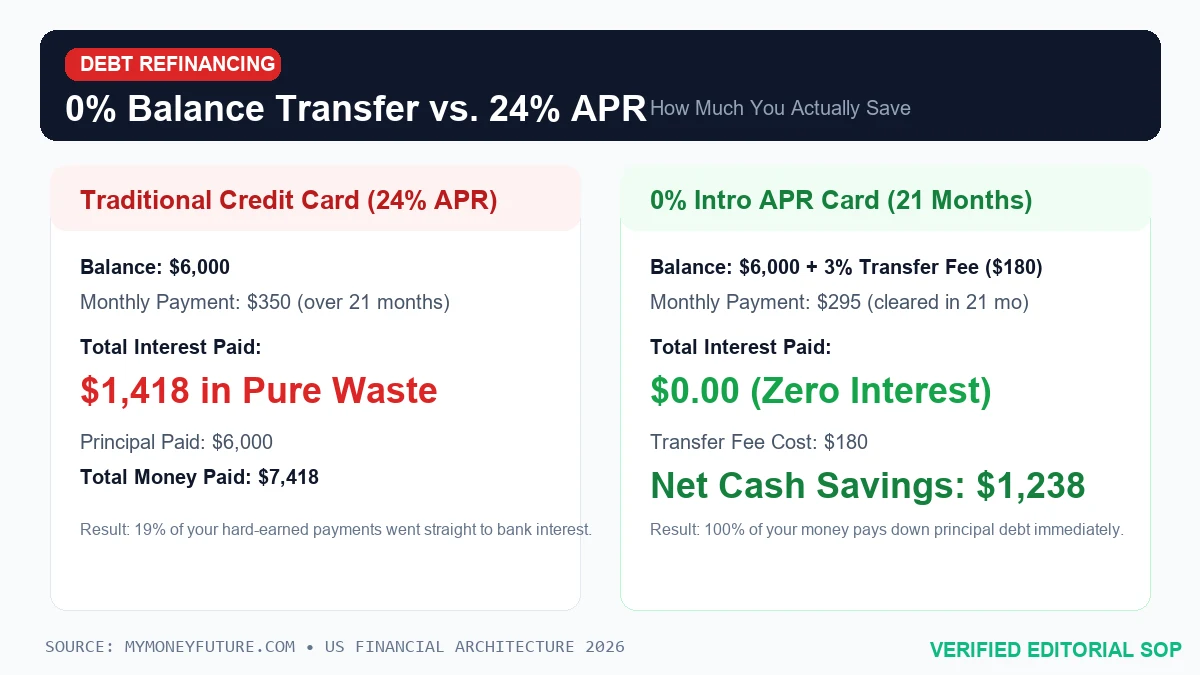
The card issuer may not approve the entire amount you want to transfer. Your credit limit, debt amount, income, and credit profile are all taken into account.
Check how the charge works before you transfer debt. A debt transfer fee can be levied even if the offer is for zero percent interest, according to the CFPB. CFPB
How a 0 percent balance transfer works
- You ask for a balance transfer card with a promotional rate.
- If accepted, your request to transfer debt from an old card.
- The new card issuer either pays the old issuer or transfers the balance via its own procedures.
- The new balance includes the transfer fee.
- You pay on the new card during the 0% APR term.
- If you pay off the sum before the offer ends, you may not have to pay interest on the debt transferred.
- If you have a debt left after the promo period, the typical APR generally applies to the remaining balance.
Example: Balance Transfer
| Item | Quantity |
| Balance of current CC | $6,000 |
| Current APR | 24% |
| Balance transfer promotion | 0% APR for 18 mths |
| 3% transfer fee | |
| Fee added to balance | $180.00 |
| New balance post-transfer | $6,180 |
| Pay down in 18 months with monthly payments | Approximately $343.33 |
The price for the transfer is $180 here. If the prior card would have cost way more than $180 in interest throughout the payback term, the transfer may be worth a look.
It’s all about the monthly cost. The only way 0% APR deals work is if you use the interest free period to aggressively pay off the debt.
The normal APR can wipe out much of the savings if you make just minor payments and still have a significant balance at the end.
When a balance transfer card makes sense
| Good Fit | Why It Matters |
| You have a credit card with high interest debt | The 0% time might lower interest as you pay down principal. |
| You qualify for a great offer | Longer 0% periods, lesser fees, better the math. |
| You can pay a fixed payout payment | A month to month schedule lets you finish before the promo finishes. |
| You cease using the previous card | Stops the debt from rebuilding. |
| You stop buying new stuff | Focuses the transfer card on debt reduction. |
When Might It Not Be Worth It?
If the cost is large, the promotional time is limited, or if you can’t realistically pay down the balance before the usual APR kicks in, a balance transfer may not be worth it.
It could also not be a good idea if you’re going to continue billing fresh purchases. In that instance, the transfer may just open more room for more debt.
A balance transfer does not alter the spending habit that produced the debt. It just changes the cost of interest and the repayment structure.
If your budget is already in the reds each month, concentrate on cash flow first. A fresh card won’t assist if you can’t make payments.
How to Determine if a Balance Transfer is Saving You Money
- Check your current balance and APR
- Estimate the time it will take to pay back without transfer.
- Calculate transfer charge on new card.
- Divide the new total balance by the number of months in the promotion.
- “Will that monthly payment work in your budget?
- Compare the transfer charge with the interest you would have paid on the old card.
- Please review the terms for late payments, purchase APR, penalty APR and promo expiration regulations.
| question # | Why it is important |
| Can I pay it off in the promo period? | This is the great test. |
| What is the cost for transfer? | Fees erode the savings. |
| What is the usual APR after the promotion? | Unused debt can be costly. |
| Can I do without new purchases? | New spending can kill the strategy. |
| Old card: freeze or close? | Stops the old debt from coming back. |
The 0% APR Payoff Plan That Pays
The best method to use a balance transfer card? Develop a plan to pay off the debt before the transfer is complete.
0% APR Balance Transfer Savings Calculator
Calculate Your Exact Interest & Fee Savings
Compare your existing high-APR credit card interest against a 0% introductory balance transfer offer.
So, if your balance after fees is $6,180 and your 0% period is 18 months, take $6,180 and divide by 18. That comes out to a target payment of around $343.33 a month.
Don’t wait until month 16 to think about the end date. From day one, treat the promotional period as a deadline.
If you can, set up automatic payments beyond the minimum. The minimum payment frequently isn’t enough to pay off the balance before the 0% term is over.
It’s easy to underestimate the danger of tiny payments. The FTC minimum payment explanation reveals how the minimum can leave credit card debt lingering long after most people think it should. FTC minimum payment explanation
Typical Balance Transfer Blunders
Ignoring the Transfer Fee
A 0% APR offer can be expensive. The 5% transfer cost on $10,000 is $500. That may be useful, but it has to be part of the calculus.
Transfer Deadline Missed
Many deals need transfers within a specified number of days after account opening. Miss that window and you could lose the promotional rate.
Using the Card for New Purchases:
You may lose your grace period or new purchases may have a different APR. The transfer card is to be used solely for repayment for safety reasons.
Paying Just the Minimum
A 0% rate doesn’t automatically erase debt. You still need a payment plan large enough to wipe out the amount.
Unlimited Keeping the Old Card Active
But if you transfer an amount and then resume using the old card, you could wind up with two debts instead of one.
Forget the standard APR
After the deal is out, the leftover balance can become pricey. Know the post promo APR before applying.
Debt Consolidation Loan Vs Balance Transfer Feature
| Credit Card Balance Transfer | Debt Consolidation Loans Interest |
| May get a 0% APR for certain period. | Usually fixed APR for the life of the loan. |
| Best for Fast pay-off of credit card debt. | Bigger balances with set payments. |
| Charges | There may be origination fees. |
| Subject to a transfer charge. | |
| Payment method | Fixed monthly payment. |
| Minimum payments, yet you want to pay more. | |
| Risk | Longer durations may add to the overall cost. |
| Regular APR after promo: High. |
If you qualify for a long 0% period and can finish repayment during that window then a balance transfer is a good idea.
A consolidation loan may be preferable if you want a fixed monthly and a lengthier, predictable schedule of payoffs.
Neither choice is always the better one. The best option relies on the interest rate, fees, quantity of debt, time to payoff and your spending patterns.
How to Safely Use a Balance Transfer
- Do not use Old Card prior to Balance Transfer.
- Create a payment plan according to the promotional time.
- Automatically pay more than the minimum.
- No new purchases on balance transfer card.
- Mark the expiration date of this promo in your calendar.
- Keep a little emergency reserve so unforeseen expenses don’t go on credit.
- Don’t transfer debt unless the new transfer improves the payoff schedule.
Balance Transfer Credit Cards: Pros and Cons
| Advantages | Disadvantages |
| Interest can be deferred or suspended for a period. | Transfer fees eat into savings. |
| Accelerates debt repayment. | Good credit may be needed for best offers. |
| Can make payments easier. | The promotional time finally expires. |
| Can define a hard deadline. | New purchases could mean extra debt. |
| Good for high-interest card balances. | Promotional terms can be canceled due to late payments. |
Expert Advice
A balance transfer card is a debt payoff tool, not a spending tool.
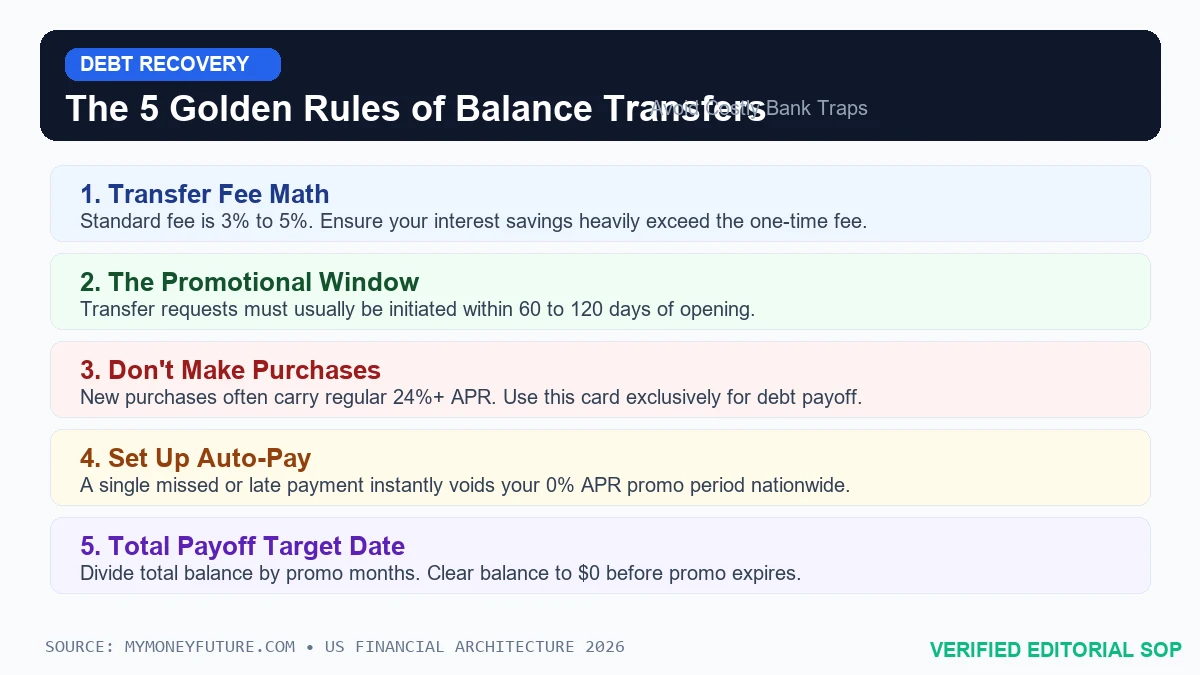
Select the card that provides the best combination of promotional time, fee, standard APR, and credit limit.
Do your math before you apply. If your amount is tiny, a shorter promo time could trump a higher cost.
Continue paying the old card until the transfer is confirmed. Transfers might take time and missing a payment can harm your credit.
Don’t close old accounts unless they are a problem (fees, temptation). Closing accounts might impact credit utilization.
Check your bill monthly to discover your remaining balance and promo end date.
Pay the final installment before the offer ends, not on the last day.
A Simple 90-Day Balance Transfer Strategy
The first 90 days after you open a balance transfer card are critical. This is when you want to verify the transfer, stop new spending, establish your payment plan and ensure the previous account doesn’t continue to accrue new amounts.
Week 1
Verify that the transfer request was submitted correctly. Keep the old card until you see a zero balance or a reduction you expect. A transfer takes time and the former issuer will continue want payment until the transaction is complete.
For the first month
For the first month, divide the entire transferred sum + costs by the number of promotional months. Next create a payment goal that ends one month early. If the deal is for 18 months, plan for 17 months. So that offers you a little cushion if one month is tight.
Third Month
Check to see if your spending patterns have altered. A balance transfer is best used in conjunction with a budget. If the old card is refilling, stop and fix the cash-flow problem before it creates a second balance.
Who Should Not Do a Balance Transfer?
A balance transfer is usually not the greatest move for someone who’s already behind on payments, doesn’t have room in the budget or uses credit cards to pay everyday costs each month. In that instance, the concern is not only interest rate, but cash flow.
The balance also has to be large enough and the promotional time long enough to make it a good fit. A 6 month offer on a $12,000 balance may include a payment that is not reasonable for the household budget.
Those attracted by available credit should be wary, too. A fresh card can be a relief, but it also make overspending simpler. If you know that a credit line may lead to more purchases, a nonprofit credit counseling talk or a structured debt management plan might be safer.
The idea is not to shuffle debt around endlessly. The idea is to pay it off. If the transfer doesn’t get you closer to a lower balance, it’s not tackling the real problem.
Q: What is a debt transfer credit card? FAQ Section
A: It is a credit card that allows you to transfer debt you already have to the new card, sometimes with a promotional low or 0% APR for a limited time.
Q: Can you truly pay 0% interest?
A: Yes, assuming the deal is 0% APR and you adhere to the requirements. After the promotional period ends, you may still be charged a transfer fee and interest may apply.
A: Does a debt transfer hurt my credit score?
A: It can ding you with a hard inquiry, it can impair credit use. If you use the card wisely, it can help pay off debt over time.
Q: What is my minimum credit score to qualify?
A: Many of the best balance transfer deals demand good to exceptional credit, but requirements vary by provider.
Q: Do I have to move all of my debt?
A: Only transfer what you can actually pay off within the promotional period or what will clearly be cheaper after fees.
Q: Can I transfer debt from one card to another bank card?
A: In general, issuers don’t accept transfers from one of their own cards to another. Check the terms before you apply.
Q: What if I don’t pay off the balance in time?
A: Generally the standard APR will be charged on the balance that is left after the promotional period is over.
A. Yes. You can use the card for purchases.
A: Not typically. If you keep the card simply for the transferred balance, the payoff plan is clearer and reduces surprises with interest.
CONCLUSIONS
Paying off debt with a balance transfer credit card at 0% interest might be a wise financial move, but only if you have a clear plan to pay it off.
Math counts. You will want to compare the transfer fees, length of the promotional time, monthly payment needs and normal apr after the promo period.
And behavior counts too. The balance transfer may just be delaying the problem if you continue to spend on the old cards or utilize the new card for purchases.
A balance transfer can help you save on interest, make payments easier and pay off credit card debt faster if used wisely. It can be another pricey card if used recklessly.
Educational Disclaimers
This page is for educational and informative purposes only. Not to be construed as financial, legal, tax or credit advice. Individual credit card terms, fees, APRs, approval requirements and effect on credit score will vary by issuer and your scenario. Read all card conditions carefully and consider talking to a certified specialist before making any major debt decisions.
Frequently Asked Questions (FAQ)
Crush Debt & Save on Interest Charges
Compare the Debt Snowball vs. Avalanche strategies and see your exact debt-free date with our interactive tool: