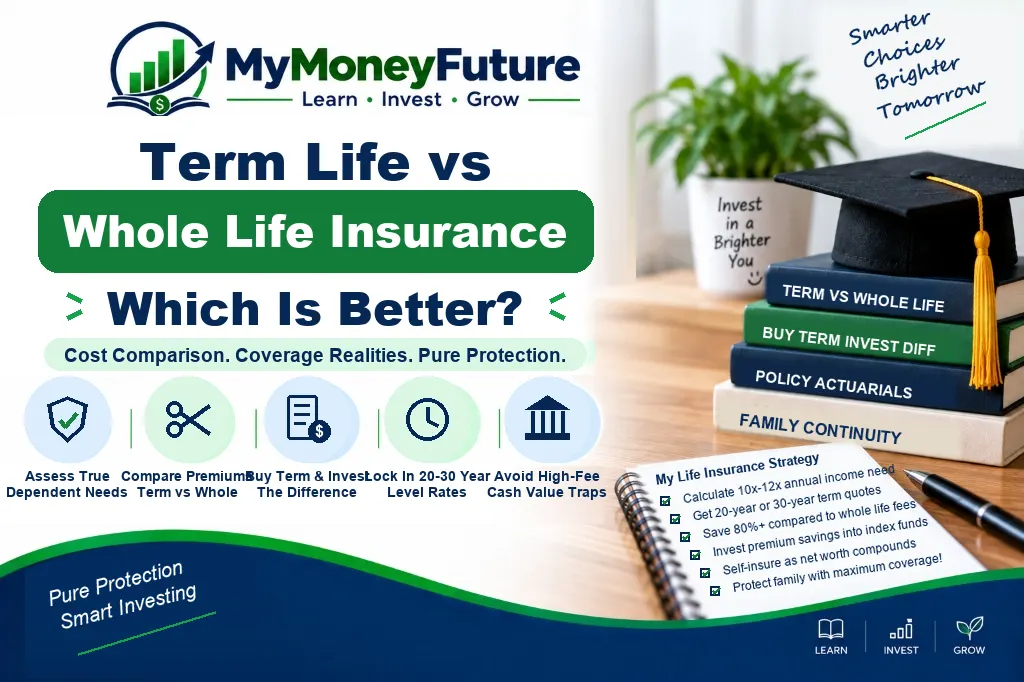
Short answer
Term life insurance is usually a good option for people who want inexpensive coverage for a certain length of time, such as when raising children, paying off a mortgage or replacing income. Whole life insurance is lifetime coverage with cash value, but it is more costly and complicated. The correct pick should rely on your budget, dependents, goals and coverage schedule.
“Highlights”
| Important Point | What does it mean |
| Term life has limits | It covers some period of time, for as 10, 20 or 30 years. |
| Whole life permanent | If premiums are paid, it can last a lifetime. |
| Usually cheaper term | It typically gives you additional protection for the same price. |
| Whole life builds cash value | Some of the policy may gain value over time. |
| The best policy fit your need | The purpose of coverage is more important than product label. |
Background Introduction
Life insurance can offer protection for those who rely on your income, care or financial support. But once you start browsing, the options may get bewildering fast.
The two most popular choices are term life insurance and whole life insurance. Both can provide a death benefit to your beneficiaries, but they have different uses.
Term life insurance is intended for a short duration. Whole life insurance is intended to offer lifetime coverage and may grow financial value.
The greatest choice is not the one the salesman wants you to make. It’s the one that fits your family’s financial risk, fits your budget and fits the reason you need insurance in the first place.
What is Term Life Insurance?
Term life insurance insures you for a set number of years. Typical terms are 10, 20 and 30 years.
Death benefit is paid to the beneficiaries if the insured dies during the policy period. Usually coverage expires when the person lives beyond the term, unless the policy is renewed, converted or replaced.
Term insurance, which is obtained for a specific length of time, is typically designed to offer lower-cost protection, according to the National Association of Insurance Commissioners. A good place to begin to learn the basic differences is the NAIC guide to varieties of life insurance.
Term life is utilized most often during the years of greatest financial commitments. These years could entail raising children, paying off a mortgage, building retirement assets or supporting a spouse.
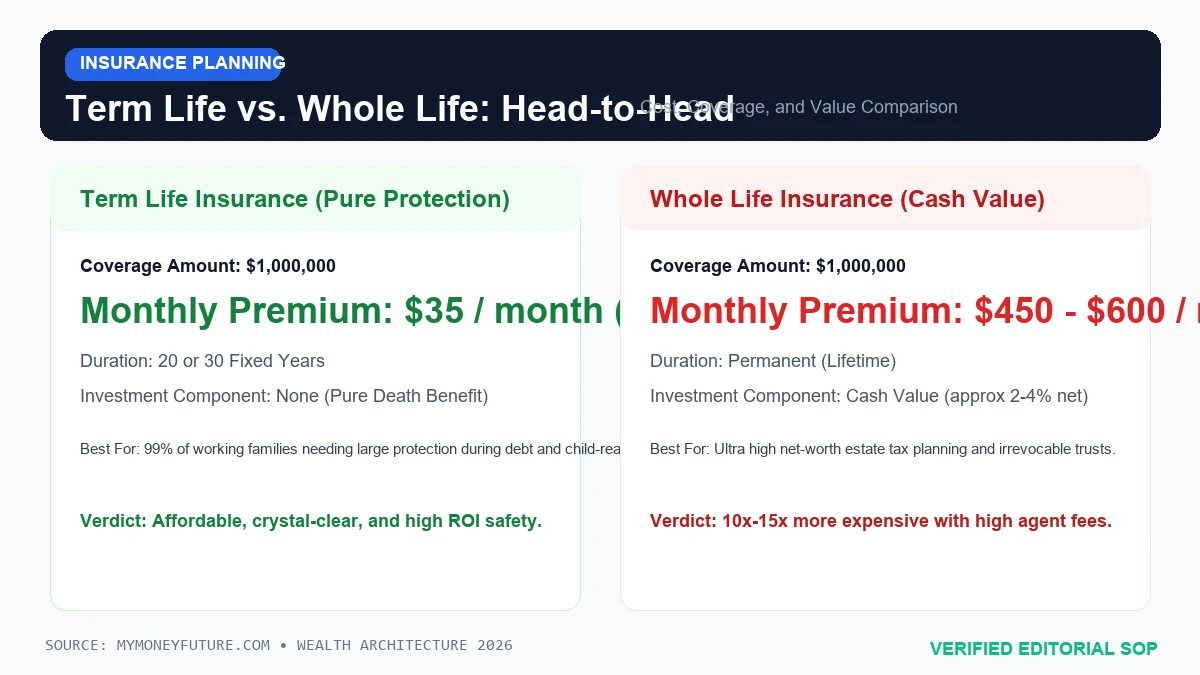
Because term life often doesn’t grow cash value, premiums are usually substantially lower than similar whole life premiums for the same death benefit.
What Is a Whole Life Insurance?
Whole life insurance is a type of permanent life insurance. It’s meant to last your lifetime as long as premiums are paid and the policy is in force.
Whole life provides a death benefit and a cash value component. Depending on the terms of the policy, the cash value can grow over time. Dividends are not guarantyd unless the insurer states otherwise, yet some policies pay dividends.
Whole life is generally more expensive than term life since it gives lifetime coverage and cash value benefits.
It may be helpful for some purposes such as lifetime dependent coverage, inheritance planning, business planning or those that desire permanent coverage and understand the cost.
It is not necessarily a superior investment merely because it has financial value. Buyers should consider expenses, flexibility, surrender charges and alternatives.
Term Life vs. Whole Life: What’s the Difference?
| Feature | Term Life | Whole life. |
| Coverage period | Fixed term, e.g. 10, 20, or 30 years | Lifetime if policy continues |
| Surcharge (cost) | Usually less | typically substantially higher |
| Cash value | Usually none. | Yes, usually . |
| Recommended for | Short term income protection | Lifetime coverage requirements |
| intricacy | Easier | More intricate |
| Flexible | Replacement needed after term | May be active for a lifetime |
| High risk | Coverage terminates when you outlive term | Premium can be too pricey to keep up |
The main practical difference is the cost. Term life frequently offers a greater death benefit with a lower premium for the years your family needs it most.
Whole life can be covered for life, but the more expensive option may make it difficult for some households to purchase enough coverage.
If you have children and you require a million dollars in income protection, term life may be more reasonable. If you have a lifelong dependence or estate planning need, you might look for whole life or similar permanent coverage.
When Term Life Might Be the Better Way to Go
Term life is generally a viable option for transitory needs. A lot of financial dangers disappear with time. Kids become older, mortgages get paid off, savings grow, retirement funds grow.
Term life may be a good fit if you wish to cover:
- Income replacement for young children
- A mortgage or other big debt
- Cost of child care if a parent dies
- Education costs
- Transition period of a spouse after a loss of income
- Strong savings for years to go before retirement
For example, if you are 35 years old and have small children, you might choose to go for a 25 year or 30 year term coverage. That coverage may continue thru the years when children are financially dependant.
Term life also helps consumers afford enough coverage without busting the monthly bank. A reasonably priced insurance of an appropriate size is usually better than an inadequate permanent coverage or one that will be terminated down the road.
When Whole Life Could Be The Better Option
Whole life works when the need is permanent or when the coverage is part of a larger financial strategy.
It can be considered for:
- A dependent requiring lifetime support
- Requirements for Estate Planning
- Planning for business succession
- Final Expenses If You Need Whole Life Coverage
- High income households with complex planning demands
- People who want permanent coverage and can afford it comfortably
Whole life may appeal to folks who seek predictability, too. Level premiums. Lifetime protection. Cash value growth as specified in the policy.
But the added cost counts. If the premiums cut into emergency savings, retirement investment, debt payments, or proper coverage, the policy might not be the best choice.
Price Difference: Why Premiums Matter
The premiums are not a regular payment. It’s up to them if you can keep the policy active for years.
A common mistake is to get a policy that appears nice in a sales graphic but doesn’t fit the household budget. Later if the policy is canceled the family may lose coverage and value.
“Buy Term and Invest the Difference” Wealth Calculator
Compare 30-Year Wealth: Term + Index Fund vs. Whole Life
See how much additional liquid wealth you create by purchasing inexpensive term insurance and investing the premium savings.
| Circumstance | Probably anxious | Potential fit |
| Young family requires high cover | Require significant death benefit at reasonable cost | Term life insurance |
| Single person with no dependents: | May need little or no coverage | Final expense or small term coverage |
| Parent of a disabled child | Working years may outlast need | Permanent coverage may be explored. |
| Business owner | May require buy-sell or key person planning | Term or permanent (structure dependent) |
| Estate planning for the high net worth | Taxes/liquidity/lifetime needs could be important | Permanent coverage can be considered |
Don’t compare insurance based on premium alone. Compare price, coverage quantity, length, guaranties, exclusions, cash value, flexibility, and what happens if you stop paying.
Cash value: a useful feature or an expensive distraction?
Whole life insurance cash value can help but it is often misunderstood.
Cash worth is not the same as a normal saving account. Accessing it could include insurance loans, withdrawals, surrender penalties, interest and possible tax consequences.
Before getting permanent coverage, read the NAIC life insurance buyer’s guide and compare how cash value policies function to simpler protection options.
Although the cash value can be useful for some planning purposes, it should not be more important than the primary reason for life insurance: to provide for those who rely on you.
If your major need is income replacement for the next 20 or 30 years, term life may be a more straightforward answer to the problem. Whole life may be worth a second look if you need life and can afford the rates.
How much coverage do you require?
Choosing between term and whole life is a different decision than deciding how much coverage you need.
Start by writing in the financial obligations your family would have to deal with if you died:
- Housing assistance
- Income replacement
- Costs of childcare
- Costs of education
- Debts
- End of life costs
- Spouse, children, parents or other dependents support
Subtract savings, investments, current life insurance, and assets your family may conceivably get to.
A tiny whole life policy may be everlasting, but if your family requires $750,000 in protection and the policy only has $100,000, it could create a huge gap.
Common Errors
One mistake is to buy whole life when the true requirement is temporary and the budget is tight. And that leads to underinsurance.
Another mistake is buying term life and forgetting the term expiration date. If you still require coverage at the conclusion of the term, replacement can be more expensive because you are older and your health may have changed.
There are those just relying on company life insurance. That coverage can be limited and can cease if you leave the job.
Others focus mainly on investment characteristics and forget that insurance is primarily a risk management instrument. If your family needs financial security, the death benefit is the most important thing.
Another is not examining the beneficiaries. A policy may be carefully designed but if the wrong person is mentioned, it might cause complications.
Decision Guide
| Choose Term Life If | Opt for Whole Life If |
| You need cheap high coverage. | You want lifetime coverage |
| Your greatest risk is transient | Your need will not expire. |
| You need simple security | You know how cash value is. |
| You have small kids or a mortgage | You have estate or company planning requirements |
| You have a budget constraint | Premiums are inexpensive easily |
| You intend to invest individually | You want the cash value characteristics of insurance |
For many households, the practical solution is to buy term life for the big income replacement years and build savings separately. Whole life insurance may be used in a more complicated plan by some households.

The correct response relies on the real problem you are trying to solve.
Expert Advice
Begin with the need for coverage, not the product. First, decide who needs money, how much they need and how long they need it for.
Make premiums affordable. A coverage that expires because of cost will not safeguard your family.
Compare different quotations. Premiums and insurance characteristics differ by insurer.
Find out if the term policies can be renewed or converted. If your health changes, conversion alternatives may be important.
If you’re considering whole life insurance, be sure to get a plain-English explanation of cash value, surrender charges, policy loans, dividends and what happens if you stop paying.
Review coverage after life changes such as marriage, divorce, children, a new mortgage, company ownership, changes in income or retirement.
Action Plan for Beginners
First, make a list of why you need life insurance. Are you trying to replace income, safeguard a mortgage, support children, provide for a spouse, fund school or pay funeral expenses? The rationale shows if the necessity is temporary or permanent.
Next, estimate your coverage amount before comparing goods. Include debts, income replacement, child care, schooling, housing support and last expenses. Then deduct savings, current coverage. This stops you selecting a policy that sounds excellent but leaves a protection gap.
Next, compare term and whole life with identical coverage goals. For example, compare the cost of $500,000 of term coverage with the cost of $500,000 of whole life insurance. If whole life is too expensive, don’t cut your coverage so much that your family is underinsured.
Finally, revisit the policy every few years. Life insurance isn’t a one-time decision. As your children grow, your debt decreases, your income increases or your assets become large enough to secure your family, your demands can change.
Real Life Situation
Jason and Priya have two small kids, a mortgage and one primary income. Their largest need is to replace their income for the next 25 years. They compare a huge term policy with a much smaller whole life coverage that costs about the same each month.
The whole life policy pays forever, but the death benefit is too modest to replace income or safeguard the mortgage. Term policy offers far better protection during the years the family is most vulnerable.
They chose term coverage for the major income demand, and continue to save thru retirement accounts and emergency savings. Later, they can reexamine choices if a permanent need for insurance arises.
Thus, this example indicates that the choice depends on the problem. Large temporary risk term may fit if problem. If the issue is lifetime assistance or estate planning, you might want to look more closely at whole life.
Section FAQ
Q: Is term life better than entire life
A: Term life is preferable for economical temporary coverage, whole life may be better for lifetime needs. What plan is best for you depends on your aim and budget.
A: A whole life policy costs more because it covers you your entire life.
A: Generally, whole life costs more because it is designed to insure you for your entire life and includes cash value benefits.
Q: What does term life insurance do when it expires?
A: Coverage normally expires unless you renew, convert or buy a new policy. If you merely outlive the term, there is no death benefit paid.
Q: Will term life insurance build cash value?
A: Most term life plans have zero cash value. They are generally meant to provide a death benefit.
Q: Can I convert term life to whole?
A. Some term insurance do have a conversion option. Please read the policy terms before purchase.
Q: Whole life as an investment?
A: Whole life builds cash value, however it is not a standard investing account. Compare prices, rewards, flexibility and insurance needs carefully.
A: No dependents, do you need life insurance?
A. If no one is financially dependent on you, you may require little or no coverage. You may still want to cover last expenses or certain familial obligations.
Q: Can I own term and complete life?
A: Yes. Some people buy term life for significant temporary demands and permanent for minor life-long needs.
Final Thoughts
Term life insurance and whole life insurance can both be valuable, but they are not the same.
Term life is typically easier and less expensive for families that require good protection during high-responsibility years. If you want permanent coverage and can pay the extra cost, whole life might be right for you.
Don’t vote slogans. Consider your dependents, bills, income, savings, health and long-term aspirations.
“The right policy should do one thing well: Protect those who would be financially hurt if you were no longer there.”
Notice of Educational
This page is for educational and informational purposes only. This is not financial, legal, tax, insurance or investment advice. Life insurance policies, rates, guaranties and cash value features differ by insurer and each policy. Before you buy or change coverage, consider talking with a competent insurance expert or experienced financial advisor.
Frequently Asked Questions (FAQ)
Explore Free Interactive Financial Calculators
Put these insights into practice with our 7 free financial planning and net-worth growth calculators: