Introduction
Travel insurance is one of those goods that people tend to think about at the last minute. You book the airline, hotel, tour or cruise, then a checkout page asks if you want protection.


Sometimes travel insurance is a good idea. Sometimes it’s not essential. The proper response depends on the cost of the trip, your health coverage, your location, refund policies, travel dangers and how much money you might afford to lose.
A weekend road vacation with refundable bookings probably won’t require much protection. Something unusual may be a $6000 overseas trip, cruise, honeymoon, family getaway or distant experience.
This guide outlines what travel insurance covers in 2026, when it’s worth buying, when you can skip it, and how to compare policies without paying too much.
Quick Answer
Travel Insurance Cost & Coverage Estimator
Estimate fair policy premiums and essential coverage limits based on your non-refundable trip expenses and destination.
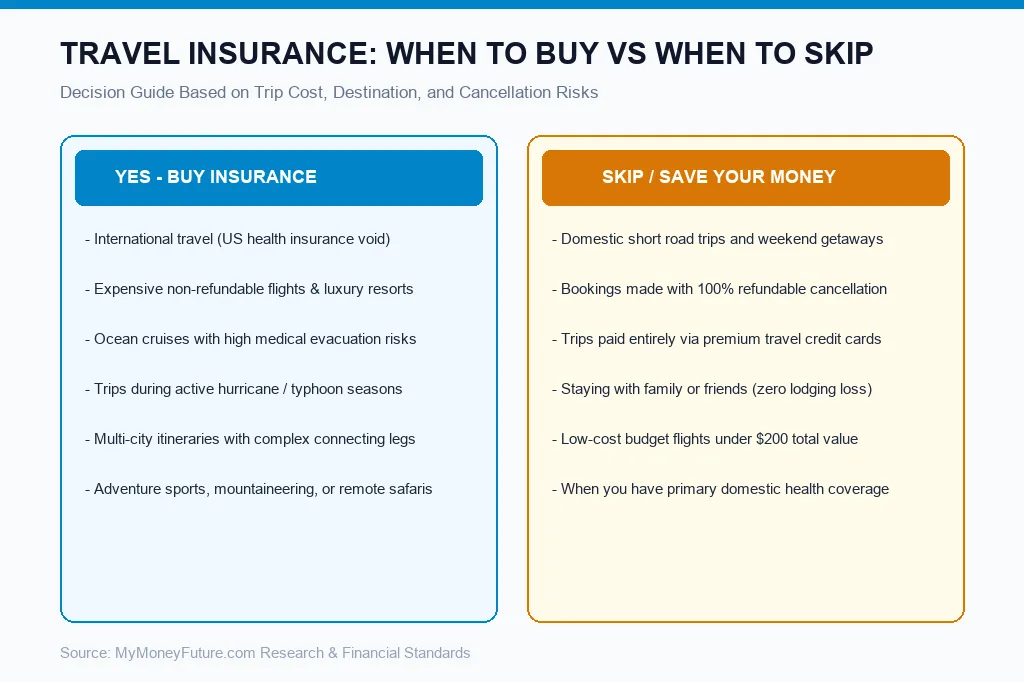
Travel insurance is worth it if you’re traveling internationally, have high nonrefundable trip costs, limited medical coverage overseas, costly flights/cruises, traveling to isolated locations, or have a higher than normal risk of cancelation. If it’s an inexpensive, refundable, domestic trip and you can afford to lose the money, then maybe you don’t need to.
Important Points
| Point. | What does it mean |
| Travel insurance is risk cover | It helps protect prepaid trip costs and some travel situations. |
| You need medical coverage when overseas. | Your current health insurance may not entirely cover care abroad. |
| Rules are everyplace | Read grounds, exclusions, limits and rules for claims. |
| Lower coverage, for refundable trips. | If you may cancel without cost, insurance may be less effective. |
| Shop early for more choice | Some advantages may require a purchase within a short time of the first trip payment. |
Typical travel insurance coverage
Travel insurance is not a single coverage. It’s typically a bundle of different protections.
A coverage can cover trip cancelation, trip interruption, travel delay, emergency medical care, medical evacuation, luggage loss, baggage delay and accidental death.
| Type of Coverage | Potential Benefits |
| Cancelation of the trip | Prepaid charges if you cancel for a covered reason |
| Break Travel | Unused travel cost if you end trip early |
| Delay in travel | Meals, accommodation or expenditures following covered delays |
| Emergency health care | Traveling and unexpected medical care |
| Air Medical Evacuation | Transfer to suitable medical facility |
| Loss of Baggage | Lost, stolen or damaged baggage |
| Delayed baggage | Essential goods when luggage is delayed |
| Car rental insurance | Some damage to your rental car, if covered |
Travel insurance can help protect against such risks as trip cancelation, interruption, delays, lost luggage and medical expenses related to travel, according to the National Association of Insurance Commissioners. Policies differ, so read the NAIC review of what is covered by travel insurance.
The language of the policy is the most significant item. Two policies might be called travel insurance, but one might cover much more than the other.
When You Should Get Travel Insurance
Travel insurance is more valuable when the financial risk is large.
If most of a $500 trip is refundable, then insurance might not be worth the expense. The risk is greater if you’re paying $8,000 for a trip that includes non-refundable airfare, tours, accommodations and cruise fees.
| Situation | Why You May Need Insurance |
| International travel | Medical and evacuation expenditures may be tougher to control |
| Cruise line | Cancelation procedures are generally severe and prepaid expenses hefty. |
| Expensive family holiday | One illness can afflict many travelers |
| remote place | Possibly increased risk for medical evacuation |
| Adventure Holidays | Injury and danger of interruption may be greater |
| Older travelers | Health problems more likely to occur |
| Non-Refundable Reservations | More money at stake if plans alter |
Here’s a good rule of thumb: If it would hurt to lose the expense of the prepaid trip, consider insurance. If you can afford the loss, you may not need as much coverage.
When You Don’t Need Travel Insurance
Travel insurance is not always required.
Skip if your journey is low-cost, refundable, domestic and low risk. For example, a brief visit to family with a refundable hotel and cheap ticket might not warrant a comprehensive policy.
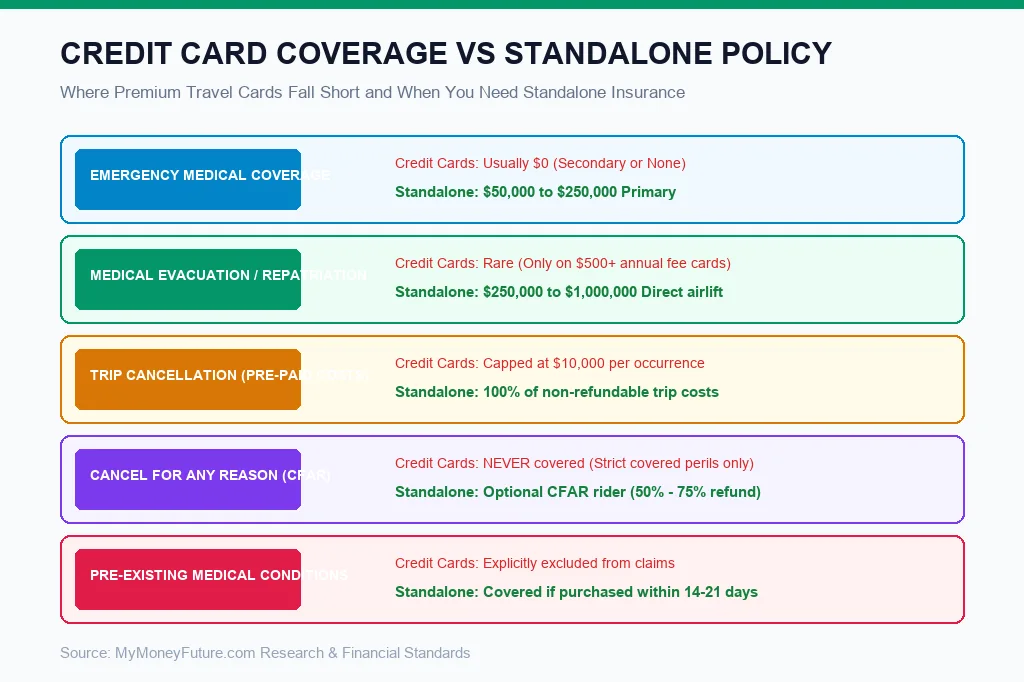
You might already be covered by a credit card. Some premium cards offer trip delay, baggage delay, rental vehicle or cancelation perks. But there are restrictions and rules for card perks, so read the benefits guide carefully.
| You Might Need Less Coverage If | Cause (Reason) |
| Trip fees can be refunded | There’s less money in it |
| Trip is affordable | Loss can be handled |
| Travel within the country | Your health insurance might work as usual |
| You receive great card advantages | Some travel protections may already be in place. |
| Plans are not carved in stone | You can alter dates with no major penalty |
Don’t buy a policy because it feels urgent in a checkout box. Compare the coverage and cost to the actual danger.
Travel Health Insurance and Evacuation Coverage
One of the greatest reasons to seek travel insurance for international vacations is for medical coverage.
Your regular health insurance may not cover you well outside your own country. For instance, Medicare usually pays little for care outside the U.S. Even private plans could need you to pay up ahead or have limited networks available while you are abroad.
You can have to pay a lot if you need emergency evacuation and you happen to be in a distant place or a country with restricted medical treatment. Travelers to higher-risk destinations or countries with limited medical care are strongly encouraged to purchase medical evacuation insurance; read its recommendations on travel insurance and medical evacuation for more information.
Travel Medical coverage is not Travel Trip Cancelation coverage. Some travelers purchase both. Others buy simply medical and evacuation coverage, since their vacation fees are refundable but medical risk still matters.
Trip Cancelation vs. Cancel For Any Reason
You cannot cancel the trip for any reason under the trip cancelation coverage. Usually reimburses prepaid, non-refundable expenses only if you cancel for a covered reason in the policy.
Reasons covered include illness, accident, death of a family member, bad weather, loss of a job, jury duty, military duty or a major situation at home. Terms differ exactly.
Cancel for Any Reason, aka CFAR, is more general but tends to be more expensive. It might cover only a part of the trip cost and usually needs to be bought immediately after the first trip payment.
| insurance coverage | How It Works |
| Regular cancelation | Pays only for covered causes |
| Cancel for Any Reason | Wider cancelation option, frequently partial compensation |
| Trip interruption | If you have to cut the trip short, helps |
| Delay to travel | Helps pay for costs following covered delays |
If your biggest concern is changing your mind, regular coverage may not be enough. Please read the cancelation section carefully.
What Travel Insurance Usually Doesn’t Cover
Benefits are just as important as exclusions.
Some policies exclude known events, dread of travel, pre-existing diseases unless waived, dangerous activities, alcohol related injuries, civil disturbance, epidemics or cancelations not stated as covered reasons.
Adventure sports are not always included unless you pay an upgrade. Some will refuse claims if you travel against official advice or don’t supply proof they require.
| Possible Exclusion Criteria | Why This Matters |
| Present conditions | May need early purchase of waiver. |
| Travel anxiety | Not normally a covered cause |
| Storms or occurrences known | Coverage may not apply until an event has been reported |
| Extreme sports | May need adventure cover. |
| Documents not found | Claims may be dismissed without evidence |
| Changing your mind | Needs CFAR, if there is one |
Don’t Count on the sales page alone. Read the insurance certificate or policy wording.
What Does Travel Insurance Cost
The price of travel insurance is determined by the price of the trip, the age of the passenger, the destination, the length of the trip, the kind of coverage and the policy limitations.
A coverage for a youthful traveler on a brief domestic trip may be low cost. An senior traveler on a long international vacation can pay a lot more for a policy.
The question is not just the premium, however. The question is whether the coverage covers the risks that matter to you most.
| Factor | Its effect on cost |
| Price of trip | Higher premiums generally indicate higher prepaid costs |
| Age of traveler | Older passengers usually pay more |
| Destination. | Medical and evacuation concerns can be costly |
| Trip distance | Longer trips might be more costly |
| Depth of Coverage | CFAR limitations and higher limits increase cost |
Compare 2 or 3 policies at least. Ignore the headline price: A inexpensive coverage with limited medical limits may not be a good choice for an international vacation away.
How to Compare Policies?
Start with the risk you’re protecting against. What most interests you: cancelation, medical care, evacuation, baggage, or delay?
Next, compare coverage limits, covered causes, exclusions, deductibles, claims process, provider reputation and availability of emergency assistance.
| Policy Feature | Question to Ponder: |
| Trip cancelation limits | Is that for the entire non-refundable prepayment? |
| Medical ceiling | Is it enough for the destination. |
| Evacuation initiation | Could it do remote transportation? |
| Waiver of pre-existing condition exclusion | How much can I get and do I qualify? |
| Delay of Coverage | How many hours before benes start |
| Coverage of baggage | Limited electronics or valuables? |
| Rules of claims | What is the proof? |
A good policy is straightforward. Don’t understand what’s covered? Call the insurer. Or select an option that’s better stated.
Common Errors
The first error is to get the cheapest policy without reading the limits on it.
The second mistake is to assume all cancelations are covered by travel insurance. Not every reason for a life change is covered by standard insurance.
The third mistake is waiting too long to. Some perks may require you to purchase early, following your first trip payment, such as pre-existing condition exemptions or CFAR.
The fourth mistake is to ignore medical coverage. When traveling internationally, medical and evacuation benefits may be more significant than baggage coverage.
Mistake #5: Failure to write down claims. Keep receipts, delay notices, medical records, police reports, proof of cancelation.
How to Make a Travel Insurance Claim
You can only use an insurance if you can file a claim right away. Many denials are due to travelers not having the required paperwork from the insurance.
Save your booking confirmations, receipts, policy documents and emergency support phone number in advance of the journey. Keep tabs on delays, cancelations, medical care, police reports and extra costs during the trip.
If your flight is delayed, get the airline to give you written confirmation. In case of misplaced baggage, make a report before leaving the airport. If you are looking for medical care, ask for itemized invoices and medical notes.
File the claim soon after the trip. Submit all the documentation as instructed by the insurance. If your claim is refused and you believe it should be covered, get a written explanation and look into the appeals process.
Travel insurance is no free lunch. It’s a deal. Good paperwork increases your odds of your claim.
Travel Insurance by Travel Type
The right travel insurance option depends a lot on the type of vacation.
Cruise cancelation and interruption coverage could be more important as prepaid expenditures may be significant and returning home in the middle of a trip could be challenging. You may require stronger medical and evacuation coverage on a backpacking trip. If you currently have medical insurance, a domestic family trip may just need cancelation or delay coverage.
| Type of trip | Coverage to Watch Carefully |
| Cruise Ship | Cancelation, stoppage, missed connection, medical evacuation |
| International holidays | Medical, evacuation, cancelation, delay |
| Tours of Adventure | Sports exclusions, emergency help, medical evacuation |
| Business travel | Equipment and cancelation and delay and employer coverage |
| Family vacation | CANCELATION DUE TO ILLNESS OF ONE TRAVELER |
| Weekend Getaway at Home | Credit card advantages and refund policies |
Don’t just buy the same coverage on every trip without thinking. A beach resort, remote expedition, boat, business conference, or local weekend break might all have very distinct risk profiles.
When to Purchase Travel Insurance
The protection you receive can be affected by timing. Some advantages may only be accessible if you purchase coverage within a specified time period following your initial trip payment.
This may impact pre-existing condition waivers, Cancel for Any Reason coverage and certain upgrade options. If you delay it until the week before you travel you may have less choice.
The best way to do this is to check coverage shortly after the first big travel expense is booked. Don’t feel you have to buy the first policy you see, but be aware if any time-sensitive advantages are relevant to your trip.
If you book in stages (e.g., first flights, then hotels) save your receipts and update the insured trip cost if the policy needs it. Underinsuring the vacation can cause issues when making a claim.
| When To Purchase | Why It’s Important |
| First payment coming soon | – May unlock time-sensitive perks |
| After full payment | May still cover some risks but fewer choices |
| Following a recognized event | That event might not be covered |
| After you go away | Many trip coverage cannot be purchased once travel has started |
The rule of thumb is: Read the policy regulations and then assume you can wait. That is the safest habit.
A Simple Buying Checklist Before You Click Buy
Wait a minute. Before you get travel insurance, answer a few questions. What part of the trip is non-refundable? Will your regular health insurance be accepted at your destination? Would an emergency flight home or evacuation pose a real financial problem? Changed your mind or have a covered emergency?
Then go thru the policy advantages in order of priority. For plenty of overseas passengers, medical and evacuation limits demand top priority. Cancelation and interruption limits might matter more for pricey planned trips. A full policy may not be essential for short local travels.
Finally, go over the claims process. A policy that seems inexpensive but is complex when something goes wrong is not as useful as a policy with clear directions, 24 hour service and easy document submission.
A good travel insurance should make the risk easier to deal with. It should not leave you wondering what is covered.
Senior Financial Editor’s Takeaway: Travel Safe, Protect Cash
Never view travel insurance as an investment—it is a catastrophic risk shield. Domestic travelers booking refundable tickets rarely need standalone policies. However, for international trips or cruises where US health insurance is legally void, a basic primary medical and evacuation policy is non-negotiable.
Key Rules Before Booking:
- Check Existing Insurance: Review our guide on Types of Insurance Everyone Needs to identify baseline gaps.
- Keep a Travel Emergency Buffer: Hold 1-2 months of emergency cash in a High-Yield Savings Account for instant card reimbursements.
- Balance Cash Allocation: Ensure you follow our Emergency Fund vs Investing Priority so your travel budget doesn’t cannibalize your savings.
- Save on Bookings: Apply the money-saving frameworks in 100 Ways To Save Money to lower your upfront trip cost.
Planning retirement travel? Explore our deep dive on How To Retire At 40.
FAQs section
Q: How much is travel insurance worth it 2026?
A: It might make sense if your vacation is pricey, non-refundable, overseas, medically dangerous or hard to rebook. It may not be so important for cheap and refundable excursions.
Q. Is the trip cancelation insurance for any reason?
A: Standard policies usually cover only listed reasons. Cancel for Any Reason coverage is more comprehensive but normally costs more and may only refund a portion of the trip.
Q: Does my travel insurance cover medical expenditures overseas?
A: There are several insurance that provide emergency medical coverage abroad. Limitations and exclusions vary, so be sure to verify the policy for coverage of your activity and destination.
Q: What is medevac insurance?
A: It contributes to the cost of emergency transportation to adequate medical care, which can be expensive in rural areas or areas with limited facilities.
Q: When should I get travel insurance for a domestic trip?
A: Depends on trip cost, refund regulations, health coverage, cancelation risk. Refundable arrangements for domestic journeys may need less coverage.
Q: When do I need to acquire travel insurance?
A. Travelers often acquire shortly after paying for their first trip, because some of the perks can expire. Always check policy rules.
Q. Does travel insurance pay for misplaced luggage?
A: Many policies cover lost or delayed baggage, but there are limits. There may be special limits or exclusions for expensive things.
Final Verdict: Protecting Your Journey and Wealth
When the danger is high enough to make the expense worthwhile, travel insurance is worth it.
A solid policy can shield you from losses that might be hard to bear on expensive, international, distant or non-refundable excursions. If you’re doing easy, low-cost, refundable vacations, you may not need much coverage.
The best policy is not necessarily the cheapest or the dearest. It’s the one that fits your genuine risks, with clear limits and gives you protection where you need it most.
Educational Disclaimer
This material is for educational and informational reasons only and is not intended to give legal, financial, insurance, medical or travel advice. How much you pay for coverage depends on your insurance, insurer, destination and situation. Make sure you read the policy documents thoroughly and consider consulting with a licensed insurance professional before purchasing coverage.
Explore Free Interactive Financial Calculators
Put these insights into practice with our 7 free financial planning and net-worth growth calculators: