Introduction
One of the most practical methods to turn your expertise into a digital product is to create an online course. You don’t need a massive audience, a studio, or a perfect personal brand to start. You do need a relevant topic, a clear promise and a course that helps real people address a genuine problem.
The online course market is more crowded in 2026 than it was a few years ago. That doesn’t mean it’s too late. It means customers may more easily dismiss mediocre courses, imprecise promises, and rehashed knowledge. A course needs to be specific, relevant, and focused on a defined student outcome.
Great courses don’t just spew knowledge into videos. They take someone from a point of departure to a better result. The outcome could be learning Excel at work, developing a budget, designing a fitness plan, passing a test, starting a side hustle or acquiring a skill for work.
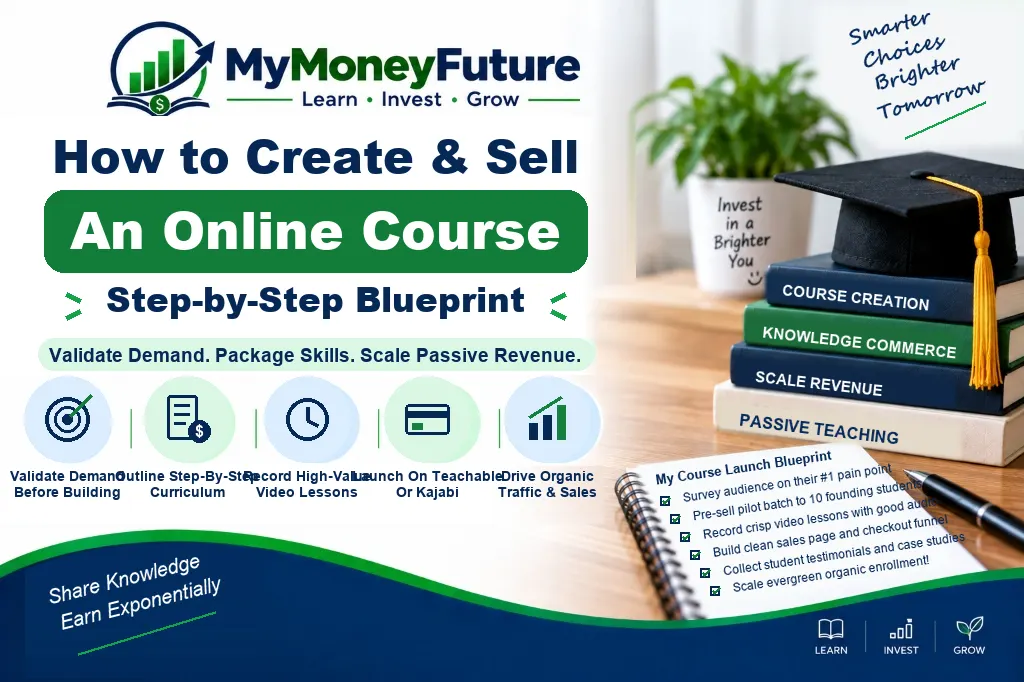
How To Create And Sell An Online Course In 2026 From Idea To Launch In This Guide You Will Learn You’ll learn how to identify a topic, validate demand, outline your courses, price your course, select a platform, market it ethically and enhance it after your first students sign up.
Fast Answer
How to Create and Sell an Online Course in 2026
- Identify a specific problem you can solve
- Confirm that people want the outcome
- Create a simple curriculum
- Record clear lessons
- Add worksheets or templates
- Publish on a course platform
- Market your course with honest content, email, social proof, and ongoing student feedback
Important Points
| Point. | WHAT IT IS |
| Some subjects sell better | A narrow course is easier to promote than a wide course. |
| Recording is after validation | “Before you spend weeks making videos, see if there is demand. |
| The result is everything. | Students purchase progress, not information. |
| Trust over hype | Don’t overstate income or achievement claims. |
| start modest launch first | A simple first version can be enhanced by real input. |
Begin With a Course Topic That Solves a Real Problem
A excellent online course begins with a problem that people already care about. Many newcomers begin by focusing on what they want to teach, rather than what the consumer wants to accomplish.
Digital marketing is a big subject and it’s challenging to sell since it can mean different things to different people. A topic such as, “How Local Dentists Can Set Up a Google Business Profile and Get More Appointment Calls” is much easier to understand.
The best subject for a course is where three things meet: what you know, what people desire, and what they will pay for. If you are lacking one of those aspects it will be hard to market the course.”
| Bad Course Concept | Best Course Idea |
| Productivity Learn | Create a planning method that works for busy freelancers |
| Earn money online | Start your first paid newsletter in 30 days |
| Learn to take pictures | How to take better product shots with your phone |
| The basics of personal finance | Make a Simple Family Budget in a Weekend |
| Getting started with fitness | ### 20-Minute Home Workout Routine (No Equipment Needed) #### Warm-Up (3 minutes) 1. Jumping Jacks – 1 minute 2. Arm Circles – 1 minute (30 seconds forward, 30 seconds backward) 3. High Knees – 1 minute #### Main Workout (15 minutes) Perform each exercise for 45 seconds, followed by 15 seconds of rest. Repeat the circuit twice. Circuit 1 1. Squats – 45 seconds – Rest – 15 seconds 2. Push-Ups (knees or standard) – 45 seconds – Rest – 15 seconds 3. Mountain Climbers – 45 seconds – Rest – 15 seconds 4. Plank – 45 seconds – Rest – 15 seconds Circuit 2 5. Lunges – 45 seconds – Rest – 15 seconds 6. Tricep Dips (using a chair) – 45 seconds – Rest – 15 seconds 7. Burpees – 45 seconds – Rest – 15 seconds 8. Side Plank (each side) – 45 seconds – Rest – 15 seconds #### Cool Down (2 minutes) 9. Forward Bend Stretch – 30 seconds 10. Quad Stretch (each leg) – 30 seconds 11. Child’s Pose – 30 seconds ### Tips: – Maintain a steady pace and focus on proper form. – Adjust the intensity by changing the speed or range of motion as needed. – Stay hydrated and listen to your body. |
Ask yourself: what painful, urgent or valuable outcome can I help someone achieve? A course that saves time, boosts revenue, reduces stress, improves health, or teaches a work skill is usually more in demand than one based only on general interest.
Validate Demand Before Building
Validation helps you avoid building a course that nobody wants. It doesn’t require a massive budget. It’s listening to the market before you record classes.
- Look for recurring questions first. Search YouTube comments, Reddit threads, Facebook groups, LinkedIn posts, Amazon book reviews and course marketplaces Demand signal is when people continuously asking the same question in multiple areas.
You could also construct a short landing page describing the outcome of the course and asking visitors to join a waitlist. If nobody signs up, maybe the issue, promise or audience needs work. If people join and inquire when it launches, you have a better signal.
Also a good test is a paid workshop. charge a nominal fee to live teach the topic If people pay and attend, you can polish the workshop into a course later.
| Validation Method | What to watch for |
| Keyword research | People also searched for the topic |
| Community questions: | Pain spots, perplexity, repeated |
| Waitlist page: | People willing to share email for updates. |
| Workshop Fees | Proof individuals pay for the outcome |
| 1-to-1 calls | The exact words buyers use to describe the problem |
Don’t confuse praise with demand. It’s one thing for your friends to think the idea sounds excellent. Quite another for strangers to sign up for a waitlist or pay for a training.
Identify the student result
A course must have an endpoint. Complete this statement before writing lessons: By the completion of this course the student will be able to:
This one single statement drives the curriculum, the marketing page, the pricing, the supplementary stuff. It also prevents you from adding superfluous lessons that only increase the length of your course, instead of improving it.
For example, a course called Start Investing is overly general. A more concrete outcome would be: By the end of this course, beginners will understand the mechanics of opening a brokerage account, picking a simple index fund, starting a monthly investing habit and avoiding frequent blunders.
This result shows the student what progress to expect. It also provides you with a natural structure for the course.
Develop a Basic Course Outline
Most initial courses should be easy to make. You don’t need 80 classes, movie editing and a massive workbook. You need a rational path that leads the pupil from perplexity to action.
A good course outline contains five to eight modules. Each module should teach one part of the journey. Each lesson should be brief enough that you don’t feel like you are being lectured.
| Part of Course | Objective |
| Welcome class. | Explain the conclusion and how to take the course |
| Module: Foundation | Teach the basic principles needed initially by pupils |
| Step-by-step modules | Follow the real procedure |
| Worksheets or templates | Get students up and moving |
| Errors Section | Show what not to do |
| End of project | Let pupils apply what they have learnt |
| What’s next | How to continue development after the course |
As a rule, the shorter the lesson the better. It’s easier to watch, re-watch and use a five-to-ten-minute lesson that answers one topic than a 45-minute lecture with too many ideas.
Craft lessons that are useful, not fluffy.
Students have unfettered access to information practically anyplace. Your course needs to provide more than information. It should give structure, judgment, examples and shortcuts so that pupils avoid mistakes.
Each lesson should answer 3 questions. What does student need to know? What’s the point? What is the next step for the student?
A lesson on the pricing of an online course, for example, should define pricing. It should have sample price ranges, explain when a low price damages trust, and have a worksheet for selecting a launch price.
More videos than usable assets can make a course less valuable. Examples include checklists, scripts, templates, calculators, swipe files, workbooks, spreadsheets and brief assignments.
| Lesson Resource | Sample |
| Checklist | Pre-enrollment launch check list |
| Template: | Course sales page breakdown |
| Worksheet | Student Outcome Planning Worksheet |
| # Script | Draft email launch sequence |
| Spreadsheet in Excel | Simple revenue & price calculator |
A good course lightens the load on the student. It doesn’t have people watch hours of stuff before they can do something.
Select the Appropriate Course Format
Online courses might be live or recorded, cohort-based, email-based, community-supported, or a combination. The right decision relies on your content, pricing and audience.
Recorded courses are scalable since students can buy and view whenever they want. Live classes are more urgent, and offer real-time support. Cohort courses can benefit students who require accountability and feedback.
| Format | What We Love | Watch Out For |
| Recorded Courses | Skills that never go out of style and studying on your own schedule | Needs to be well structured. Students are on their own. |
| Live workshop | Teaching fast and testing demand | More difficult to scale without recurring sessions |
| Cohort Class | Accountability and transformation | Need scheduling and help |
| Email training | Simple teachings and habit formation | Restricted for difficult demos |
| Membership | Ongoing support & new content | regular delivery required |
A live workshop or small beta course is where a lot of beginners should begin. You can test the topic, answer genuine queries and enhance the material before generating a final evergreen product.
Choose a Platform Without Overthinking It
Course platforms, marketplaces, your own website, or a basic checkout + video hosting arrangement are all ways to sell courses. Don’t spend months comparing tools before evaluating the offer.
A marketplace can enable discovery but offers less control over pricing, branding and consumer connections. You have greater flexibility with your own platform, but you have to do your own marketing.
| Type of platform: | Advantages | Cons |
| Marketplace for courses | Easy setup and an existing audience | More competition, less control |
| Course platform hosted | Good course tools and design | Cost per month |
| WordPress Learning Management System | More control and freedom | Requires technical setup |
| Checkout + easy film | Low complexity for modest launches | Student experience less refined |
Pick a platform that provides safe payment facilities, student access, video hosting, basic analytics, and refunds. Advanced features are useful later, but don’t get held up on your first launch.
Set Your Course Price with Results & Guidance
When pricing a course, consider the value of the outcome, the depth of the material, how much support you provide and the buyer’s ability to pay. A course that teaches a professional skill or helps someone earn more may generally justify a higher price than a light hobby course.
Very low prices are not necessarily the easiest to sell. They can attract fewer committed buyers and make it difficult to afford support, upgrades and marketing. Very high costs demand more proof, better positioning and more hands-on assistance.
| Type of Course | Common Sense Pricing |
| Mini-course | Limited result, cheap price |
| Self-Paced Course Full | Moderate cost, comprehensive process |
| Course based on cohort | Higher price, live support and accountability |
| Premium Program | Increased pricing, feedback, coaching, or implementation support |
A good first launch can leverage founding-student price. For feedback, testimonials and the opportunity to develop the course with genuine student queries, you pay less than the future price.
Ethics of Course Marketing
Marketing an online course is not screaming that your course is life changing. It’s about demonstrating the proper folks that you understand their problem and you can help them to take the next step.
Good marketing content is enough information to generate trust, but the course itself seems beneficial. You can create tutorials, case studies, checklists, comparative blogs, short films, email courses or live webinars.
Watch out for income claims. If your course is about business, investing, side hustles, or professional advancement, don’t promise guarantyd results. The FTC has suggested modifications to stop fraudulent profits claims by money-making opportunity vendors, and course developers should be careful when making earnings claims. If you decide to use testimonials or income examples in your sales material, read the FTC guidance on money-making opportunities and earnings claims.
Use real proof. If you use student screenshots, testimonials or outcomes, they should be true, specific and not overstated. If the results are not usual, point that out. Trust is worth more than a speedy sale.
Launch With a Small Audience
If the offer is clear, a limited launch can work. You don’t need 100,000 followers. What you need is the proper team of people that care about the situation.
It is a simple launch routine.
- Announce the course
- Explain the problem
- Show the result
- Share a lesson or a preview
- Answer objections
- Open enrollment for a limited time
Chat with potential buyers on your initial launch. Ask what they don’t understand. Their questions will make your sales page and future lessons better.
Begin Step 2
| Begin Step 2 | How to act |
| Before launch | Write useful content about the problem |
| Waiting list | Collect email addresses of interested people |
| Preview | Free lesson, workshop or checklist |
| OpenCart | Who is this course suitable for? What is included |
| Close cart | end enrollment or get rid of founding-student pricing |
| Better | edit the course based on feedback |
But the first launch isn’t only about the income. It’s also market research.
Set up Payments, Taxes and Basic Business Rules
If your course is a money-maker, run it like a company. Monitor income, payment processing fees, software charges, refunds, advertising expenditure, contractor payments and other costs.
In the United States, the IRS says, self-employed persons normally calculate net profit or loss by deducting business costs from business income. If you have income from a course or digital product business, visit the IRS self-employed tax center.
Depending on where you live, and where your purchasers are, you may need to consider sales tax, VAT, GST, business registration, payment processor rules, and refund policies. Rules vary from state to state and country to country.
At the very least maintain separate records, and don’t intermingle course income with personal spending. A simple spreadsheet is better than guessing when tax time comes.
Frequent Errors
The first mistake is to build the whole course before validating demand. If there are no buyers, it’s a failing product, a slick course.
The second problem is to make the course overly general. Beginners will typically try to put everything they know in. That generally leads to confusion. A tighter path with a defined goal is easier to sell, easier to finish.
The third mistake is to hide behind production quality. Better lighting and editing can help but they can’t solve a weak offer. What counts is clear teaching, relevant examples and practical workbooks.
The fourth mistake is to price only on the basis of course length. Buyers are not buying hours. They pay for the result, for confidence, for quickness, for assistance, for convenience.
Mistake #5: Ignoring student completion. A course people buy but never finish is going to struggle long term.
- Reminders
- Action steps
- Quick lessons
- Checkpoints
FAQ Section
A: Yes, you are able to develop an online course without a huge audience.
A: Yes, that’s right. If the topic is specific and the solution solves a clear problem, it can work with a tiny audience. After you validate demand, you may also start with workshops, partnerships, SEO content or sponsored ads.
Q: How long should an online course be?
A: As long as it takes to deliver them to the promised outcome, no more. In many rigorous courses, brief lectures and practical assignments substitute for extended lectures.
Q: What is the ideal place to sell a course?
A: The best platform relies on your budget, your technological comfort level and your marketing approach. A hosted platform or a rudimentary checkout setup can work effectively to test demand in the beginning.
A: That depends on what you want to charge for your first course.
A: This depends on the outcome, the audience, the level of support, and the proof of the price. You gather input, and can provide a first beta version for a reduced founding-student pricing.
A: No, you don’t require professional video equipment.
A: No, not at first. Better than pricey gear is good lighting, clear audio and planned lessons. A new camera often doesn’t do as much for the quality as a decent microphone.
Q: How do I ethically market an online course?
A: Provide free information that is valuable, know your target audience, share authentic testimonials, don’t make promises, have a clear refund policy, support system, and state the course results.
Q: Are online courses passive income?
A: They can be semi-passive, but most popular courses still require updates, marketing, customer service and periodic enhancements .
Conclusion
You can still create and offer an online course in 2026 but the threshold is higher. Buyers expect clear results, honest promises, valuable lessons and practical tools.
Choose a specific problem. Don’t record anything without validating the demand. Design a straightforward course that takes students from confusion to action. Then ship small, listen hard, and iterate on the course based on genuine feedback from students.
A course is not just a bunch of videos. It is a guided way. If your course can solve a real problem for people, trust builds, sales are easier, and the product can become a long-term digital asset.
Educational Note
This material is intended for educational and informational purposes only. This is not intended to be legal, tax, financial or business advice. Registration, taxation, earnings claims, refunds, and consumer protection rules are all location-specific. Please get the advice of a knowledgeable expert before you create or offer a paid course.
Explore Free Interactive Financial Calculators
Put these insights into practice with our 7 free financial planning and net-worth growth calculators: