Introduction The introduction
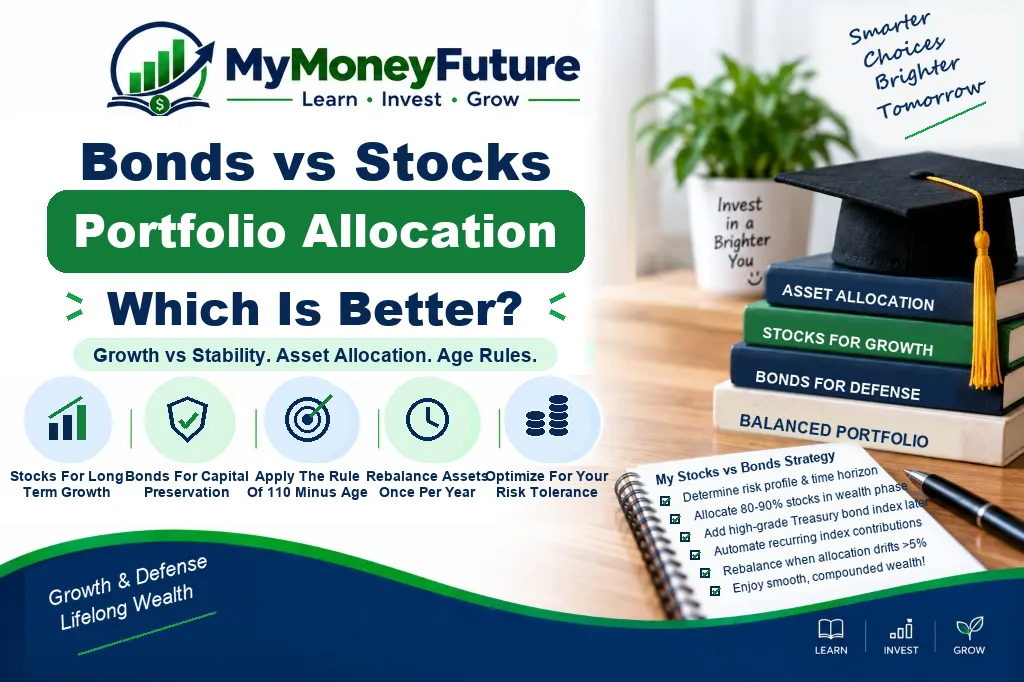
Stocks and bonds are two of the most frequent building pieces in an investment portfolio. Both help investors put money to work, yet they act very differently.
A stock is a share of ownership in a firm. A bond is more like a loan to a government, municipality or corporation. Stocks tend to provide more growth over the long term, while bonds are generally more for income, stability and risk control.
The hard part is not to select one and ignore the other. The key dilemma for most investors is how much of each should be in the portfolio.
The right combination depends on your age, time horizon, risk tolerance, income needs, ambitions and how you respond when markets go down.
This tutorial covers bonds vs stocks in plain English, how they function, the dangers and advantages, and how novices may start balancing their portfolios without becoming lost in the jargon.
Short answer
Stocks normally do a better job of generating long-term growth, while bonds are better for income, stability, and lowering volatility in a portfolio. Most investors don’t have to pick just one. A balanced portfolio might comprise both, with a larger percentage of stocks for longer time horizons and a larger percentage of bonds for shorter-term goals or a lower risk appetite.
Highlights
| Main Point | Abstract |
| Stocks are ownership. | When you acquire stock , you own a little share of the firm . If the company expands , you may benefit . |
| Bonds = Loans | A bond is a loan you give to an issuer. In exchange, the issuer promises to pay you interest and to return your principal at some future date, called the maturity date. |
| Stocks tend to be more volatile | They can grow at a quicker rate over time but can also drop quickly in adverse markets. |
| Bonds can lower risk | Income and stability can come from high quality bonds, but there are still hazards. |
| Your mix should fit your purpose | Allocation should be driven by age, time horizon, risk tolerance and income needs. |
What is a stock?
A stock is a piece of ownership in a firm. When you purchase shares in a public corporation, you become a part owner of that company.
Stock investors can make money in two major ways. The stock price could also go up over time. Second, certain corporations provide dividends to the shareholders.
The reason stocks are attractive is because they may create wealth over extended periods of time. Solid companies can boost revenues, earnings and market value. Those investors who own those companies can profit from that growth.
Stocks are not guaranteed. Poor earnings , recessions , interest rate changes , competition , poor management or investor concern can cause prices to fall .
In the near term, a stock portfolio can lose value rapidly. That’s why equities are usually better for long-term goals than money you need now.
Featured Stock
| Implications For Investors | Property. |
| Potential for growth | So , how do you get returns ? Business development and higher share prices . |
| Dividends: | Some corporations pay some of profits to shareholders. |
| Volatility | Prices might fall and rise dramatically. |
| No promise of return. | If the stock price drops or the company goes bust you may lose money. |
What Are Bonds?
Bond is a debt investment. When you buy a bond you are lending money to the issuer.
The issuer can be a government, municipal or enterprise. In exchange, the issuer typically agrees to pay interest and redeem the principal at the time the bond expires.
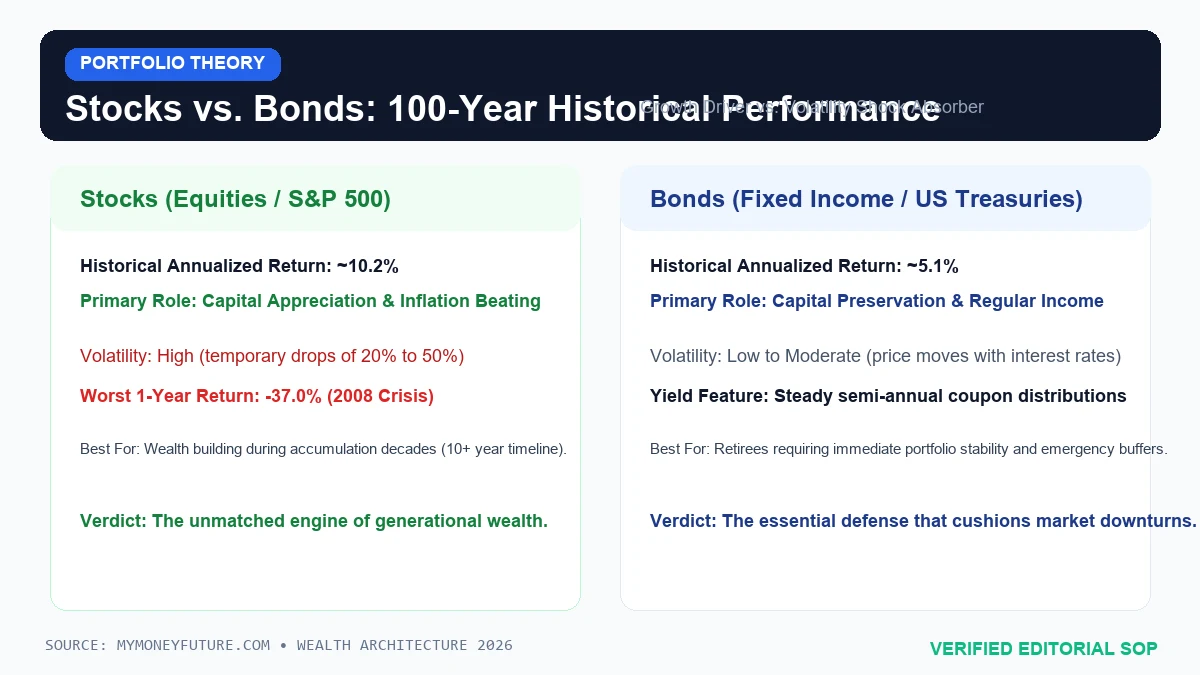
Many bonds are called fixed-income investments because they pay regular interest. That income can be a valuable resource for retirees, conservative investors or anyone who wishes part of their portfolio to be less dependent on the vagaries of the stock market.
According to Investor.gov, bonds are debt securities comparable to IOUs, in which debtors borrow money from investors for a specified length of time.
That little thot is crucial. A bondholder isn’t an owner. A bondholder is a lender. If a corporation becomes highly lucrative , shareholders may profit more . Bondholders typically get the guaranteed interest and principal, not unlimited upside.
Bonds can also lose money. Interest rate changes, inflation, credit risk and issuer difficulties affect bond prices. Long-term bonds are quite susceptible to increases in interest rates.
Bond Feature
| Bond Feature | What this means for investors |
| Lending Relationship: | You lend money to a government, municipality or corporation. |
| Interest paid | Many bonds pay interest periodically. |
| Date of maturity | If it is able to meet its commitments, the issuer repays principal on a fixed date. |
| Lower potential growth | Upside generally restricted compared to stocks. |
| has danger still | Bond pricing and issuer credit quality may vary. |
Bonds and Stocks: Key Differences
| Feature | Stock | bonds. |
| What you own. | Ownership in a Firm | Loan to an entity |
| Main source of return | Appreciation and dividends | Interest payments & principal repayment |
| Risk rating: | Usually increases | Good quality bonds tend to lower |
| Volatility | Often bigger | Lower but not without risk |
| Best use | Sustainable development | income, stability, risk management |
| Drawback | Can drop sharply or be worthless | May lose value or default |
| Advantages | Potentially high | Normally confined to interest and repayment |
It gets more evident if you look at a company from 2 perspectives.
If you acquire its shares you are wagering that the business will be worth more. If you buy its bond , you are essentially wagering the company will be able to make interest payments and repay the loan .
This is why stocks and bonds both have a role in portfolio construction. They do different jobs.
The Importance of Stocks in a Portfolio
Stocks are typically the growth engine of a portfolio. Over the long haul, they have traditionally been able to offer the possibility of better returns than safer investments, albeit the ride is bumpy.
A young investor investing for retirement may have decades to recover from market losses. Over that long time horizon, equities can be more valuable since the investor can wait thru downturns.
Stocks also can be an inflation hedge. If corporations are able to raise prices, grow sales and increase profits, shareholders may be rewarded over time.
The tradeoff is emotional stress. It is easy to declare you can handle volatility when the markets are calm. When a portfolio falls 20%, 30% or more, it feels different.
When Stocks May Be Appropriate
| Cause | |
| Your goal is 10+ years out | The longer the time, the more is the room to recover from falls. |
| You wish to grow | Stocks have more potential for long-term growth. |
| You can deal with volatility | Stock investment is short-term price fluctuation. |
| You are creating wealth | Stocks can help retirement and long-term savings grow. |
The Role of Bonds in Portfolio
Bonds are commonly utilized for income and stability. They can assist ease the mental and financial strain caused by stock market downturns.
A retiree who is drawing down a portfolio may not want to sell stocks after a steep market decline. Bond values can vary, too, although holding bonds or bond funds can provide a more stable source of withdrawals.
Bonds can help investors stay invested as well. If you have 100% equities in your portfolio, market dips might sting. Allocating bonds can help cushion the ride.
That smoother ride counts as the best investing plan is pointless if you give up on it in a downturn.
If Bonds Might Fit
| Reasoning | |
| Your goal is close | Shorter time frames typically require less volatility. |
| You desire income | Most bonds pay interest at intervals. |
| You are retired or about to retire | Stability may be more important than maximal growth. |
| You grow anxious as the market declines | Bonds can even smooth swings in portfolios. |
The Real Asset Allocation Decision
The most essential question is not whether stocks or bonds are better. The better question is what combination suits your life.
This is known as asset allocation. This implies spreading your investments among several asset types such as equities, bonds, and cash.
The SEC’s Investor.gov explains that asset allocation is based on your time horizon and risk tolerance, and that a good balance might alter over time.
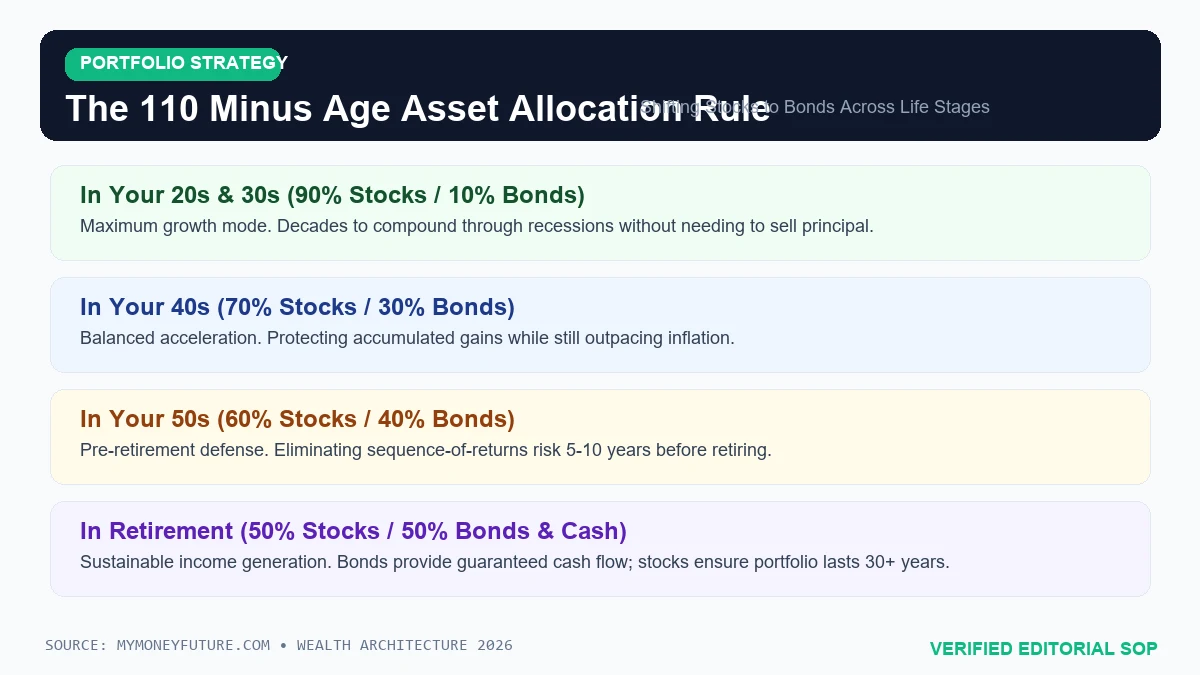
That advice is practical. For example, a 25-year-old client saving for retirement may not require the same mix as a 65-year-old investor who is planning to take money next year.
Stocks vs. Bonds Return & Drawdown Simulator
Simulate Portfolio Longevity, Growth, and Crash Cushion
Adjust your stock/bond allocation to evaluate historical compounding return versus recession drawdown protection.
A long-term investor might choose more stocks. A short-term investor may want more bonds and cash. Someone in the middle might prefer a balanced mix.
Type of Investor
| Type of Investor | Potential direction of stocks/bonds | Why? |
| Future long-term investor | More stocks, less bonds | Growth counts & Time frame is long. |
| Investor mid-career | Mixture balanced | “Growth still matters, but risk management becomes more important.” |
| Investor near retirement | More Bonds than ever | Portfolio and income stability become more crucial. |
| former investor | Meaningful relationships and money | Declines and withdrawals in the market must be managed. |
Portfolio Sample Mixes
These are not suggestions for you. They are easy examples to explain how stock and bond allocations might differ based on goals and risk tolerance.
| Style of Portfolio | Equities | Cash/Bonds | Best-fit |
| Fast growth | 90% | 10% | Long-term investors who can stomach steep drops |
| Expansion | 80% | 20% | younger investors with a high risk propensity |
| Balanced growth | 60% | 40% | Growth investors with a bit of stability |
| Moderate conservative | 40% | 60% | Investors nearing a goal or with a low tolerance for risk |
| Income oriented | 30% | 70% | Retirees or investors looking for stability and income |
A common error is to choose a portfolio just solely on age. Age is a factor, but not the only one.
A 35 year old person with an inconsistent income and no emergency fund may need to take a more conservative strategy than another 35 year old person with substantial savings and a stable employment.
A 70-year-old with ample assets and no need to take money out might have more stocks than a 55-year-old who is planning to retire soon and has limited reserves.
Comparison of risks
Stocks and bonds have different risk characteristics. That knowledge of the dangers helps you prevent surprises.
Stocks have company risk, market risk, valuation risk and emotional risk. Even solid companies might be caught up in a broad market sell-off.
Bonds have credit risk, interest rate risk, inflation risk and reinvestment risk. A bond is safer than a stock only if the issuer is financially solid and the terms are consistent with your aspirations.
Bond funds add another dimension. They may not have a single maturity date as an individual bond. Their price can alter as interest rates change.
| Danger | Stocks | Bond’s |
| Market volatility | High. | Typically lower |
| Main loss | Maybe | Possible, especially with defaults or early sale |
| Inflation Risk: | Offsets can be used for a long time | Harm fixed interest payments |
| Risk of Interest Rate Change | Indirect effects | Immediate impact on bond prices |
| Income security | Dividends can vary | Interest is more predictable, but not always. |
| Continued growth | More possibilities | Potential lower. |
When Stocks Might Be the Better Choice
If your target is far away and you want growth, stocks may be the way to go.
Someone preparing for retirement 30 years from now, for example, may be willing to accept market fluctuations because the money isn’t needed anytime soon. The focus is on long-term compounding, not short-term comfort.
If you are worried about inflation , stocks can also make sense . Companies growing earnings over time may better preserve purchasing power than fixed payments.
But investors have to be truthful. If a stock-heavy portfolio leads to panic selling, then the anticipated long-term return is irrelevant. It is contingent upon how you act.
When Bonds May Be the Best Choice
Bonds might be a better place for the money if it’s needed sooner, if income is necessary, or if portfolio stability is more important than maximum gain.
For example, someone who needs a down payment in two years should generally avoid a stock-heavy approach for that money. A market decline could come at the wrong time.
Bonds also work for retired investors making withdrawals. Having a bond allocation can help you avoid selling stocks during bad periods.
But bonds are not a substitute for cash. Cash or near-cash accounts are generally used to hold money to pay payments in the short term, not long-term bond funds.
Common Mistakes of Beginners
Thinking bonds are risk free
Bonds may be more stable than stocks, especially high-quality bonds, but they can also lose value. Credit issues. Interest rates and inflation all matter.
Going 100% stocks without knowing volatility
And a portfolio made up of purely stocks can be a very strong long-term performer, but it can also take a nasty tumble. Novice investors need to understand the emotional side of investing.
Having too many bonds too soon
Too soon to conservative young investors may retard long term growth.
Using stock money for short term purposes
Any money needed in the next year or two should not be dependent on stock market success.
Search for yield
High bond yields may indicate more credit risk. More money doesn’t necessarily mean more security.
No charges
fund charges, trading costs and advisory fees can lower profits over time.
After every headline, changing allocation
Portfolios should be changed based on goals, not daily market noise.
Select Your Mix
Ask yourself these questions before you decide on the stock/bond mix:
- When do I need this money?
- How much of a loss might I take before I panic and sell?
- Income today or growth later?
- “Do I already have emergency savings?
- Is my investment for retirement, a home, education or wealth?
- Do I look at the portfolio once or twice a year instead of reacting day to day?
As a rule of thumb, match your risk to your time horizon. More consistency needed for shorter targets Longer-term goals usually can handle more volatility.
It can also help to develop an investment policy for yourself. It can be straightforward. Target allocation. When to rebalance. What events might justify modifications.
This minimizes emotional decision making in fast moving markets.
Rebalancing: Keeping the Mix in Line
Your portfolio mix will drift over time. If equities rally swiftly, stock allocation may become larger than expected. If stocks tumble, bonds might represent a bigger piece of the pie.
Rebalancing is the process of getting the portfolio back to the target mix.
For instance, if you want to be 70% stocks and 30% bonds, a good stock market might lead you to 80% equities and 20% bonds. Some money would go back into bonds in a rebalancing.
Rebalancing requires discipline. It can lead you to prune the overgrown and supplement the lagging rather than to pursue what is fascinating.
Q&A Section
A: Stocks are not always better than bonds. Stocks are riskier than bonds, but they have the potential to earn higher returns. The risk-return tradeoff is a key concept in investing. Stocks are considered a higher-risk, higher-return investment compared to bonds. However, this does not mean that investors should always choose stocks over bonds. The decision depends on an investor’s risk tolerance, investment goals, and time horizon. Bonds are generally considered safer than stocks because they provide a fixed income stream and have lower volatility. However, bonds also often offer lower returns than stocks.
A: Stocks tend to be more aggressive in their long-term growth potential, but they’re also more volatile. Bonds could be more stable and provide higher income. It is contingent upon your purpose and risk appetite which is best.
Q: Do bonds have less risk than stocks?
A: Bonds of quality are generally less volatile than equities, but they are not without danger. Bond prices can decline. And some issuers can go bust.
A: Beginners should look to invest in both equities and bonds.
A: A lot of new investors are using both. Stocks can give growth, while bonds can give stability. The precise combination will rely on your time horizon and your risk tolerance.
Q: How much should I have in bonds?
A: There is no one percent. Younger investors tend to have fewer bonds, while those approaching retirement tend to have more. Your income requirements and your risk tolerance.
Q: Can I lose money in bonds?
A: Yes. You can lose money if interest rates rise or the issuer has credit trouble or you need to sell before maturity for less than you paid.
Q: Do bonds pay dividends?
A: Bonds typically pay interest, not dividends. Stocks can pay dividends if a firm chooses to return some of its profits.
Q: Are bond funds the same as individual bonds?
A: No. Individual bonds may mature at some point but bond funds contain lots of bonds and the price of their shares may fluctuate as market conditions change.
Q: Should I have bonds in retirement?
A: Many retirees own bonds to smooth out volatility and generate income to fund withdrawals, but it is contingent upon other income sources and overall assets.
Q: What is the largest error people make in stocks and bonds?
A: The biggest mistake is picking an allocation you can’t stick with. You can have a plan that appears fine on paper but generate panic selling thus it is too hazardous.
Q: How often should I check my portfolio?
Q: How often do you rebalance? A: For many long-term investors, a once or twice a year rebalancing is fine. Come back sooner after major life changes, or if your goals change.
Summing Up
Bonds vs stocks is not a zero sum game. Stocks and bonds do different things.
Stocks can be a great way to grow wealth over time . Bonds can provide income, stability and risk control. A strong portfolio typically uses both in a way that meets the investor’s aims.
If you’re young and investing for a goal that’s decades away, equities might merit a larger role. If you are near retirement, or taking money out for a shorter-term aim, bonds may become more relevant.
The best portfolio is not the most aggressive nor the most conservative. It’s the one that gives you a decent probability of getting to your goals and enough confidence to stick with it when the markets feel bad.
Educational Disclosure
This post is for educational and informational purposes only and is not financial, investment, tax or legal advice. Investing entails risks, including possible loss of investment. Asset allocation should depend on your goals, time horizon, financial status and risk tolerance. Before making any big investment decisions, seek the advice of a financial advisor.
Frequently Asked Questions (FAQ)
Calculate Your Long-Term Wealth Growth
See how compounding interest accelerates your net worth and calculate your exact FIRE retirement freedom number: